• About
  • Blog (Ext.)
  • Books
  • Contact
  • Education Resources
  • News Links

PERRIN LOVETT

~ Deo Vindice

PERRIN LOVETT

Tag Archives: book review

A Review of THE SUBSTITUTE

01 Monday May 2023

Posted by perrinlovett in fiction

≈ Comments Off on A Review of THE SUBSTITUTE

Tags

book review, Clyde Wilson, The Substitute

Dr. Clyde Wilson surprised and flattered me with his assessment of James Bond’s replacement:

A Southern James Bond Goes to School
By Clyde Wilson | May 1, 2023 | Blog

Southern fiction has a new hero—Tom Ironsides makes his appearance in book form in Perrin Lovett’s work The Substitute (Shotwell Publishing, 2023). Sequels and prequels are in the offing.

Ironsides is a sort of James Bond, but a much better man. He is a master of his former craft as a CIA operative, although he has progressively developed a realisation that he had not really been defending his country but rather the worst people in it. Lovett describes his paramilitary adventures vividly and more realistically than Bond fantasies.

Ironsides has seen much of the world and has lived a good deal abroad, including as a college professor in Slovakia. Like Bond, he drinks and likes women (and additionally is a cigar connoisseur ). He is also a Christian, a genuine classical scholar, and feels deeply a duty toward his declining country and people. Ironsides was born and bred in the snows of New Hampshire, but is a happily adopted South Carolinian.

…

Read the whole thing.

Six 5-Stars: An Omnibus Book Review

25 Tuesday Apr 2023

Posted by perrinlovett in News and Notes

≈ Comments Off on Six 5-Stars: An Omnibus Book Review

Tags

Addicott, book review, books, Hudson, Macris, Martin, Martyanov, Morrissy, read

Six 5-Stars: An Omnibus Book Review


While I’d like to take the time to give each of the following works independent consideration, I do not have that time. Instead, I’ve assembled a short list of short reviews of five six (of so many) more recent books I highly recommend. Each part will be accordingly pushed at Amazon. There were five, but I added one more to the end. (Amazon is, for some odd reason, a little slow to add a few of these, but we shall see).

Getting right into it:

Andrei Martyanov, Disintegration (2021)

Almost daily, Mr. Martyanov provides learned, insightful commentary on various geostrategic matters that all thinking Westerners (and others) need to consider. Even if, especially if they do not want to. His book reads a bit like The Decline and Fall of the Roman Empire, if Edward Gibbon had lived during the 5th century, and had Gibbon addressed the process as it unfolded. Post-modern America has essentially rejected everything that once made it excellent. It has shunned Western Civilization itself. In fact, it increasingly shuns any civilized standards. This book keenly examines multiple “whys”, some of which go far beyond Martyanov’s usual military expertise: mindset, morals, economics, and more. The military adventurism, if one is honest, provides perhaps the most highly visible evidence of the decline. Yet, as the author notes, the United States is undeniably gripped by the “historical, psychological, and anthropological centrifugal forces of disintegration”. Before one can hope to salvage something for the future, it is important to understand what has led to the present. This book is a fine summary starting point.

Michael Hudson, …and forgive them their debts (2018)

Were one honest, and one wanted to claim a single book to demonstrate the vampiric effects of mass financial capitalism on a modern or postmodern economy, then this work would be very high on the list of available options. Hudson traces the history of usurious destruction across the ages. Time and again, the same patterns play out, a tale of credit, overextension, misaligned allegiances, corruption, decline, poverty, and immiseration. One thing that will stand out to the Western and/or Christian reader is the repetitive Biblical calls for sound economics and necessary periodic debt forgiveness. No civilization that fails to curtail financial excesses and protect its people therefrom ever lasts. Ours is no exception. But, while the contrary might seem true, it is never too late to do the right thing. In 2023, half the world is already breaking from the broken werewestern system of lies, theft, and enslavement. May the other half follow. This book lights the way.

Alexander Macris, Running On Empty (2022)

At the moment, as I write this review, de-Dollarization is all the rage around the globe. This will have ramifications for all populations and for generations to come. Some will benefit more and sooner than others. Macris’s excellent short book examines a nearly-hidden, or, rather, oft-ignored reason behind the rise, fall, and changes to and behind the Dollar Almighty. The Petrodollar was a first in world history, and perhaps a “worst” so far as economic ideas go. Instituted as a kind of emergency stopgap, it indeed served a temporary purpose for a select few beneficiaries. Their day has now ended, and many will pay the (over)due bill. It’s remarkable that many of the predictions in this book, written but a few months before my review, have already come to pass. And then some. If one wants to rapidly catch up, this is a fine place to start.

Padraig Martin, et al, The Honorable Cause (2023)

By the current, hysterical counter-reactions, one would never know or even suspect that the cause of Southern Nationalism and identity was lost. Mr. Martin and his associates have assembled a wonderful collection of short essays on the very-much-alive-and-needed cause. Herein, one will find others frequently talk about yet seldom deliver with sincerity, clarity, or intelligence – diversity. Read a grand assortment of diversity of thought concerning a People and their rightful place in the modern/post-modern pantheon of nations. While each of these presentations will or might strike the reader differently, they all point in the same, forward direction. As Martin correctly summarizes near the end, “we need to create functional parallel societies”. Given the general decay and collapse around us, that is an imperative notion. The great news for Dixie is that they, we, rather, already have such a society. In time, perhaps sooner than most imagine, we will only need to hone it a bit further and then turn it loose. Even better news: the ideas expressed in The Honorable Cause are not necessarily exclusive to Southerners. It is understood, if unpopular to admit, that many other demographic and geographic groups yearn for independence and sovereign peace and prosperity. I encourage members of all identifiable parties to consider the hopeful and honest expositions herein.

Mary Morrissy, Prosperity Drive (2016)

Humanity. Morrissy has delivered eighteen gripping short stories about, ultimately, the human condition. This book is a little outside of my ordinary reading. As such, beyond the author’s high and deserved reputation (including the esteemed recommendation of a close mutual friend), I had few expectations. Refreshingly, both expectation and reward were forged hard and fast as I plowed through the pages. There is an element, or so I gather, of feminism in the collected works – of what wave I cannot say. Yet, without saying, I was happily pulled along by the current. We people are not always pretty, pleasant, kind, or worthy, and neither are all of the characters contained between these covers. But they are all real; they feel real, recognizable, and memorable. One will find a little of many mortal commonalities herein: the beautiful, the sorrowful, the pitiful, the startling, the regrettable, the disdainful, and the mundane. There is also a recurrent notion of familiarity as the various well-painted actors revolve around the title location. One may not exactly “find” oneself in the text, though one can expect to trace a few memories, perhaps in homage to the old Welsh concept of hiraeth, the longing for a home or place that one may have never even visited before, or which is not so clearly recalled. For instance, for those who venture but a few pages in, my grandfather (not father) kept his mint-conditioned old American car in a garage packed full of lawnmowers of all things (scores of them – a hobby I suppose it was). For a moment, before being shocked, again, by the depths of human nature, I was taken back in time. It’s a fascinating ride, made all the more enjoyable by Morrissy’s flowing, alluring poetic prose. Go for it. Cruise Prosperity Drive.

Jeffrey Addicott, Union Terror (2023)

It’s remarkable to consider, in the early 21st century, that in the middle of the 19th, the only world power that gave substantial material support to Lincoln’s Union was Russia. I sometimes wonder if modern Russians consider the irony that Czar Alexander’s support for nascent US terror helped give rise to the empire that would deliver similar tactics and operations to the American Indian Tribes, Nagasaki’s Immaculate Conception Cathedral, the good people of the Donbass, and many others. Professor Addicott delivers a tour de force about a tragedy that has afflicted populations far and wide beyond the borders of Dixie. I encourage all to carefully consider, among many other points, what Addicott says and implies about the wisdom of Karl von Clausewitz, against whom there really is no intelligent arguing. A must-read for all peoples of goodwill and open minds.

COLUMN: A Review Of RECLAIMING THE CATHOLIC CHURCH by Giuseppe Filotto

15 Wednesday Mar 2023

Posted by perrinlovett in Other Columns

≈ Comments Off on COLUMN: A Review Of RECLAIMING THE CATHOLIC CHURCH by Giuseppe Filotto

Tags

book review, Christianity, Giuseppe Filotto, Reclaiming The Catholic Church

A Review Of RECLAIMING THE CATHOLIC CHURCH by Giuseppe Filotto


The times are interesting, though they are also Blessed. We’ve had more than a few extremely important books published this young century. I herein present a brief look at another one of them.

Giuseppe Filotto, RECLAIMING THE CATHOLIC CHURCH: The True History of Vatican II and the Visible Remnant of the Real Catholic Church now that the Vatican is a Pederast Infested Hive of Impostors, Warrior Monk (2020) (Amazon).
© Giuseppe Filotto.

Lately, I keep hearing variations of one kind or another, from Catholics and others, of the question, “What is going on with the Catholic Church?” Something is happening. Because something happened, something changed. While most people appear capable of sensing something is wrong, it took Reclaiming The Catholic Church to explain what went wrong, how it happened, and who was and is responsible.

Roundabout, via following Vox Day’s writings for years, I learned of Giuseppe Filotto, a very interesting Italian writer, engineer, and philosopher. Like so many of us, he wandered around for some time, only to come home to the Catholic faith (There is great meaning and truth in the play-on-words title of another book, Scott Hahn’s Rome Sweet Home). The good news for us, regarding the esteemed Mr. Filotto, is that when he came home, he brought his energy, his style, and his keen wit with him! I’ve been reading his blog for a while now. I’ve also seen a few of his video presentations. His is a knowledgeable style, measured, rational, and considerate, all with an edge and a fire about it. It is indicative of both stern character and higher intelligence. It works and remains likely that it took someone like Mr. Filotto to research and write such a book – which I recommend in the highest regard. All Catholics should read it along with anyone else who considers himself a Christian of any stripe.

Reclaiming The Catholic Church is 500+ pages of substance. I read it on Kindle where, thanks to the ease of digital operation, the reader may immediately access reams of additional, supporting information from other works, original and meta-analytical. The material presented and discussed is exhaustive. Filotto’s literary approach is as humorous as it is intellectual. I found the entire book, in addition to being almost overly cited, to be extraordinarily well laid out. Beyond mere structure, it naturally developed a smooth “flow” for lack of a better word. This may have been intentional on the author’s part, or else Filotto has an innate storyteller’s ability. It could be both cases. It could be, it most certainly is, that Filotto makes fine use of the Gifts given to him by the Holy Spirit. In exposing the plans of the enemy, he exhibits a fearless resolve sanctioned by Scripture. “Behold, I have given you power to tread upon serpents and scorpions, and upon all the power of the enemy: and nothing shall hurt you.“ Luke 10:19. All that said, here is the beginning of why this book is a critical work of Christian thought.

Filotto’s interspersed side commentary lends an aura of readability and humanity to the work. On page 58 he implores Catholics: “Face reality and deal with it sensibly…”, further noting that “Life is hard.” It is. And most Catholics, most Christians, and most Westerners have been woefully prepared to deal with it. In fact, they have been intentionally counter-prepared for a kind of unreality. The architects of this false existence are the same wicked degenerates that have ruined or attempted to ruin literally everything on planet Earth, especially Christianity.

On page 43, as if channeling Harvey and Laurie Bluedorn, Filotto writes, in explanation of Catholicism and Catholic thought: 

Be Able to Think Rationally and Logically. Although in essence this is already implied in the first two aspects of Catholic thought mentioned above, it is worth noting it separately and individually because training in formal logical thinking is nowadays so rare that you will most likely have to learn how to do it on your own. As well as teach it to your children. 

Rational thinking is a formal process. It is not taught today. Rather, its evil opposite is drilled into the brain. This is one primary reason why no sane, decent adult should ever allow any child near anything called a modern “school.” Another reason has to do with the nature and purpose of the schools – to break the family unit, and the nations, and to ultimately corrupt and undo Christendom. What passes for modern education is only a part of the centuries-long onslaught against Christian civilization, the capping achievement of which was the coup in Rome, a subject well and thoroughly explained in Filotto’s book.

The problems we face go far beyond any Church building or any one group of our assorted peoples. The reader may discover a personal attachment either through acknowledgment of the core principles or just from one of many darkly humorous cultural references. For example, Filotto is about the only author I have ever read who knows this anecdotal story from faded Dixie (unless it also happened elsewhere). From page 50, emphasis mine: “…so many Protestant “Pastors” seem to subscribe to the personal prosperity “gospel” that to all appearances is something like: “Throw your money in the air! What stays in the air you keep, the rest, is for me!” My grandmother used to tell of such a “Pastor” and his washtub collection plate with which he engaged in this exact abomination. I found the recitation charming, even as it serves as an indictment for much of modern Churchianity.

The whole point of Filotto’s book is that Christianity means Catholicism. As he points out, this was universally understood for approximately 1,000 years. The Christian Church is the Catholic Church. Unlike the book, which covers semi-tandem subjects in detail, my review will skip over Protestantism and Orthodoxy. I, for one, have a deep affection for many members of both of these groups. However, the schisms among Christians are not the kind of division Christ desired. Through His plain statement, Jesus Christ came to divide His Followers from the failed, collapsed faith of the Pharisaical Jews and from the general darkness of the fallen world. Upon Saint Peter, Christ founded His Church, upon which, per Matthew 16:18, the gates of hell shall not prevail. Yet, the past 2,000 years have demonstrated time and again that hell continues to crash against the Church, even if in vain. Satan’s attempts, we know, are ultimately futile, though they have had a discernible transient impact. Thus, out of alarm or ignorance, people keep asking the above-referenced question. Every attempt (and temporary minor success) in dividing the Faithful from the Church is the work of the devil.

Filotto concentrates his considerable knowledge and talent on the freemasonic infiltration of the Roman Catholic Church, over time, particularly, during the mid-20th century. The underlying premise of the book is something we are all familiar with. Men are weak. We are prone to stray. Christ had no more Ascended into Heaven than the Nicolaitans immediately began to forge a blasphemous cult of Bacchus atop the Holy foundation of the Church. That attempt was rapidly stamped out by the earliest Church Fathers. Filotto, to his great credit, gives numerous examples of other inspirational men rising to the challenge and defeating the impulses left in us by original sin. He does, indeed, continuously exhibit a Crusader’s spirit, which is rather appropriate for a Christian man. Christ was a fighter! As must be His followers.

The major premise of the book revolves around the seeming fall of the Church, to luciferian infiltration, which culminated with the publications of the Second Vatican Council (“Vatican II”). This matter, this deception, is a personal matter for all Christians. I encourage them to read Filotto’s book! Like my former self, most of them likely do not know and have not read a single word of the Vatican II documents. This is a terrible mistake, but a correctable one.

Today, later-day, fake apologists, the ones who barely contain their luciferian contempt for Christ and His Church, try to rhetorically turn the situation around. They claim that any Catholic who rejects Vatican II is a heretic, a schismatic, or both. Or worse. The truth is the opposite. The uninitiated will be introduced to two words they may have previously heard, but which they likely do not understand: “Sedevacantist,” and “Sedeprivationist.” The “Sedes”. More I leave to the intrepid reader, but Filotto well explains the definitions (and the difference) on page 249:

The only material difference between a Sedeprivationist and a Sedevacantist today is in the fact that a Sedeprivationist is saying that the Seat of Peter is not in fact “empty”, because an impostor is materially filling it, preventing a legitimate Pope from doing so. As well as preventing many nominal Catholics who have been badly catechised (or not catechised at all in many cases) from being able to grasp that the impostor is a fraud. Having an impostor in the Holy See is in fact worse than merely having no one in it at all.

Vatican II provided the schism, by way of heresy. Any Ordained official who does not reject Vatican II, tacitly endorses it. Publicly supporting heresy, legally means those leaders automatically lose their ordination and authority. So, we are left with only a Papal question of emptiness versus usurpation. The Sedes are the only Catholics fully, advisedly holding the devoted line, regardless of how one answers the question.

Along the way, Filotto does a grand job of explaining the real history of Catholicism, sometimes as a refutation of various slanders told against it. “Inquisition!” they shriek. It was real and it was really not what we’ve been told. Chart after chart of cases, with dispositions, is included. They paint a portrait of a just and charitable Church punishing evildoers while concurrently exuding Christ’s Grace, Wisdom, and Kindness. At one point, with a particular set of heinous crimes, I found myself mentally criticizing the author for being too lenient! However, he atones for himself and causes his reader (or caused this one) to stop and consider true justice and equity. I do believe there are miracles within this work! I leave their exact discovery to the joy of the reader.

Chapter Four is dedicated to explaining the precise meaning of each of the sixteen main points of Vatican II. All amount to base heresy, except for one part that is also blasphemous, and another that is, at best, meaningless and unnecessary. The entirety of the new false doctrine has the effect, as Filotto notes, of rendering the whole of the modernist, post-Vatican II Church a fraud, and essentially just another Protestant denomination. The build-up to this ruinous evil is explored in painstaking detail. All points and matters are presented, by necessity, by astute summation. However, all issues discussed are backed by full authority and are conveniently linked (especially through Kindle) for the reader’s instant or delayed perusal. 

Understanding what Vatican II (and its architects) did to the Church, necessarily leads to rejecting Vatican II (and its architects!). What it all means is that the majority of what most consider to be the “Catholic Church” is an intentionally misguided imposter, and all “popes” after Pious XII died in 1958 are imposters. This was and is a great rebellion. These people, the ignorantly misguided and the overtly evil, left the Church. But like all other attempts, this one will fail. The gates have not and will not prevail against us because of the supernatural Protection of Christ. Filotto’s book is beyond important. It is a fun, necessary, and exciting call to the Good, the True, and the Beautiful. We needed the explanation this book provides. An accurate description is all the more needed as evidence of the problem, in an unexplained state, is all around us.

Information has surfaced of late that reinforces the truth of “Sede” Catholicism, as the secret police of the former United States have designated “Radical Traditionalist Catholics” or “RTCs” as domestic terrorists and a threat to globalism and satanism. Guess who qualifies as an RTC? This kind of calculated insult is in reality the highest form of praise, and it is proof of Christ’s wisdom concerning the world hating us as expressed in John 15:18-19. Part of the US DOJ’s [SIC] definition of “RTC” revolves around insistence on the Traditional (pre-Vatican II) Latin Mass ( or “TLM”).

The TLM is under direct assault worldwide by the modernists and their anti-pope(s). If you are Catholic, the odds are that your local Diocese has recently ordered the termination of TLM at all Parishes. Why? The National Catholic Register even ran an opinion piece a few years ago explaining how the Latin Mass became a cult of “toxic tradition”. That is an exemplification of the Church balefully conforming to the ways of the fallen modern world. It is also what is referred to as projection. One need only read most any news story out of Rome these days to discover what a real cult of toxicity looks like. It looks the way it acts. There is a distinct perfidious nature in the modernist Church. Aside from becoming an open, teeming hive of sodomites and pedophiles, it does things like request its own school boys go to Washington, DC to protest against infanticide. By itself, such a call is exactly what the Church should do. It should do much more. However, in American unreality, when stalwart young Catholic men answer the call, only to be met with savagery and slander, the same “Catholic” leadership quickly throws them under the proverbial bus. The 1960s modification of the Church, to fit in with contemporary moral standards and behaviors, has been a success that renders the modernist Church little different in character than the average social justice warrior or neo-Trotskyite. 

Filotto labels Chapter Five “the core and heart” of the book. It is. That is the chapter where is presented the majesty of the Code of Canon Law of 1917 and the resulting Catechism. This is where the differentiation between valid Christianity and the “values” of the new anti-Church becomes manifest. I have suffered through reading a few trollish attacks on the legitimate Church, often misusing the very language of the Code of 1917. Anyone who makes it through Filotto’s fifth chapter and still rejects the eternal wisdom of the pre-masonic Church is either dull-witted or possessed of a dark ulterior motive. For their sake, I sincerely hope it is the former.

One reasonably acquainted with real Church history knows that, sadly, this kind of betrayal and alienation has happened before. For those living in times of Ecclesiastical fissure, the process is understandably discomfiting. Yet, rest assured that history also repeatedly shows that momentary breaks in our orders inevitably give way to renewal. Our quest is to both understand, and then get through the unpleasantries. We should, of course, be thankful at all times, for all things – even, or especially those things that cause us disquiet.

For those attempting to separate the real from the false, a “witch test” is presented on page 244:

It is really easy enough to know if a Cleric is indeed a Catholic or not. Ask him if he rejects everyone and everything that does not reject Vatican II and its antipopes in totality. If they do, then they may well be actual Clerics, if not, they are most certainly not.

It is – all of it – a shocking revelation. But it is true. And one need not fear the truth. We are reminded on page 320 that “Catholics are NOT given to a spirit of fear”. We’re not. And the first step toward doing the brave first thing is to know what is going on. Start by reading Filotto’s book. Think long, hard, and critically about what is explained. Be bold! The next step is finding a valid Catholic church home. This reclamation will proceed one Catholic at a time. All one has to do, all one really can do, is to look, think, and then make a commitment. To begin the process, commit to reading Reclaiming The Catholic Church.

COLUMN: Teaching The Trivium: A Review

25 Wednesday Jan 2023

Posted by perrinlovett in Other Columns

≈ Comments Off on COLUMN: Teaching The Trivium: A Review

Tags

Bluedorns, book review, Christianity, homeschooling, read, Teaching The Trivium

Teaching The Trivium: A Review


Dear readers, our topic for today is one of the most important books of this century: Teaching the Trivium: Christian Homeschooling in a Classical Style, Harvey and Laurie (RIP) Bluedorn, Trivium Pursuit, Muscatine, Iowa (2001). If my review drives home nothing else, then I must at least emphasize that this book is critical to those who either have young children or who intend to have young children. It’s also important for those with older children, or grandchildren, along with those who have no children, or those who only want to further their own intellectual development. It is a cogent defense of and general plan for preserving high Christian Civilization. 

Do not send children to schools. Let that stand as my second critical point. Please take all contrary excuses and burn them. I am angered by the fact that generation after generation of our children (this includes you, your children, your grandchildren, your parents, and even your grandparents) have been, are being, or will be misled or forced into the same trap. Most people do not realize what they’ve missed and what we’ve collectively lost. Teaching the Trivium sheds a bright light on this tragedy while offering a wonderful escape from it. 

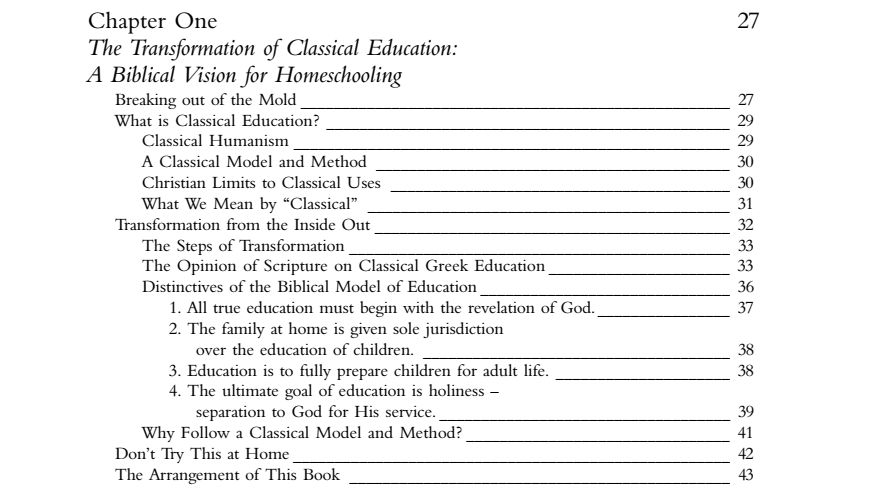
When I finally sat down with the book and started thumbing through it, I was struck by how comprehensive the Table of Contents alone is, and how much the relayed organizational wisdom differs from what passes for institutional educational doctrine. For purposes of commentary, I reproduce a small segment, for Chapter One:

(Bluedorns, Trivium, page 11).

Contrast any part of the foregoing with what passes for valuable systemic pedagogy in, say, fag queen pedo hour, a horror with a purpose even conservatives finally begin to notice.

Perhaps the greatest veritas of this partial page is the line: “All true education must begin with the revelation of God.” The entirety of the text is a roadmap for implementing proper Holy education. One of the tell-tale Hasbara one-star reviews I read at Amazon, while subtly chastising Christianity, stupidly lamented the lack of a comprehensive, easy, ready-to-go curriculum. “Breaking out of the mold” means just that; this is a task that no formal syllabus is capable of adequately presenting or fostering. As a guide, it is an extensive map of a long, meandering road – one well worth the effort. The Table of Contents is fourteen pages, and it sets a better cursory direction than any other work I have ever seen. It covers everything from the Christian formation of the nuclear family to fueling the family by having children, to raising children, to shielding children from the evil of the world, to properly coaching children through grammar, logic, and rhetoric, to successfully sending children forth on their most important earthly endeavor – having and raising more children. The whole matter is a testament to God’s plan; the “conventional-minded” detractions I’ve read are also, negatively and indirectly, testaments to His intention. 

The Bluedorns note, on page 34, “Education is for a purpose. If the purpose does not have God in view, then it is  godless education, and it will eventually produce godless results.” They also maintain, correctly, that the only real education begins with, and consistently maintains, the revelations of Almighty God. One may be aware that in the USSA, God has been banned from schools and from the larger society, and the result has been a kind of hell on earth. The book also does a masterful job of clarifying and interweaving the Greco-Roman classical model of learning with that of fundamental Christianity. In that context, their wise view of the purpose of education does not so widely differ from Old Tully’s: “The purpose of schooling is to free the student from the tyranny of the present.” For a century and a half, our wicked, stupid culture has dispensed with all such wisdom, with our schools becoming the tyranny of the present.

With very few exceptions, homeschooling children, under the authority of the family, is not only the best way to educate the young, but it is the only way that fulfills various Biblical commandments. That may be the key takeaway from the book, along with the general “how-to” structure of the curriculum. It offers a one-size-fits-one approach; the exact Bluedorn route might be slightly different from mine, as mine might be from yours. This is fine and, in fact, great for us, but it is anathema to the luciferian status quo. And make no mistake, the schools, by design, are satanically evil. They were always that way, literally instituted to turn people into wage slaves, dumb down the population, terminate the family unit, and destroy Christian Western civilization. They have been extremely successful, an Enlightenment gift that keeps on killing. They cannot be fixed unless the fixing involves a Caterpillar D9 and an ample quantity of fire. But my own experience, and likely the reader’s, is almost exclusively set within the confines of the unnatural, anti-traditional, and unproductive K-12 classrooms. We are to be forgiven then, or at least a little lenient with ourselves, as we think about the schools and about saving future generations from them. 

To properly assess the wickedness of the schools is to ultimately dismiss them. Perhaps the best words to that end belong to Anthony Esolen. “There are only two things wrong with our schools: everything that our children don’t learn there and everything they do.” Esolen, Out of the Ashes, page 68 (another must-read). The Bluedorns partly refer to this as teaching trivia instead of the trivium, coddling along with pre-packaged nothing facts rather than teaching the elemental processes of thinking. This maleducation is a grievous sin. It also fails even by its own pitiful metrics.

The cat is out of the bag that the USSA’s school systems produce results, in all areas, far below other developed, or even developing countries – even as compared to foreign systematized schools. George Carlin summed it up well when he said “they” only want people who are “just smart enough to run the machines and do the paperwork, and just dumb enough to passively accept [all the Carlin-Esque explicatives]”. Again, the schools have not failed in their intended purposes. They have worked almost perfectly. And that near-perfect working literally kills real learning and any notion of legitimate education. The Bluedorns have a subsection about this phenomenon called “Regressive Learning,” pages 97 – 98. They’re not alone.

The late, great John Taylor Gatto went into some depth with this lurid concept in his 2009 book, Weapons of Mass Instruction (read it too). Gatto noted, as early as 1990, that homeschooled children were five to ten years ahead of their state-abused peers. Things have become much worse since then. In addition to noting the disparity and that compulsory schooling indisputably lowers things like literacy rates, he focused on a little-known university study about university studies (the UCONN study_. Read all about “Another Inconvenient Truth,” pages 37 -38, and how roughly half of the colleges in the USSA teach nothing and the other half force negative learning on their victims. 

I’ve added to this sad observation, elsewhere, by tracking mathematical failure, in a Georgia school system, from elementary (14% math proficiency), to middle (11.9%), to high school (7%). From end to end, our worse-than-useless schools reverse learning. Frequently, the longer a child is in school, and the more he is instructed, the less he will know. 

Something like eighty to ninety percent of US schoolchildren are doomed to languish in evil government-run schools. Roughly ten percent (my hasty estimate) attend private schools, of one degree of value or another (most increasingly dreadful as they conform to public expectations). Around five to ten percent of our kids, the homeschooled champions, receive one degree of real education or another. I once said that the C19 Hoax was the best thing that ever happened to the schools because it temporarily closed them. No education is better than maleducation! And, happily, a few more parents woke up and started allowing their children to learn. Still, the hyper-majority of them continue to send their precious young off to indoctrination and grooming centers. For that, they should perhaps be horse-whipped. Or, perhaps, forgiven. They either don’t understand the importance of education, or else they just don’t care.

But the other side does care about homeschooling if malice counts as caring. The nefarious educrats, most of whom deserve to be burned at the stake, know that the valid alternative of home education not only makes them and their evil work look like what it is, but they also know that homeschoolers, like latter-day monks in little, quiet monasteries, hold the potential to carry the seeds of civilization through the spreading fires. Therefore, the acolytes of the devil’s enlightenment hate with a passion the ordinary Christian families who properly raise and teach their children. These low, crawling Deevs make war on noble homeschoolers. Know their intentions and actively resist them.

Chapter two is an exposition of why the family, and certainly not the state, has genuine authority to educate children. Subsequent chapters explain what, exactly, that entails, along with how to go about doing it. For most of us, this is foreign territory. For instance, while we may associate classical grammar with Latin instruction, too many of us would neglect Greek. I, for one, was somewhat surprised by the logical and forceful arguments for including Hebrew studies as well. 

The recommended course of instruction is broken down by age and ability levels, and also by sex differences. The book assumes that some or most parents will not have anything but a rudimentary understanding of what they are teaching their children. Rather than viewing this deficiency as an obstacle, it is presented as a great opportunity, with the adults gaining a real education alongside their children. As many autodidacts have discovered, it is never too late to learn. The Bluedorns note that as many as three generations of homeschoolers may be required before parent instructors are masters of the material they present. Happily, those who started early are now one generation into the new era. May many more follow the trailblazers. 

The Appendixes are almost 200 pages of relevant articles and resources, beginning with The Lost Tools of Learning by Dorothy Sayers (1947). In short, there is something for everyone within these immaculate 600+ pages of encouragement and wisdom. Some of it may appear unusual, but all of it is unusually beneficial. Several myths, even as held by general homeschool advocates, are dispelled. For instance, my understanding of the theory of “un-schooling” was misplaced, barring, I still suppose, exceptional circumstances. Read chapter ten to understand why. And there are so many more topics even the intelligent and curious might not have independently fathomed. 

Personally, I have already taken one such lesson to heart: “Protecting a Child in the Library”, page 325: “Libraries have become dangerous places for children. The covers alone on some books on display are very wicked.” This was observed over a decade before the pedo queers in dresses and clown makeup first polluted the library assembly rooms. But it was observably true, just as to the book covers, and it was so at the beginning of this century as well as at the end of the last one. Therefore, I have resolved that no book cover of mine, regardless of subject, shall ever appear risque or salacious, to say nothing of appearing “wicked.” I am proud to say that no existing cover of mine risks contributing to this problem, though I had never reflected on the possibility; however, having now reflected, I intend to keep it that way. The odds are that no matter who one is, one will find something of interest and value, even if it is something as mundane as my example. If one happens to have young children, then the odds are one will be walking into a goldmine with Teaching the Trivium. I still have never developed a rating system, therefore I will merely mark this book as an absolute must-read. Read it!

And, if one has a little extra time, then I have another book to recommend – and it’s a short one: Christian Nationalism, Andrew Torba and Andre Isker, GAB AI, Inc. (2022). It’s not perfect, but it is one heck of a statement in defense of Christendom in the post-modern age. Among other things, it provides a list of the official state religions, through time, of the several sovereign American States (one will note that they all fell away by the latter half of the 19th century when the unofficial religion of the US Empire was instituted), and a rebuke of the heretical nonsense of the “Judeo-Christian” idea. 

Read, read often, and teach your children a love of reading. Deus vult.

Deo vindice!

COLUMN: A Review of CHARLOTTESVILLE UNTOLD (With Bonus Material!)

14 Wednesday Dec 2022

Posted by perrinlovett in Other Columns

≈ Comments Off on COLUMN: A Review of CHARLOTTESVILLE UNTOLD (With Bonus Material!)

Tags

Anne Wilson Smith, book review, Charlottesville Untold, GG, history, War

A Review of CHARLOTTESVILLE UNTOLD (With Bonus Material!)


Here follows my review of Charlottesville Untold: Inside Unite the Right, by Anne Wilson Smith, Shotwell, 2021.

For a variety of reasons, I encourage everyone to read this book. Reason the first being that the subject matter had long eluded my immediate attention, fading away in the storage room of my mind, and yet I found Smith’s presentation informative and commanding. If you know nothing about UTR and Charlottesville, then you need to read the book. If you think you know everything about Charlottesville, you need to read it. If you were there, read it. If you’re convinced of the mainstream lies about Nazism and “hate,” read it. Just read it. For it is a concise evaluation of a history long in the making.

To that latter point, I turn to the observations of Pastor Chuck Baldwin from August 24, 2017:

“In 1864, Confederate General Patrick Cleburne warned his fellow Southerners of the historical consequences should the South lose their war for independence. He said if the South lost, “It means the history of this heroic struggle will be written by the enemy; that our youth will be trained by Northern schoolteachers; will learn from Northern school books their version of the war; will be impressed by the influences of history and education to regard our gallant dead as traitors, and our maimed veterans as fit objects for derision.” No truer words were ever spoken.

History revisionists flooded America’s public schools with Northern propaganda about the people who attempted to secede from the United States, characterizing them as racists, extremists, radicals, hatemongers, and traitors.”

Who knew Cleburne was a prophet? Today, one need not advocate anything close to succession to warrant those ridiculous labels. Simply being a Christian, a Caucasian, or just not being evil qualifies one as a racist, an extremist, a radical, a hatemonger, and a traitor. Dear reader, remember there are few accolades higher than being called bad names by wicked fools. Rejoice!

Rejoice, but be cautious.

When I finally got around to buying Charlottesville and reading it, I emailed the author and told her I had essentially reviewed her work some five years in advance. On August 13, 2017, I wrote out a few of my hasty observations. I hereby summarize them, with bracketed commentary as necessary:

  1. Stay away from events like this… They are dangerous and largely pointless. [The best way to avoid a bad situation is to avoid it].
  2. There are going to be more of them. They will grow increasingly worse… [These are already substantial understatements, and we really haven’t seen anything yet].
  3. This is that beloved diversity in action. … Ram enough incompatible people into close proximity and all hell will eventually break loose. … [Diversity + Proximity = War. Always, like a law of physics].
  4. In a sense, for the first time in 50 years, this was a race riot featuring White people in roles other than those of fleeing victims. Maybe you didn’t specifically ask for it. Really doesn’t matter now. [Among the many things chronicled in Anne’s great book were the tactical withdrawal of White/Right people and their remarkable restraint. As things continue to devolve, while the need for calculation will increase, restraint is becoming a negative factor].
  5. I said it was a bad idea to attack all things Confederate. [“Men were here before you, and they were better than you!” The extreme hatred of our best historical examples, by our worst enemies, is understandable in context].
  6. Perhaps hundreds of assault rifles were carried in force and not one single shot was fired. Restraint amid the madness. [The positioning of those guns, the role of the organized militias, and more is well covered. Maybe not from an assault rifle, but shots were fired – this is also covered. The rest of the world is beginning to mock overly armed Americans who can never seem to use their arms for anything other than talking points. That will change].
  7. Whichever side you’re on, please remember that the police are not your friends….  [This point is driven home again and again in the book. It is not our government anymore – any part of it. Police officers and soldiers are the open, dangerous agents of our enemies. To borrow from BLM and ANTIFA: ACAB. If you’re LEO or DOD, and this does not describe you, then you will have ample opportunity to prove it].
  8. Communists, BLMers, and SJWs: Cars can be deadly weapons. … [The Charger case is well covered, as are many of the others. All of them amounted to show-trial railroading of otherwise decent and innocent people. This is the legal new normal. This is the domestic application of the systematic destruction of ancient Western jurisprudence that commenced in mass at Nuremberg. Our enemies control the government, including the courts. Remember that].
  9. Alt-Right and Nationalists: lose the Nazi and KKK sh!t. … Hitler was a fool. Leave him in the bunker. … [Here, I learned (or was reminded of) something new. I’m not perfect, and in 2017, like so many others, I fell for some of the MSM BS. Smith explains in detail how little of the UTR crowd was in any way affiliated with neo-NSDAP idiocy. I’d now hazard a guess that those who were or are also receive a paycheck from the FedGov. Trust nothing from the government or its media. Also, when warranted, fully write out s-h-I-t].
  10. On a partially related note: some have spent the better part of a year calling Donald Trump “Hitler,” “Literally Hitler,” and “a Nazi.” … [H]ow could you possibly expect your “Literal Hitler” to start condemning Nazis??? No sense whatsoever. [Trump is fairly well covered in the book. Per his usual habit, his words were great, but his actions were beyond lacking. Hindsight is better than 20/20; the same cretins who called elderly Americans “Nazis” in 2017 are the same wicked degenerates who have spent 2022 funding, arming, assisting, and praising the literal descendants of Stepan Bandera. Go figure].
  11. Politicians: shut the hell up. This is your mess. Blame no one but yourselves. [Again, back in 2017, still possessed of a little faux libertarian optimism, I foolishly assumed the politicians still mattered. They do not, though they are still guilty beyond redemption. They’ve become like the eunuch acolytes of Jezebel, but who follow her without any notion or capability of ever casting her down. They are perhaps the most useless human beings who have ever polluted God’s Creation].
  12. Globalists: go to hell. Go now. Do not pass go. [I’ve since come to acknowledge that the globos, like the Nazis and the commies, are but tools deployed by our true enemy. This is another chapter of the ongoing war of Christians (and allies) against satanists].
  13. Mr. Jefferson: please pardon the mess. Seems you were right about watering the tree. [I think TJ would be with the rest of the world, wondering why 400 million firearms are still cold and holstered].
  14. I don’t think these trends will reverse. The old America is on the path to civil war or a breakup. I sincerely hope I’m wrong. Prepare as best you can. [Veritas].
  15. There is no point 15. I just added this so some moron won’t call this Perrin’s 14 points. See No. 9, above. [I apologize to myself for caring in the least what people who cannot think might have thought. Shake the dust off, so to speak, and move on].

Part of my hesitation going into this book, or any other about UTR, was my misperception about already having dissected the events. If that pause grips you, then know you really need to read the book. And right now, December 2022, is as fine a time as any. The calamity in Charlottesville only accelerated trends that have been in hard play ever since. Smith’s book is as much a compilation of the mood, structure, and betrayals of UTR as it is a roadmap of sorts for the subsequent atrocities like the Coup of 2020, the J6 setup and betrayal, the economic collapse, the tranny-fication or the world, the Great Hoax and Biowarfare Crime of 2020-, the Saint Floyd summer of love, the Stage Nine White genocide, 2015 – present, the dismal “election” of 2022, the satanic prosecution of the war against civilization amidst the Great Bifurcation, and more. Rather than diminishing the valiant efforts of our people in 2017, the horrors that have followed have only added clarity; Smith’s book, by design or chance, somewhat ties those threads together.

Where I might be tempted to pick a few minor quibbles from the text, I will instead turn them into lessons, well presented and integrated over nearly 400 pages. I am not an activist. And while I shun participation in most “street” activities, I still admire those good people who continue to try to do something. Even as it fades, hope is a wonderful thing to hold dear. The greatest lesson from Charlottesville might be that the game has forever changed for us. We are in a war we didn’t ask for. We are losing (though we will win in the end – it is assured). We still cannot exactly grasp the nature of the war as it manifests in corporeal form. We must never despair; rather, we must march forward, ever hopeful, while exercising a rather generous caution.

Regarding marching and caution, many voices have, from 2017 onwards, decried the rise of certain leaders who may be best described as “fake right.” Tensions in and between our factions and theirs are deeply explored in the book. I note that even Mr. Kessler, who while not necessarily a fraud, is or was certainly new to our side, took or was elevated into a position for which he was not ready. I’m not faulting him, here and now, but there is another great lesson to be learned from his experience. We have always had fakes and traitors in our midst. Long before the queer CIA asset Buckley misled generations of “conservatives,” Judas accepted his paltry silver payment. Some of the newer iterations of this age-old plague, with names like Peterson, Shapiro, and Spencer, either present with vapid emptiness or a malodorous hint of sulfur. They are easier to spot, ignore, or deal with. It’s those like (I suspect) Kessler, who genuinely “convert,” who present special cases that we would do well to remember. Accept the honest scab who crosses over. Just be very hesitant or slow to place such newcomers in positions of authority. This is easier said than done, but again, Smith’s book goes a long way, via examples of what can and will go wrong, toward being able to do it.

When presented with the option by Amazon and Goodreads, I rated the book (or tried to) with a full Five Stars. It is that good, a rare melding of forceful yet dispassionate advocacy with tempered even-handedness. The author is capable of adding extra realism to her well-researched, well-written, and engaging work because she was present for the underlying events. This proves that in limited circumstances, we benefit from select people disregarding my first rule of conflict avoidance. We should be grateful for that. Charlottesville Untold is as interesting as it is educational, another rarity. As I said, read it.

And, now,

Bonus 1

The other day I learned that the Goodles team, led by the amazing GG, deployed the mobile noodle stand in Los Angeles. Watch a quick video of the auspicious event. Still photos are here. I have no idea when they will motor from the Left Coast to the rest of us, but I can say the “Mover & Shaker” Goodles I had were the best boxed instant mac I’ve ever tasted. (Perrin is an unpaid, perhaps unwanted spokesman for Goodles and all things GG). 

Bonus 2

Next week, in lieu of polemical rambling I have a special bit of Christmas fiction for you! Newbies, prepare to meet the inimitable Dr. Ironsides. Old hands, some new stuff and characters are coming. And, thanks to the talented Anna De La Cruz and the venerable Blowing Rocket (NC), you can see a preview picture HERE that sets the mood. 

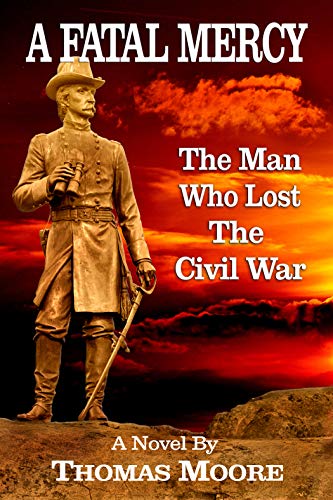
A Review of “A Fatal Mercy, The Man Who Lost The Civil War,” by Thomas Moore (1948 – 2021)

28 Saturday Aug 2021

Posted by perrinlovett in fiction

≈ Comments Off on A Review of “A Fatal Mercy, The Man Who Lost The Civil War,” by Thomas Moore (1948 – 2021)

Tags

"Civil" War, A Fatal Mercy, book review, books, fiction, Thomas Moore

A Review of “A Fatal Mercy, The Man Who Lost The Civil War,” by Thomas Moore


*We can add to Tom’s long list of achievements his proper raising of three sons and his very positive influence on his step-children. Within two or three hours of learning of his death yesterday, I had a few ideas and thought, “wow, I need to run that by Tom.” I’m still in the hit in the face stage; shocked to follow, I suppose. Here, I repost my 2019 review of his last major novel, an instant classic on several fronts. He was approached, though I don’t think the porject evolved far, about turning A FATAL MERCY into a TV or Netflix mini-series, which, if done correctly, would be excellent. Don’t wait for that; buy the book. 


The boy had it right in quoting his grandfather: “courage and fortitude are never in vain … no good cause is ever lost because all good causes are lost causes.” Even if he didn’t exactly understand the last part of it, that quote expresses an oft-felt theme, if not a rule, of life and of a higher civilization. It is the theme of his grandfather’s story from 1863 through 1913.


Was Drayton FitzHenry the man who lost the War for Southern Independence? The man himself certainly thought so, perhaps with good reason. Then again, the reader can, likely will, come to understand that there may have been a good reason behind the losing. The story is simple in its complexity, and visa versa.


Moore has really written two books in one. A Fatal Mercy is an in-depth study of the human condition and of Christian morality, Western in origin – Southern by the grace of God. On the one hand, the book is a stirring rendition of The War. In that alone, it is fantastic martial fiction, at once woven by an elegant and commanding imagination and steeped in painstakingly researched history. The story is compelling, riveting.


That is especially high praise from me. Unlike my father, I am not a “Civil” War buff. As a child, the old man dragged me from battlefield to battlefield, constantly uttering information gleaned from his (separate) War library. I certainly gained a respect – and the good manners to at least phrase “Civil” with those all-important quotation marks – but I never developed the … obsession. This book, all through its 727 pages, engendered some of that. This is a work my father would have read – and liked. Those of you who knew him, know that is higher praise.


Perhaps highest of all, is what that aforementioned history and the associated culture, presented alive and burning, generates with regard to what I see as the second grand interpretation, a thoughtful, reasoned, and unapologetic defense of relevant antiquity, classical knowledge, honor, and the grandeur of Western Civilization.


I am a student of classical Greco-Roman tradition. Here, Moore writes as well and true as any: “One reason we study the Classics, apart from the value of the knowledge itself, is for what they may teach us about our times.” With this sentiment, Cicero concurs: “To be ignorant of what occurred before you were born is to remain always a child. For what is the worth of human life, unless it is woven into the life of our ancestors by the records of history?”


Today, most Americans, Southerners included, are ignorant of history, children easily led astray from their ancestral heritage. Moore addresses this issue, with direct examples, slightly dramatized, through the eyes of his protagonist. Drayton’s book-long dilemma revolves around a momentary eye of the storm at Gettysburg. Rather, around the eye of the fish hook, as Shelby Foote put it if we stretch Foote’s geographic definitions to include Little Round Top (and it is, topography-wise, a sub-eye). See: The Civil War, a Narrative, Stars in Their Courses, p. 479, Random House, New York (1963).


Of that terrible battle and its defining outcome, Bruce Catton wrote: “There was no pattern to any of this, except for the undesigned pattern that can always be traced after the event.” Never Call Retreat, Encounter at Gettysburg, p. 186, Doubleday, New York (1965). If this is true – and who doubts Catton – then Drayton’s dilemma is understandable. Drayton lived out the maxim: “Iniuriam facilius facias quam feras – Easier to do a wrong than to endure one.” – Syrus, Maxims. As he refrained from the former, so he endured the latter. Both counts are attributable to – and tribute to – his wisdom and honor.


And, there is an honor, and a wisdom, about Drayton FitzHenry that is rare among literary creations. Odysseus has it, as does Frodo. That wisdom moves beyond the narrative of the War, the horrors of Reconstruction, and into the following age. Along with other, innumerable truths, a lesson and a warning speak directly to us. It finds different ways of expression:


  • The kindly nature of a freed slave towards her former master;
  • The correct realization that the War ended the original American Republic, freeing one class of slaves only to create another;
  • Understanding the force and effect of the demonic legal trilogy of 1913: to this end, three separate quotes, conjoined (by me, for my purposes): “Power transmutes into Empire. Empire begets hubris. Hubris brings ruin. … [O]ur virtues will be needed by America, perhaps even the world, more than ever. … We must do the best we can and leave the consequences to God.”

Moore’s articulate, enrapturing characters witness the end of a Republic. We stand at the very possible end of an Empire. Then, in the fable, and now, in our reality, both intelligent free will and resolve to honor Providence properly combine. Sayeth the poet: “Flectere si nequeo superos, Acheronta movebo – If I can’t move Heaven, I’ll raise Hell.” – Virgil, The Aeneid, VII, 312. The men at Gettysburg, of both sides, did exactly that. A Fatal Mercy does the same, does both in fact, recalling the horror and heroism of combat while instilling pride in the genteel, the cultured, the learned, the respecting, and the respectable. It is all of powerful magnitude.


The Author states: “My principal goal was not just to write the best contemporary novel of the War, but also to place my protagonist in an excruciating moral and emotional dilemma and see how he would resolve his inner conflict.” Moore has done that, and greater still. This book is a timeless Classic.


Also: The letters… The burning of the letters, Chapter Seventeen, moved me. The reader will, I trust, understand soon enough.


(Picture: Amazon/Green Altar Books – Shotwell/Moore)


A Fatal Mercy, The Man Who Lost The Civil War, Thomas Moore, Green Altar Books, Columbia, SC (2019).

Review of UNSCHOOLED by Kerry McDonald

08 Monday Jun 2020

Posted by perrinlovett in Other Columns

≈ Comments Off on Review of UNSCHOOLED by Kerry McDonald

Tags

book review, children, education, Kerry McDonald, Unschooled

Unschooled: Raising Curious, Well-Educated Children Outside the Conventional Classroom

Kerry McDonald, 2019

It’s no secret that, around here, the government schools are frowned upon as satanic prisons where children are abused and civilization is crushed into oblivion. What if it’s not the government part that’s the main problem? After reading this book and thinking about all I have seen, lived, and experienced, I think the idea of “school” itself is problematic. Such is McDonald’s premise in this excellent, methodical, and entertaining work.

I just gave it 5 stars at Amazon and Goodreads and I may go back and incorporate some of these words in a house review. First, there was one thing that caught me a little off guard in the pages. It’s something McDonald doesn’t shy away from and qualifies upfront. There is, to me, an inordinate amount of reference to the … alternative lifestyles. That said, by way of qualification, the author notes that the modern trend was largely started by radical leftists and leftover hippies, then followed increasingly by the Christian right. She also praises Andrew Carnegie, for whom I have no sociological use at all. But, at any rate, the whole tome is very well-balanced and apolitical.

And, though the current “movement” started in the 1970s, the concept is ancient. Until about 150 years ago, there were next to no schools anywhere. Or, at least there were no monstrosities of the kind that dot American towns and cities these days. There were colleges, elite academies, private tutors, and local private collective efforts, but the bulk of human education was left to the family … and to the children themselves. And it worked.

It still does.

I made something like 169 Kindle notes and highlights as I worked my way through. Most of them, I’ll leave off, here. What really stood out to me was the concept of what McDonald styles the “instruction assumption.” We, most of us, naturally (or unnaturally) assume that to learn one must be instructed. I wrestled with this, as likely you will as well. McDonald did. It is a fallacy.

Who taught you to stand up? To walk? To talk? To run? The answer is “you.” Believe it or not – and the book really helps – children can and will continue to self-educate, constantly and with all subjects. The purpose of an “instructor,” a parent, is to maintain a state of freedom, riddled with inspiration and opportunity, so as to facilitate what the child can do on his own.

“Public” schools are antithetical to this natural process, as are many (most) private schools, and even curriculum-directed homeschooling. A period of “de-schooling” may be required to dispense with the horrible habits of conformity and debasement.

Some quotes:

“The reason kids hate school is because it’s school.”

“It’s Not the kids. It’s the schools.”

Let those words sink in. If you’ve worked in a school or if you have a child in a school, then you subconsciously know. If not, then remember back to your own experiences so many years ago.

McDonald breaks down, as have many other analysts, how modern schools are designed to break spirits, foster useless conformity, and miseducate. This is the opposite of learning. For doubters – and I had my doubts – she presents example after example, to include academic studies and historical examples, that prove the laissez-faire approach not only works but that it generally works much better than the alternatives. It works for happy children and also for the greater society. Most of our titans of intellect and accomplishment, from Athens to London to Philadelphia, were unschooled and yet managed to change the world or parts thereof. Her example of “young Tom” was insightful and hilarious. *I understand that Tom Ironsides also read the book and is reconsidering his classical school model along more decentralized lines.*

Children can forego school completely, take no standardized tests, receive no useless credentialing paper, exempt the SAT, and still gain admittance to a good college. There, they typically outpace their schooled counterparts. College is not the only secondary path; it may not be the best one given a particular child. There are all kinds of alternatives. The keys are freely-informed consent, individual interest and pacing, and independent and critically-acquired knowledge. Those keys are natural. What goes on in the dull halls of the K-12 world is not.

The solution, as is often the case, is freedom, in this case freely allowing the child to pursue his own interests at his own pace. Even in our crazed, rule-plagued country, this is legal in all 50 states. I developed a sense of awe in the reading. I was also a little jealous; this could have and probably was the best (non) system for me. But, times change. Think of this, for those in the know, as a Sudbury School in the home.

Given human nature and especially the nature of Americans (or what passes for them), I doubt this self-directed methodology will appeal to the masses. But it should. UNSCHOOLED gave me a great, renewed sense of hope. If you have children or if you care anything about the future of intelligent civilization, then I highly recommend not only the book but at least an exploration of the ideas within it.

This Week

07 Sunday Jun 2020

Posted by perrinlovett in Other Columns

≈ Comments Off on This Week

Tags

book review, history, TPC

We have a great TPC/PL column scheduled for tomorrow in honor of the chief historic incident of the date. You’ll enjoy it.

And, I’ve finished UNSCHOOLED by Kerry McDonald. I made around 169 notes, so I’ll have to shift through before I can review it in full. It’s good.

Until then, P

“A GRITTY, REALISTIC LOOK INSIDE THE PUBLIC SCHOOL”

19 Tuesday Nov 2019

Posted by perrinlovett in Books For Sale

≈ Comments Off on “A GRITTY, REALISTIC LOOK INSIDE THE PUBLIC SCHOOL”

Tags

book review, books, fiction, novel, The Substitute, Tom Ironsides

The first 5-Star review of THE SUBSTITUTE is now live at Amazon:

Thomas
5.0 out of 5 starsA GRITTY, REALISTIC LOOK INSIDE THE PUBLIC SCHOOL

November 17, 2019

It takes courage to write a book. Few things are as intimidating as sitting down in front of a blank computer screen day after day and trying to fill it with something worthwhile. Perrin Lovett is doubly brave. He has written an original, exciting, entertaining story. But he also had the courage to take on the most sacred cow in the vast American herd – the public schools. THE SUBSTITUTE gives us a vivid, realistic, inside look at the failing public schools based on real, day-to-day experience. Many non-fiction studies of public education have been appeared in the past few years. But THE SUBSTITUTE is the only novel on the subject I’m aware of that compares to the famous “muckraker novels” of the early 20th Century that exposed such social evils as child labor, worker safety, and political corruption. Writers like Upton Sinclair, Ida Tarbell, and Lincoln Steffens changed America by using fictional truth to expose the social ills they addressed. I hope that Perrin Lovett’s novel will have a similar effect on how we look at public schools, which demand an ever greater bite of tax revenue while producing an ever worse result.

Perrin Lovett is a natural story-teller, with a superb command of language and a tone, sardonic at times, that is appropriate to his subject. And he has created a splendid protagonist, Dr. Tom Ironsides, the substitute of the title. Dr. Ironsides is also Colonel Ironsides, retired from the Marine Corps and from subsequent “black ops” with the CIA. He is an academic, trained in the Classics, and a warrior, trained to function in a world where survival demands competence.

At first I was concerned how Lovett would get such an engaging character from the battlefield against terrorism to the battlefield against ignorance. But he does it quite well, quite credibly. Ironsides is one of those people with the self-confidence and the idealism to want to spend his later life setting things right. What better venue for his knowledge, skills, and natural authority than the schools? But since he’s not officially certified, he has to start out teaching as a full-time substitute. As a substitute, he covers many different grade levels and subjects, giving the reader a genuine cross-section autopsy of an unsustainable system. It’s crushed by its own bureaucracy, treats its students more like inmates of a prison, destroys love of learning, and drains the heart out of the teachers. Most of them love their kids and aspire to teach them well, but they’re over-burdened with ever more testing and data-keeping and bureaucratic procedure. Instead of making the classroom a place of excellence in learning, public schools are creating sinkholes of mediocrity.

I won’t spoil the ending except to say it’s very satisfying. It’s fictional, of course, but it ends the only way the whole national public school debacle can end if America is to remain a strong, free, prosperous, self-governing nation. Only a well-educated people can keep it that way. If we do follow the new course described in THE SUBSTITUTE, we’ll have Perrin Lovett to thank.


Wow. That feels like a heavy responsibility. For my part, I’ve started making a few minor changes to the book. First, there are always little improvements to make, my pedantic CYA in the Afterword aside. Second, the formatting needs a little work, which I can accomplish soon. (For that, I blame the computer and the template).

Screenshot 2019-11-19 at 10.10.33 AM Screenshot 2019-11-19 at 10.10.59 AM

Let’s keep those going!

A Review of THE SUBSTITUTE

17 Sunday Nov 2019

Posted by perrinlovett in Books For Sale

≈ Comments Off on A Review of THE SUBSTITUTE

Tags

book review, books, fiction, novel, The Substitute

My advance copy of a review headed to The Substitute Amazon page. This is, frankly, better than any description I’ve ever attempted:

It takes courage to write a book. Few things are as intimidating as sitting down in front of a blank computer screen day after day and trying to fill it with something worthwhile. Perrin Lovett is doubly brave. He has given us an exciting, entertaining story. But he also had the courage to take on the most sacred cow in the vast American herd – the public schools. THE SUBSTITUTE gives us a vivid, realistic, inside look at the failing public schools based on real, day-to-day experience. Many non-fiction studies of public education have been appeared in the past few years. But THE SUBSTITUTE is the only novel on the subject I’m aware of that compares to the famous “muckraker novelists” of the early 20th Century who exposed such social evils as child labor, worker safety, and political corruption. These writers changed America by shining the light of truth on the social ills they addressed. I hope that Perrin Lovett’s novel will have a similar effect on how we look at public schools, which demand an ever greater bite of tax revenue while producing an ever worse result.

Perrin Lovett is a natural story-teller, with a superb command of language and a tone, sardonic at times, that is appropriate to his subject. And he has created a splendid protagonist, Dr. Tom Ironsides, the substitute of the title. Dr. Ironsides is also Colonel Ironsides, retired from the Marine Corps and from subsequent “black ops” with the CIA. He is an academic, trained in the Classics, and a warrior, trained to function in a world where competence equals survival.

At first I was concerned how Lovett would get such an engaging character from the battlefield against terrorism to the battlefield against ignorance. But he does it quite well, quite credibly.

Ironsides is one of those people with the self-confidence and the idealism to want to spend his later life setting things right. What better venue for his knowledge, skills, and natural authority than the schools? But since he’s not officially certified, he has to start out teaching as a full-time substitute. As a substitute, he covers many different grade levels and subjects, giving us a genuine cross-section autopsy of an unsustainable system. It’s crushed by its own bureaucracy, treats its students more like inmates of a prison, destroys love of learning, and drains the heart out of the teachers – most of whom love their kids and want to do well – burdening them with ever more testing and data-keeping and procedures instead of allowing them to instruct.

I won’t spoil the ending except to say it’s very satisfying. It’s fictional, of course, but it ends the only way the whole national public school debacle can end if America is to remain a strong, free, prosperous, self-governing nation. Only a well-educated people can keep it that way. If we do follow the new course described in THE SUBSTITUTE, we’ll have Perrin Lovett to thank.

Who writes that? Thomas Moore, author of A Fatal Mercy and Hunt for Confederate Gold. Hopefully, this will spark a string of five-stars!  I’ll have a picture added, here, once the review hit Amazon. Now, if it all falls apart, am I to blame?? This is the kind of accolade one wants but then feels the burden of. Thanks, Tom!

PS: TPC “preview” – I keep waffling on ideas this week. Whatever it is, it will be good. See that, mid-week.

← Older posts
Newer posts →

Perrin Lovett

From Green Altar Books, an imprint of Shotwell Publishing

From Green Altar Books, an imprint of Shotwell Publishing

Perrin Lovett at:

Perrin on Geopolitical Affairs:

Archives

  • May 2026
  • April 2026
  • March 2026
  • February 2026
  • January 2026
  • December 2025
  • November 2025
  • October 2025
  • September 2025
  • August 2025
  • July 2025
  • June 2025
  • May 2025
  • April 2025
  • March 2025
  • February 2025
  • January 2025
  • December 2024
  • November 2024
  • October 2024
  • September 2024
  • August 2024
  • July 2024
  • June 2024
  • May 2024
  • April 2024
  • March 2024
  • February 2024
  • January 2024
  • December 2023
  • November 2023
  • October 2023
  • September 2023
  • August 2023
  • July 2023
  • June 2023
  • May 2023
  • April 2023
  • March 2023
  • February 2023
  • January 2023
  • December 2022
  • November 2022
  • October 2022
  • September 2022
  • August 2022
  • July 2022
  • June 2022
  • May 2022
  • April 2022
  • March 2022
  • February 2022
  • January 2022
  • December 2021
  • November 2021
  • October 2021
  • September 2021
  • August 2021
  • July 2021
  • June 2021
  • May 2021
  • April 2021
  • March 2021
  • February 2021
  • January 2021
  • December 2020
  • November 2020
  • October 2020
  • September 2020
  • August 2020
  • July 2020
  • June 2020
  • May 2020
  • April 2020
  • March 2020
  • February 2020
  • January 2020
  • December 2019
  • November 2019
  • October 2019
  • September 2019
  • August 2019
  • July 2019
  • June 2019
  • May 2019
  • April 2019
  • March 2019
  • February 2019
  • January 2019
  • December 2018
  • November 2018
  • October 2018
  • September 2018
  • August 2018
  • July 2018
  • June 2018
  • May 2018
  • April 2018
  • March 2018
  • February 2018
  • January 2018
  • December 2017
  • November 2017
  • October 2017
  • September 2017
  • August 2017
  • July 2017
  • June 2017
  • May 2017
  • April 2017
  • March 2017
  • February 2017
  • January 2017
  • December 2016
  • November 2016
  • October 2016
  • September 2016
  • August 2016
  • July 2016
  • June 2016
  • May 2016
  • April 2016
  • March 2016
  • February 2016
  • January 2016
  • December 2015
  • November 2015
  • October 2015
  • September 2015
  • August 2015
  • July 2015
  • June 2015
  • May 2015
  • April 2015
  • March 2015
  • February 2015
  • January 2015
  • July 2014
  • June 2014
  • September 2013
  • August 2013
  • July 2013
  • June 2013
  • May 2013
  • April 2013
  • March 2013
  • February 2013
  • June 2012

Prepper Post News Podcast by Freedom Prepper (sadly concluded, but still archived!)

Create a free website or blog at WordPress.com.

  • Subscribe Subscribed
    • PERRIN LOVETT
    • Join 41 other subscribers
    • Already have a WordPress.com account? Log in now.
    • PERRIN LOVETT
    • Subscribe Subscribed
    • Sign up
    • Log in
    • Report this content
    • View site in Reader
    • Manage subscriptions
    • Collapse this bar

Loading Comments...

You must be logged in to post a comment.