• About
  • Blog (Ext.)
  • Books
  • Contact
  • Education Resources
  • News Links

PERRIN LOVETT

~ Deo Vindice

PERRIN LOVETT

Category Archives: Other Columns

Columns concerning any and everything. Enjoy!

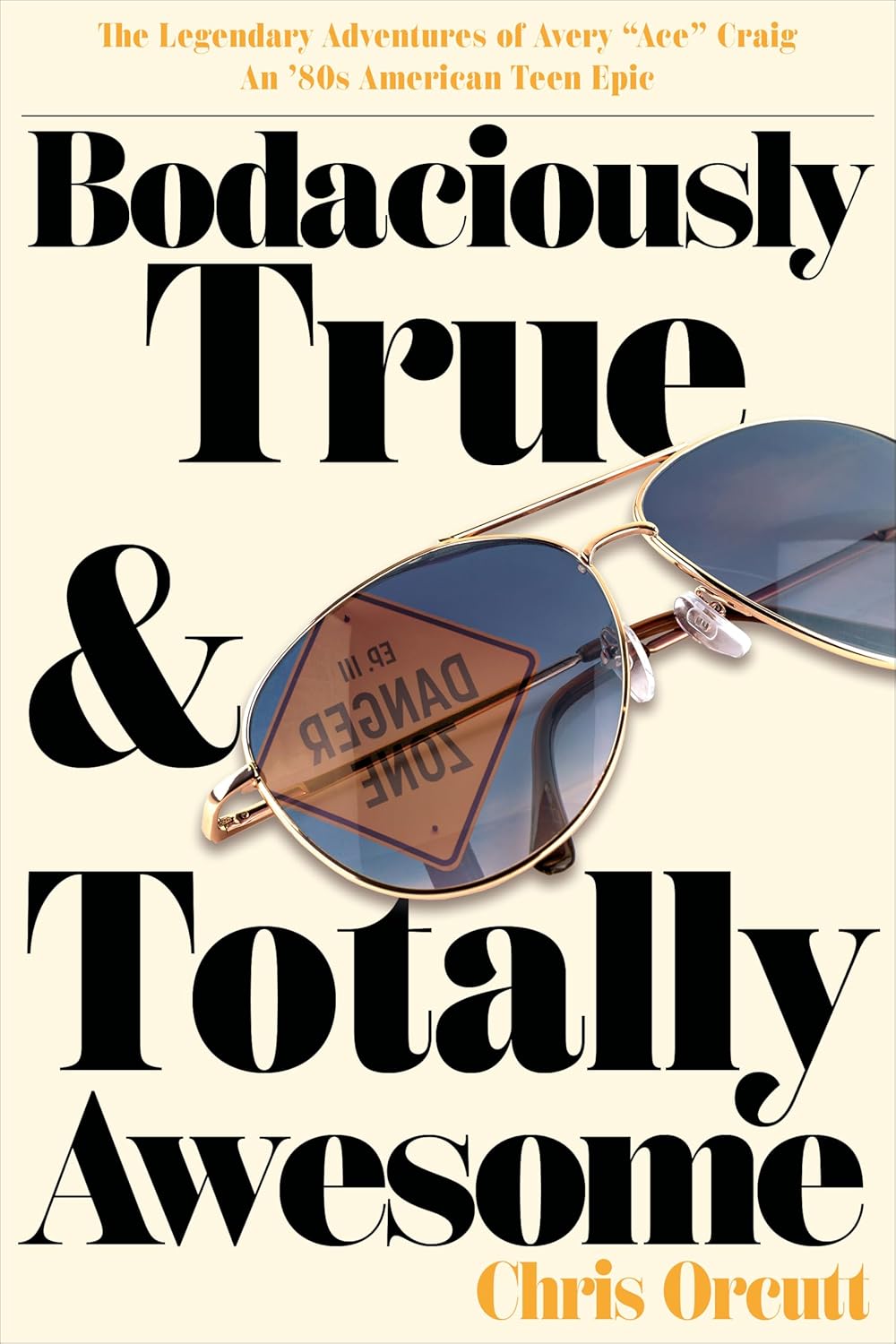
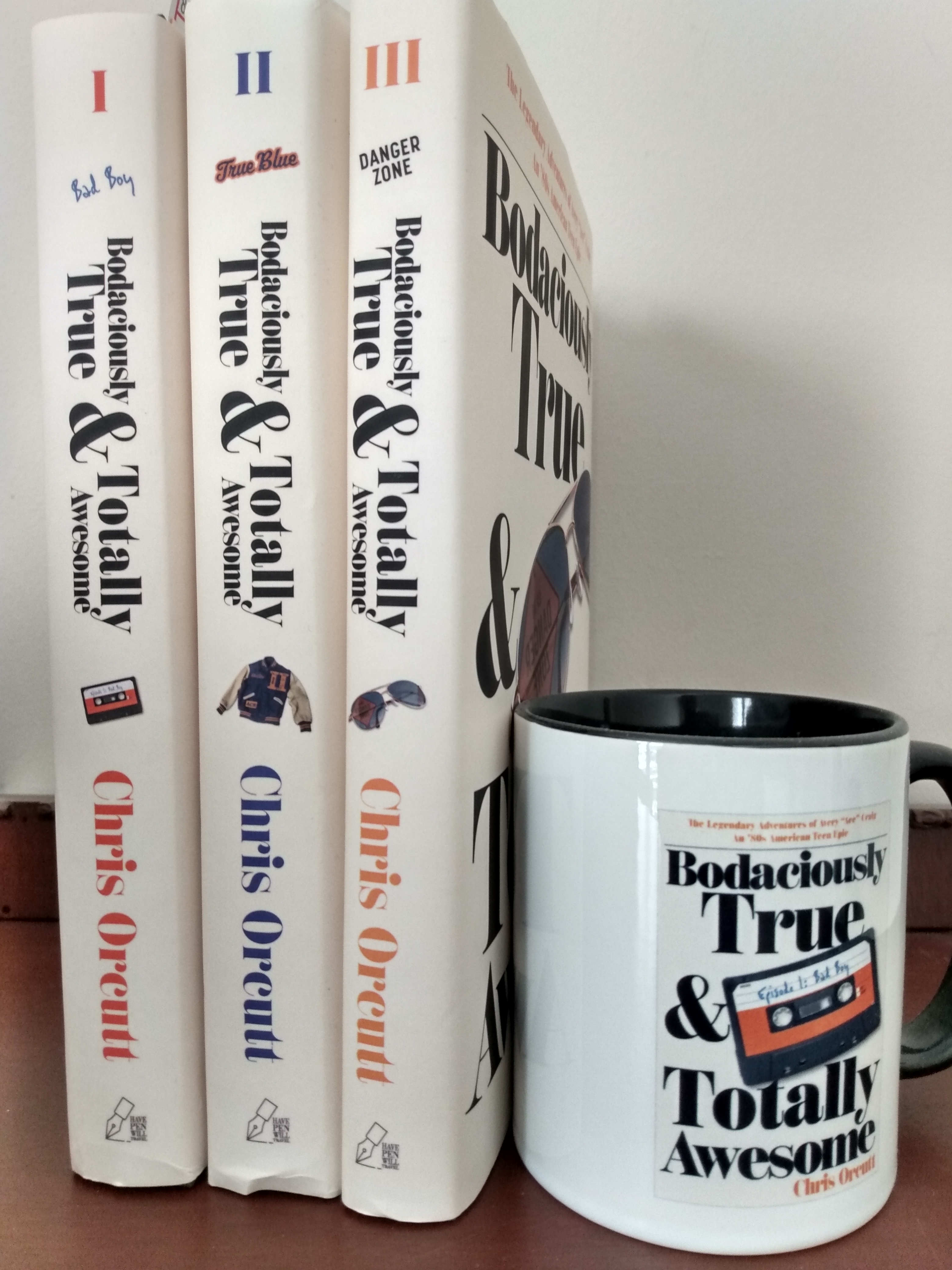
BOOK REVIEW: Bodaciously True & Totally Awesome, Episode II: True Blue by Chris Orcutt

01 Wednesday Apr 2026

Posted by perrinlovett in Other Columns

≈ Comments Off on BOOK REVIEW: Bodaciously True & Totally Awesome, Episode II: True Blue by Chris Orcutt

Tags

Bodaciously True and Totally Awesome, book review, Chris Orcutt, True Blue

Bodaciously True & Totally Awesome, Episode II: True Blue by Chris Orcutt

Review by Perrin Lovett


Here we go again! Generation X, elders, young folks, it’s once again time to head back to the glory of the 1980s. Here’s another brief look at Chris Orcutt’s unfolding masterpiece, Bodaciously True & Totally Awesome. Specifically, it’s Episode II: True Blue. To butcher some Whitesnake lyrics, “here [we] go again on [our] own.” But, of course, we’re not alone. Far from it. Thanks to Orcutt, we’ve got some hellaciously good company for this particular tour de force down memory lane!

(Cover design by Victoria Heath Silk with image by Hurst Photo & Top Quality Vectors.)

*Orcutt, Chris, Bodaciously True & Totally Awesome, Episode II: True Blue, New York: Have Pen, Will Travel, 2026.

If necessary, please read my review of Episode I: Bad Boy. Please also read my interview with the author. Orcutt also gives a mean video interview! And if you’re just tuning in, then please buy a copy of both books (Bad Boy is now available, outright, and True Blue is available for pre-order) and fully acquaint yourself with Chris Orcutt, the author some regard (rightly) as the American Tolstoy and whom I’ve previously called “the best American novelist alive today.” I’ve also proclaimed, based on reading Episode I: Bad Boy, that Orcutt has joined the ranks of the greats—Homer, Ovid, Chaucer, Shakespeare, Pushkin, Gogol, Murakami, et al. With True Blue, he does not disappoint. 

Your reviewer herein incorporates all points of the Bad Boy review as if each were restated in full. I will now specifically summarize a few of them, updated for True Blue. Bodaciously… still moves like a roller coaster, although this time, there is a lot of snow, so kindly remember a parka and boots. Avery, the sixteen-year-old protagonist and James Bond fan, now acts out his admiration for Ian Fleming’s star character in gripping fashion. Once again, Orcutt’s writing is flawless. Again, my six-by-nine paperback is a marvel of literary engineering. Yet again, a spiritual or philosophical theory presents itself throughout the pages; Avery, as Orcutt put it in our interview, “is groping for meaning spiritually, kind of trying on different spiritual or philosophical hats.” As Orcutt said, this process was not deliberately inserted into the text. As I said, it is something the reader will discover and process on his own. Orcutt says, correctly, that a story is a story, not an argument. Of course, this particular story, like the better ones, comes with good examples and keen reminders—notes to engage the reader’s spirit and intellect. Avery continues to be a stellar ladies’ man, and his relationships, proceeding at a dizzying pace, add multiple aspects of excitement to the reading experience. That experience is further heightened by Orcutt’s deft usage of various historical elements, added via living incorporation, that take True Blue into territory where most novels simply cannot go. The reference footnotes keep rolling, and Orcutt even has one FOR TOLKIEN! (A big deal for your reviewer.) The exploration of human psychology continues, led valiantly by Avery, the alpha. Through all the new twists and turns, the reader, regardless of age or generation, will continue to feel and recall the attendant emotions and notions of youth. Oh, and the quintessence of our glorious 1980s music also continues! 

Now, without giving too much of the story away, here is a modicum of detail. True Blue presents a series of little reminders about things that have practically vanished from American life. Remember popping the clutch to bypass a dead battery? You will! Well, those over forty or fifty will. Remember high school employment? Avery takes a few interesting jobs, which, in addition to earning him money, further the excellent action and romantic themes of the book. There is a subtle shift, or intensification, in the story, wherein Orcutt expands on the groundwork previously laid out in Bad Boy. The refined, non-dialectical social commentary continues. For instance, Avery’s life and times, his adventures, are set betwixt and between his high school tenure. There is a long, well-woven subplot concerning the highs and lows of American education, particularly how it interferes with life and learning without necessarily adding much substance. In chapter seventeen, around page 313, a capstone is raised, more poignant than anything from, say, Ferris Bueller’s Day Off, that highlights the dichotomy. At precisely the right time, Avery kindly states the obvious: “It was amazing how much of school was superfluous.” John Taylor Gatto would have approved. (Note: I’m keeping the citations slightly rough [e.g., “around page…”] just in case any minor formatting adjustment moves anything a page or so.)

True Blue dives deeper into family dynamics, in general, and, especially, those concerning the late modern American period as typified by the 1980s. Several families are portrayed, each with its own flavor and characteristic. Without preaching or even trying to scene set, Orcutt exposes the good, the great, the not-so-good, and, frankly, the awful about how we live(d). Some of the material, all of it strikingly realistic and serious, feels a little dark and disturbing—and some of it is. Therein lies part of its literary beauty, as it accurately showcases the way we were, the way many of us have always been, and the way we still are today. There is no need to consult any edition of the APA’s DSM, but one will ponder why we, any of us, sometimes do the things we do, and how we tolerate our own ways and the ways of others. There is nothing in this thread to salvage, esoterically, per se, but Avery does use some of what he discovers as the impetus to right a few wrongs. (If one hasn’t read Bad Boy yet, just know that one will simply love Avery, a legitimate hero and endearing figure.) 

One of those rightings allows, in my opinion, the best action sequence in the epic so far. I won’t give any of it away. Rather, I ask the reader how far he’d be willing to go to restore the honor of a horribly wronged friend. Avery, one will discover, is willing and able to go into icy hell and back. Previously, Orcutt opined that one of his favorite scenes in Bad Boy was the D.C. hotel pool fight. I concur with him: that scene, a relatively short sequence, was detailed in the extreme and came to life better than most screen performances. The snowy scene I’m thinking about in True Blue is like that, but better, longer, and with far higher stakes. 

In real life, one of the interests we all share involves the advice we give and receive. Avery and company walk through a sea of advice, some good and some terrible. Generation X and subsequent generations have generally lacked good advice and role models. They’re there if one is lucky. Avery lucks out during a scene in chapter nineteen, around page 348, while he’s working one of his unusual jobs. The scene could have come right out of a Robert Ludlum thriller, by the way. After a brief discussion about the Craig household, one of Avery’s older “coworkers” remarks, “It’s terrible what they’ve done to your generation. … You have to figure out all this stuff by yourselves.” In answer, Avery observes, “We might have to fend for ourselves more, but we’ve also got a lot more freedom, so I figure it evens out.” Roundabout, there follows some of the best relationship advice I’ve seen in the whole compendium, fatherly words young men need to hear more often.

One last scene I adored—find it during your reading(!)—saw Avery and a friend enjoying cigars one evening. Specifically, they smoked a few Macanudos. While it was not stated, the preponderance of the leaf suggests the exact models were probably Cafes, then and now ultra-popular smokes. When I read it, I, the man who usually doesn’t annotate fiction, jotted down a quick set of financial speculations: my guess is that back in 1986, the boys would have probably given, at most, two or three dollars for each cigar. Today, the going price is closer to ten to twelve dollars. (Many thanks to our beloved banksters and politi-critters and their mass financialization for the endless inflation!) This particular scene was personal for me because every once in a while, I get to enjoy a cigar or three with a very good friend from high school. Some years ago, he remarked that we should have smoked the occasional cigar while we were in school. It was by then, of course, far too late; however, I heartily agreed with him. So it was that I was very happy to relive the missed experience in fictional form. (To the “cigars are bad,” hand-wringing harpies: put it in your pipes and smoke it.)

If it’s possible, I might like this episode 2% better than the initial installment. And as with Bad Boy, I don’t just recommend True Blue, I’m mandating it. Or, allow me to put it like this: on January 20, 1981, in his inaugural address to the nation, President Reagan said, “We have every right to dream heroic dreams. Those who say that we’re in a time when there are not heroes, they just don’t know where to look.” If you’re still in doubt as to where to find the living remnant of the American Dream, then all you have to do is look in Bodaciously True & Totally Awesome. 

Special Guest Post: ‘Southern Katehon’ by Walt Garlington

08 Sunday Mar 2026

Posted by perrinlovett in Other Columns

≈ Comments Off on Special Guest Post: ‘Southern Katehon’ by Walt Garlington

Tags

guest post, poem, Walt Garlington

Friends, I am honored to share a poem by the esteemed bard of Louisiana, Walt Garlington. Many, many thanks to Walt for sharing this very timely and comely message. Please pay careful attention, and enjoy! 

‘Southern Katehon’

By Walt Garlington

[Poet’s] Note: ‘Katehon’ is the Greek term used in St Paul’s Second Letter to the Thessalonians, chapter 2, verses 6 and 7, to denote the one who withholds the Antichrist from rising to power in the world.

***

When the Southern States
Peacefully left their union
With the revolution-minded
States of North and West,
Then did the name and strength
Of katehon descend upon them.

When Gen’ral Lee stood upon
The green Virginia hill,
O’erlooking his lines of men,
Barefoot and meanly clad,
He held within his graceful hand
The sword of katehon.

When the Southrons marched and fired,
And loosed their Rebel Yell
To thunder through the air,
Forcing the mechanics and mercenaries
Of the Yankee force to flee,
Land and air reverberated with its might.

When the boys aboard the Hunley
Launched their underwater missile,
Striking smug, unsuspecting
Northern navy ship,
Sending it quickly beneath the waves,
The waters round them rippled with it for a time.

When the tragedy
Of Appomattox befell the South,
The mysterious power
Of katehon was taken from her,
And the Yankee American antichrist
Began its slow, serpentine ascent to global power.

Now, fixed fast upon its infernal throne,
Built upon the blood and bone
Of nations near and far,

Few oppose it anymore for fear.
But perhaps the Lord, in His mercy,
Will grant Dixie, like Samson,
For one more moment brief –
To redeem her complacency
And cooperation with the devil’s pet –
The role and power of katehon
To bring it crashing down
Forever to its grave.

COLUMN: The Epstein Empire Strikes Back

01 Sunday Mar 2026

Posted by perrinlovett in Legal/Political Columns, Other Columns

≈ Comments Off on COLUMN: The Epstein Empire Strikes Back

Tags

America, Epstein empire, evil, Iran, Israel, War

The Epstein Empire Strikes Back


On orders from Supreme Leader Benjamin Satanyahoo, Yankee marionette Donald “Dumb as a Stump” Trump commenced an idiotic, illegal, and evil war against the Islamic Republic of Iran. The reason is that Iran, a civilized and responsible nation, stands in the way of Greater “Israel,” a proposed Sabbatinic supremacist state stretching from the Nile to Basra and beyond, a national Big House from which to govern the Talmudic World Plantation. 

The Trump and his gaggle of morons, drunks, fools, witches, sodomites, pedophiles, kabbalists, lunatics, foreigners, usurers, and other trash murdered the honorable Martyr Grand Ayatollah Ali Hosseini Khamenei, leader of Iran, may he rest in peace. The goal of the decapitation strike was to get ordinary Iranians into the streets demanding the overthrow of their government and Shia theocratic civilizational state. That part was a partial success: hours after the murder, seemingly all Iranians were in the streets of all towns and cities protesting. The catch was that they all chanted, “Death to America! Death to Israel!” So much winning.

America and “Israel” are now a conjoined entity. Americans, unwittingly, coerced, or otherwise, have now joined Zionist and Pharisaical Jews as the stepchildren of the devil, as the adversaries of all men. So much winning they don’t know what to do. 

While The Trump Tweeted incessantly and stupidly, Satanyahoo bravely fled to Germany, already having dispatched his troll doll wife to their son’s residence in Miami. Iran commenced a massive counterattack against “Israel,” Yankee military and intel bases across West Asia, and, most interestingly, against various greedy Arab puppet enablers and profiteers. The latter, we’ve learned, for all their vast riches, never thought to procure air defenses. Winning looks a lot like burning luxury high rise apartments and hotels. The war is ongoing as I type. I have few ideas about how it is going or how it will end. And I am sickened by the entire thing.

America, “Israel,” and most of the fallen West are now governed by open and avowed satanists who molest, cannibalize, and ritualistically murder children. The free world now refers to this system, mockingly, but accurately, as the Epstein Coalition or Epstein Empire. So. Much. Winning. This Empire, following in the ways of its dark false god, hates God the Father of Jesus Christ, Jesus, the Holy Spirit, and all men. They especially hate children because the young are the purest among us and, thus, spiritually closest to God. This system, as represented by the Epstein Files, which we will never see fully exposed, is directly connected to an endless chain of evil, to the Finders/Satanic Panic of the 1980s, the little skeletons found under Ben Franklin’s London house, the human sacrifices of the Tenochca Empire, the tophets erected along the shores of Gaul by the Phoenicians 28 centuries ago, and to that rabble of degenerates gathered outside Lot’s door and blinded by the Angels. 

In keeping with the war on children, the Judeo-Yankee attacks also murdered over one hundred little girls at an elementary school in coastal Minab, Iran. May they rest in peace. Here, dear and gentle readers, are a few of the losers to your accursed winning:

(Photos from DDGeopolitics, Telegram.)

Don’t like the looks of your work? Too damned bad. The girls didn’t enjoy it either. Repent, heathens!

Persia has a three thousand year history. Something tells me it will endure. As will Russia, China, and the rest of the sovereign world. The Evil Empire, for all its murder and destruction, will not. 

Those in the Greater West, in “Israel,” and, especially, in America, need to come to terms with where they stand. Do any of them really want to face off against Saint Michael and His unconquerable armies? It is time to pick a side.

Death to the Epstein Empire!

Hostibus semper mortem! 

Deo vindice!

BOOK REVIEW: Veriphysics: The Treatise by Vox Day

20 Friday Feb 2026

Posted by perrinlovett in Other Columns

≈ Comments Off on BOOK REVIEW: Veriphysics: The Treatise by Vox Day

Tags

book review, Enlightenment, philosophy, Veriphysics, Vox Day

Veriphysics: The Treatise: The Failure of the Enlightened Mind and the Path Toward Truth by Vox Day

Review by Perrin Lovett


If traditional Western Civilization were an airplane, then the philosophy of the Enlightenment was the set of new-fangled engines installed under the wings. The engines failed and, predictably, the plane crashed. Luckily, there are survivors. It is up to them, as soon as they recover, to rebuild and relaunch the craft and its mission. They’ve just received blueprints and schematics courtesy of Vox Day and Veriphysics: The Treatise: The Failure of the Enlightened Mind and the Path Toward Truth. Here follows a quick glance at Day’s proposed path forward.

(Castalia House 2026. That guy looks familiar.)

Day, Vox, Veriphysics: The Treatise: The Failure of the Enlightened Mind and the Path Toward Truth, Switzerland: Castalia House, 2026.

Vox Day is the genius behind the Darwin-crushing concept of MITTENS, the full taxonomy of the socio-sexual hierarchy, SJWs Always Lie, Corporate Cancer, Probability Zero, and a host of other useful projects and publications. Your reviewer has read Day with great appreciation since 2001, and his earliest days as a columnist at World Net Daily. A Top 40 recording artist, he slings some mean beats and lyrics. Veriphysics is available from Amazon. 

A funny thing happened on the way to the philosophy. A few years ago, I was involved with a minor project with a then-functioning Moscow-based educational think tank. My proposal was understandably placed on the back burner pending the debut of a major project, an introduction to philosophy geared towards high school and college students. While I waited, I inspected some of the incoming major project material, finding it slightly out of place. Rather than beginning with classical philosophy, say, with Plato or Aristotle, the wisdom of the Russian Church, or any other ancient source, the focus jumped straight to the Enlightenment. And the material was sourced from a U.S. Ivy League university. I found this odd for several reasons, not least among them the copious availability of knowledge at MSU, RSUH, and other local institutions. Something felt off. I will not say it felt like an attempted inversive encroachment, but…

Anyway, for whatever reason, the fledgling think tank ceased primary operations. My contribution was published elsewhere. And the philosophical direction and defense of Mother Russia continues, in no small part due to the efforts of men like Alexander Dugin.

Dugin’s Fourth Political Theory is a framework for reclaiming tradition. See Dugin, Alexander, The Fourth Political Theory, London: Arktos, 2012/2018. In 2024, I wrote: “Dugin’s Fourth Theory may be summarized as a rebellion against Liberalism, its “enlightened” modernity, and the underlying anti-human satanism at its heart.”

One of the criticisms of Dugin’s theory is that it lacks exactitude. However, rather than being a precise “how to” set of directives, it is a potentially universal approach wherein the exact applications are left open for each society, nation, or civilizational state. See my essay at the last link, above, for a glimpse of how Dugin the philosopher is also Dugin the doer, rebuilding a critical component of Russian society, the traditional Russian way. Russia’s ancestral trajectory was broken by decades of communism, followed by a single decade of hard, heavy liberalism. This century, Russians are forging ahead while also rekindling tradition, with Dasein in one hand and Oreshnik in the other. Much or most of the wider world is, to one degree or another, following their path.

But what of the West and its potential? The heirs of the Greco-Roman legacy have endured many centuries of relentless liberalism. As Day previously noted, this is observably worse than communism. As Dugin has said, Westerners are the original victims of liberal modernity. How, then, will Westerners begin to shake off the Enlightenment and relaunch their civilizational aircraft? The process, which cannot begin a day too soon, will take time and great effort. Luckily, Day’s Veriphysics provides an accessible, actionable framework for understanding what went wrong and how to remediate it. 

As a treatise, Veriphysics is a short book, 86 pages long, but it is packed from beginning to end with gems. In fact, in its totality, it is essentially a large diamond. Herein, as if with a jeweler’s loop, I merely examine a few facets. I’m also going to try an experiment towards the end. 

The Enlightenment has failed. Day notes, on page 4:

One by one, the foundational concepts that shaped the modern world have been tested against reality over time and found wanting. The social contract, the invisible hand, the marketplace of ideas, the arc of progress, democracy, the separation of powers, freedom of speech, and the rights of Man: each of these ideas have been weighed in the balance of recent centuries and discovered to be, at best, a partial truth elevated far beyond its proper domain, and at worst, a deceptive illusion that fueled three centuries of unnecessary human suffering.

Veriphysics breaks the illusion and its five main premises, from page 8: “…autonomous reason, sovereign individuality, mechanical nature, the fact-value distinction, and inevitable progress…” Here I note that, like Dugin, Day correctly identifies individuality as a duplicitous issue, rather than a concrete value. While the individual, created in God’s Image, has his definite worth, he is not severed from the whole as the Enlightenment proposed. The realization of this atomization of man was a shock for your formerly libertarian reviewer, a shock I trust is shared by many.

Part One is a recitation of the failures of various Enlightenment planks: representative democracy, the inversion of natural rights to make J.B. Bury blush, assorted economic disasters, the corruption of science, and more. Day explains the general pattern of observable failure: “[L]ogic first, then mathematics, then empirical evidence—and still the orthodoxy persists, sustained by institutional inertia and the career interests of its beneficiaries.” Page 32. Day’s new philosophy aims to reverse and undo these failings by allowing the bold to preserve tradition while conforming that tradition in a way that meets modern needs. 

Day defines the doctrine on page 58:

[U]nlike classical philosophy, … Scholasticism, … and Enlightenment philosophy, … veriphysics is focused solely on truth, or veritas. Every aspect of veriphysics is meant to explore and expand the concept of truth to the greatest extent possible, through every path that is capable to leading to some aspect of the singular, core, and underlying Truth. The objective of veriphysical philosophy is veriscendance … veritas and ascendance.

Two areas where Day goes into detail are the capture of our traditional institutions and the baleful curse of usury. I have lumped these two together for a reason. And in getting to the institutions, Day examines how classical philosophy failed to adequately counter the Enlightenment’s rise, a matter partly of the dialectical versus the rhetorical. He notes that understanding the previous weaknesses is necessary for reversing the damage those weaknesses allowed. Day lists five mandatory factors for defeating the Enlightenment’s grip on mind and society, culminating with the rebuilding of what was lost. Part of this process involves the ancient Christian concept of participation—the melding together of knowledge, human and divine. See page 62.

The university is an example of a stolen institution. “The very idea of a university, a community of scholars devoted to preserving, transmitting, and extending knowledge, was a medieval Christian innovation. The Enlightenment did not create these institutions; it invaded them, subverted them, and eventually seized them.” Page 48. Furthermore, the Enlightenment, while removing academic value from the formerly functioning universities, increasingly ransoms the lives of students via usurious debt, a double evil. Student loans in places like the United States are a severe problem for the young, yet they are only one piece of the collapsing debt puzzle. 

The Enlightenment dispelled and reversed millennia of prohibition against interest on loans. This was a direct contradiction of the commands and wisdom of Almighty God, Jesus Christ, the Christian tradition, the Hebrew tradition, the Islamic tradition, the traditions of other religions, and the traditions of all civilizations, great and small, that survived the lethal temptation of usury. “The Enlightenment promised liberation; the usury that funded it delivered a new form of bondage.” Page 25. 

And in a nation like the United States, it’s really a matter of super-usury; not only does the required extra money for the interest not exist in reality, but the underlying money loaned out is also a fraudulent, non-existent fiction. “Money itself is debt—a liability of the central bank, created through lending, destroyed through repayment. An economy that repaid its debts would be an economy without money. The system requires perpetual expansion of debt to function; deleveraging is not an option but a crisis.” Id. 

The postmodern monetary system is about as simple as it is evil. The money masters geometrically increase the money supply and, accordingly, its burden on the people, while sucking all true wealth and real value into their own pockets. It’s not a system of robbing Peter to pay Paul; it is a scheme of murdering Peter to pay Judas. How can this be fixed? The notion of the sabbatical and the jubilee comes to mind. But how to get there from the ruins of the Enlightenment? As noted above, understanding precedes correction. To that end, Day offers a starting point, a mechanism for evaluating the ideas, fantasies, and deceptions of the liberal disorder: the Triad of Truth. 

“Veriscendancy offers a genuine criterion: the Triad of Truth, the Triveritas. A claim merits assent—may be accepted as probably true—when and only when it satisfies three conditions: logical validity, mathematical coherence, and empirical anchoring.” Page 70. He also lists a few examples of the Triveritas in action. For my experiment, I thought to apply it, in a quick sketch, to usury. 

The premise of usury, as currently practiced in the U.S., is that paying monopoly rent to the Epstein Class for limitless debt-based fake money is beneficial for societal prosperity and harmony. The logic behind it is a stretch, but let’s give them that one out of kindness. The mathematical analysis, however, fails. Michael Hudson, Steve Keen, David Graeber, and others have described in extraordinary detail how the multiplication of money through debts quickly outpaces a society’s ability to repay the debts. The compounding effect is too great to be sustainable. Hammurabi knew this, as did anyone else who ever ran the numbers. The empirical anchor is likewise broken free from the economic ship. Forget the financial damage done; the hyper-financialization is having dysgenic and dyscivilizational effects. Because they can’t afford families, people are no longer having children. The nation subjected to unfettered usury literally flirts with extinction. Thus, the usury premise fails the Triad of Truth.

Day’s conclusion is optimistic. “The ascent is possible. The tools are available. The opportunity is open. All that is required is the will to climb.” Page 85. And he’s correct. Veriphysics provides an inspirational, well-reasoned, and superbly functional framework for starting the ascent. Buy it, read it, and commence your part in forging truth from knowledge. Western Civilization depends on you.

*Many thanks to Vox Day for writing Veriphysics and for graciously allowing me to use the foregoing quotes and cover image.

BOOK REVIEW: The Frozen Gene: The End of Human Evolution by Vox Day

11 Wednesday Feb 2026

Posted by perrinlovett in Other Columns

≈ 1 Comment

Tags

book review, evolution, genius, science, THE FROZEN GENE, Vox Day

The Frozen Gene: The End of Human Evolution by Vox Day

Review by Perrin Lovett


While the term is usually associated with having a high IQ, with perhaps little popular thought given to substantial achievement, a genius is a person who innovatively solves novel problems for the betterment of society. See chapter seven, “Identifying the Genius,” Charlton, Bruce, and Dutton, Edward, The Genius Famine, London: University of Buckingham Press, 2016. Vox Day is a genius. There, now it’s in print—all protestations, Day’s included, notwithstanding. 

Day’s ability to identify and solve problems, especially those overlooked by experts for generations, is on full display in The Frozen Gene. In his new book, Day builds on the mathematical attainment of Probability Zero and breaks new ground. Part of his latest success is the refutation of Motoo Kimura’s neutral theory of molecular evolution. But there is much more, some of it possibly holding profound consequences for mankind. Here follows a cursory look at a few facets from Day’s second major work in demolishing the dogma and quasi-theology of evolution and human genetics.

(The Frozen Gene, Castalia House, 2026.*)

Day, Vox, The Frozen Gene: The End of Human Evolution, Switzerland: Castalia House, 2026 (Kindle edition). 

Vox Day is one of the few defenders of Western Civilization who, while others whined and complained, did something to preserve our heritage. Rather, he’s done many things, including writing and editing a slew of books (SJWs Always Lie, Corporate Cancer, A Throne of Bones, Probability Zero, etc.). Your reviewer has read Day with great appreciation since 2001, and his earliest days as a columnist at World Net Daily. He assembled the comprehensive taxonomy of the socio-sexual hierarchy (alpha, sigma, gamma, et al). He is the author of MITTENS, the Mathematical Impossibility of The Theory of Evolution by Natural Selection, an empirical demolition of Darwin’s theory of evolution and a core concept in Probability Zero and The Frozen Gene. A Top 40 recording artist, he slings some mean beats and lyrics. The Frozen Gene is available from Amazon. 

Like Probability Zero, The Frozen Gene is partly written in the language of mathematics. However, as I told someone, somewhere, the written explanations accompanying the many formulas make for easy reading, even for those not possessed of a “math” brain. An open mind will go far in understanding what might otherwise be intimidating. As for help understanding or reacquainting with various mathematical symbols, please start here. The Frozen Gene is in part an explication of a series of scientific papers published on Zenodo by Day and his valiant assistant, the esteemed Claude Athos. An illustrative preview paper, Generational Extension and the Selective Turnover Coefficient Across Historical Epochs (Day and Athos, 2025), is found here. And by explication, I mean the kind of linguistic elucidation that not only reinforces and clarifies, but also adds a degree of relatability. And even fun. Accordingly, such calculus as “d = T × [∫μ(x) × l(x) × v(x)dx/∫l(x) × v(x)dx]” appears alongside analogies to crowded bar rooms, full parking lots, an Italian tale genetically reminiscent of Poe’s The Masque of the Red Death, and the science fiction classic Blade Runner. Day even separates the relative importance of the latter fiction by book and movie. A kind genius.

The Frozen Gene kicks off with a Foreword by Steve Keen, one of the foremost economists of our time, perhaps of all time, and a man familiar with mathematics and the correction of misrepresentations. On page 11, he writes:

If the human genome is indeed frozen, as this book asserts, then this is not merely a scholastic debate, but one with profound consequences for the future of the human race, and of the knowledge we have accumulated in the last quarter millennium. To survive the other threats that humanity faces, from global warming to nuclear annihilation, and yet succumb to evolutionary extinction, would be the worst of Pyrrhic victories.

His acknowledgement and supposition look towards the surprising findings of the book and, in particular, the “scarier” questions raised in chapter fourteen. Scary or not, Day’s ultimate conclusion is straightforward: “We are now living in a frozen gene pool.” Page 16. 

The sample formula, above, is for “d,” the Selective Turnover Coefficient, the rate at which gene pools turn over based on various components, as explained in chapter four. The rate depends on a number of factors, some of them morbid, like infant deaths, that modern life has largely cured. The curing, in and of itself, is a good thing for humanity. But it has radically slowed the rate of genetic transition. Our Neolithic ancestors had a d value of approximately .53. The rate has slowed over time (Medieval d = .44), especially since the industrial revolution; the current estimated d = .015. This 35-fold reduction in turnover speed means that the current rate is too slow for any positive mutation to occur: “Six hundred and thirty thousand years. For a single beneficial mutation to spread through the modern human population.” Page 159. What does that mean for standard Darwinian evolution? “[T]he evolutionary consequence is that natural selection has been deprived of its raw material.” Page 161. 

The consequences for mankind of this freezing are startling. “Beneficial mutations cannot spread because there is no selective mortality to favor their carriers. But for the same reason, deleterious mutations cannot be purged.” Id. 

Day goes on to dismiss concepts like genetic drift, neutral theory, and parallel fixation. In doing so, he shows the “spectacular” failure of Kimura’s theory. He also points out additional Darwinian ridiculousness. For example, if biological imaginings were real, then we should witness the birth of a new, different species every eleven days. Page 286. That, as one might guess, even without a formula, is impossible. 

In chapter thirteen, Day goes deeper into the ramifications of “d” as applied to human society. What is theoretically supposed to represent complete generational genetic turnover is confounded by the fact that human generations overlap, sometimes by factors of four (i.e., four generations in a family alive at the same time). It was also in chapter thirteen that Day relayed a humorous (or sad) tale of ironic rejection. Day and his AI wingman, Claude Athos, submitted several of the aforementioned papers to various scientific journals. One of the rejection letters chastised Day for not respecting the vaunted credentials of other scientists, many of them surely sinecure automatons, while simultaneously rejecting poor Claude for being an automaton. In other contexts, one assumes these gatekeepers are the same sort who laud technological developments like AI, but who evidently do not like their positive real-world usage. But who, really, knows about such people?

That anecdote leads to chapter fourteen and some remarkable speculation about where humans are heading in the future. Stuck without new positive development, but also unable to purge detrimental traits, “[t]he frozen gene pool is not merely frozen. It may be failing.” Page 379. If so, then we may be entering into, or we may already be centuries into, a period of genetic degradation. High-minded (and illogical) biologists and their globalist allies promised us a shiny future with man as a kind of god. We may, in fact, be destined for something that looks more like the movie Idiocracy. “The failing gene hypothesis is not reassuring.” Page 388 (the “actuary in Davos” story). But it is just that, a hypothesis, speculation, not an iron law of destiny. 

All of Day’s findings and conjectures will give the thinking some things to consider. They will give the innumerate more to fret over. As for the implications of gene failure, your reviewer has, of course, little in the way of concrete solutions. Pick one’s recourse, if one will: the apophatic faith all is in God’s hands, the dialectic equivalent, or a combined mixture. In any event, and by any approach, it is better to know where we stand at present. Thanks to Day’s calculations, we do. Genius begets a little comfort. 

As with Probability Zero, your reviewer highly recommends The Frozen Gene. Rarely will one come across a duo of texts that correct such a terrible deception. Day’s work, while it is mathematical in nature, should be of the utmost interest to Christians and other believers seeking to refute the anti-God and anti-man propositions of (post)modernity. As Day states, on page 437: “For more than a century, the theory of evolution by natural selection has been wielded as a weapon against religious belief, against the idea that humans are special, against any notion that our existence has meaning or purpose beyond the blind churning of differential reproduction.” Day has given us copious ammunition with which to return fire. 

Accordingly, and as a side note, I suggest an inspection of sorts for those whose Russian skills exceed my “street signs and menus” level. How might Day’s books bolster the existing Christian efforts to counter Darwinism? Specifically, how could a proper mathematical refutation build upon the work of, say, Bufeev, Fr. Constantine, The Orthodox Doctrine of Creation and Theory of Evolution, Moscow: Russian Education Center of Saint Basil the Great, 2014 (English translation slowly forthcoming)? If our genes are frozen, then our options are not.

*Many thanks to Vox Day for writing The Frozen Gene and for graciously allowing me to use the foregoing quotes and cover image.

The 1980s Time Machine is Operational

20 Tuesday Jan 2026

Posted by perrinlovett in fiction, Other Columns

≈ Comments Off on The 1980s Time Machine is Operational

Tags

1980s, Bad Boy, BTTA, Chris Orcutt

It’s BTTA time, friends. Buy Episode 1, Bad Boy today.

BOOK REVIEW: Probability Zero: The Mathematical Impossibility of the Theory of Evolution by Natural Selection by Vox Day

19 Monday Jan 2026

Posted by perrinlovett in Other Columns

≈ Comments Off on BOOK REVIEW: Probability Zero: The Mathematical Impossibility of the Theory of Evolution by Natural Selection by Vox Day

Tags

book review, Enlightenment, evolution, math, PROBABILITY ZERO, Vox Day

Probability Zero: The Mathematical Impossibility of the Theory of Evolution by Natural Selection by Vox Day

Review by Perrin Lovett

By meticulously researching, calculating, and writing Probability Zero, Vox Day has driven a stake through the vampire heart of evolution by natural selection, the last lingering, and possibly the most destructive concept of the failed Enlightenment. Here follows a brief overview of this new and fascinating scientific tour de force.

(Probability Zero, Castalia House, 2026.*)

*Day, Vox, Probability Zero: The Mathematical Impossibility of Evolution by Natural Selection, Switzerland: Castalia House, 2026 (Kindle edition). 

Vox Day is one of the few defenders of Western Civilization who, while others whined and complained, did something to preserve our heritage. Rather, he’s done many things, including writing and editing a slew of books (SJWs Always Lie, Corporate Cancer, A Throne of Bones, etc.). Your reviewer has read Day, with great appreciation, since 2001 and his earliest days as a columnist at World Net Daily. He assembled the comprehensive taxonomy of the socio-sexual hierarchy (alpha, sigma, gamma, et al). He is the author of MITTENS, the Mathematical Impossibility of The Theory of Evolution by Natural Selection, an empirical demolition of Darwin’s theory of evolution and a core concept in Probability Zero. A Top 40 recording artist, he slings some mean beats and lyrics. Probability Zero is available from Amazon. 

If the universe has a language, then its name is probably “math.” Heat rises unless it’s confined to a weightless vacuum. Men act rationally until they don’t. But two plus two always equals four. Math is beautiful and unforgiving. It is the driving force behind Probability Zero. The attendant mathematics absolutely obliterates the random propositions of evolution by natural selection. Professor Frank Tipler (Ph.D., Tulane) notes, on page 6, “Probability Zero represents the most rigorous mathematical challenge to Neo-Darwinian theory ever published.” It is certainly that, though it is, amazingly, more.

If it ever occurred to me, then it occurred rather loosely that evolution is or was just another plank in the misleading, inverted structure of the Enlightenment. Day’s Introduction is a fast summary of the failings of the Enlightenment, a series of supposedly glorious and progressive theories that, when applied in reality, deliver only ruination. The ultimate aim of the Enlightenment, akin to what Professor Alexander Dugin calls the first political theory, (macro) Liberalism, is to whittle away every facet of society, reducing everything down to the individual. Once separated from all that once defined his existence, the individual is then deprived of himself. The role of Darwinian evolution is to subtly deny the hand of God and, thereby, the existence of God. The Almighty is replaced with a shroud of smoke, high and scientific-sounding, but bereft of any substantiation—love and awe superseded by hollow falsehood.

While his argument touches briefly on religion (Christian, Islamic, etc.), Day maintains focus on the theories, words, and examples posited by evolutionists and faux light bringers themselves. He explains the pattern by which all of these dark fairy tales have been exposed over time, coming to rest upon Darwin’s theory, deeming it perhaps the most important of all similar concepts. Applying the pattern, again via a mathematical approach, Day systematically dismantles Darwin. And rather than taking it easy, Day builds a series of “Steel Men” arguments, allowing the broadest discretion in favor of the evolutionists, to make his demolition unassailable. A mathematical dissent against random evolution has existed since at least 1966, although until recently, it lacked the necessary observational proofs. Day completes the puzzle. 

He begins with basic definitions and proceeds to explore and counter each and every proposition the selectionists have come up with (parallel fixation, etc.). Using the pre-existing argument that humans and chimpanzees had, at one time, a common ancestor, and using all available parameters, Day asks, on page 23, “…given the total number of generations available and the observed rates at which mutations spread throughout populations, is there enough time for 20 million mutations to have reached fixation in the human lineage?” The answer is a resounding “no.” Evolutionary biologists should have reached the same conclusion, except that, as Day notes, they evidently do not understand basic math and statistical analysis. And as the biologists put it, they don’t even use experimental data in their experiments; scientists do not practice science. 

If they did, then they would find, in accordance with MITTENS, that the number of (human from chimps) generations, divided by the required number of generations per mutation, reveals a total number of fixed mutations several orders of magnitude insufficient to support their theory. Kindly running the math for the biologists, Day discovered that the odds against evolution by natural selection are ten raised to the (negative) one hundred seventy-second-millionth power. That staggering number, a statistical absolute zero, is what Day terms a “Darwillion,” a factor 1.72 million times larger than the already astronomical Googol. A common ancestor being thus explained by natural selection is, as Day puts it, page 103, “beyond impossible.”

Day goes much further, proving, among many other things, that in addition to being impossible, at least one of the biologist’s pet conceptions, “drift,” is self-disproving; drift, rather than beneficially mutating a species, would, if true, exterminate the species. (Failure to math might have dire consequences!)

Day then proposes the theory of Intelligent Genetic Manipulation (IGM) (Dr. Tipler labels the new hypothesis the “Gray Day Theory,” after Day and botanist Asa Gray (1810-1888)). As random, undirected natural selection is impossible, any and all detectable genetic modifications must be caused by a directed, programmed plan. IGM does not identify the manipulator, nor does it have to in order to supersede Darwin’s fancies and trickery. From page 212: “The fingerprints of manipulation, which consist of genetic changes that could not have fixed naturally in the available time, look the same regardless of whose fingers happen to have made them.” Day finds this principle consistent with Aristotle’s notion of the Unmoved Mover and Saint Thomas Aquinas’s First Cause of theism. Day has given himself plenty of room to build upon his new theory, and evidently, he is hard at work doing just that. Atheists and Enlightenment mongers will, of course, deny that such intelligence is or was possible. They just won’t hang their objections on any concrete proofs or workable formulas.

Regardless of one’s mathematical abilities—assuming one is not a biologist—please read the book in order to fully understand its devastating, yet straightforward proofs. (Your reviewer’s experience is limited to a “B+” in college calculus, and even I found the going easy and even thrilling.) If one seeks material with which to refute what one’s children are (mis)taught in their schools, even their Christian schools (some of them), then read the book. If one enjoys making a righteous mockery of profane travesty, then please read the book. Probability Zero is the scientific innovation of the year, and possibly, of the century. The probability that it will be useful is infinite.

*Many thanks to Vox Day for writing Probability Zero and for graciously allowing me to use the foregoing quotes and cover image.

Victory! — The Final (Regular) Column

09 Friday Jan 2026

Posted by perrinlovett in Other Columns

≈ Comments Off on Victory! — The Final (Regular) Column

Tags

columns, novels, Perrin Lovett

Victory!


Happy 2026, dear and intrepid readers. I drafted this one before Trump decided to prop up the Petrodollar via Venezuela. Or whatever he’s doing. After contemplating some analysis, I’ve decided against it. Rather, this special column merely represents my official proclamation of what has already essentially come to pass. Per Ecclesiastes 3:1, “All things have their season, and in their times all things pass under heaven.”

Twenty-four years ago, I launched the first of my editorial columns. While my scheduling consistency has been, at times, lacking, I’m calling it a quarter century of word slinging. Ever posting away at my blog, I’ve written in and for a large number of publications and forums, including Reckonin’ and Geopolitika. I’m most grateful to everyone who regularly reads my words, and I hope I have contributed something valuable every once in a while. 

Of course, lately, over the past six months or so, the publication basis of those words has become somewhat irregular. What was once a column a week has dwindled to every other week, once a month, or whenever I can get to it. There’s also the matter of some things I write not being that popular or conventional, a condition that sometimes limits syndication. 

I’ve read and watched over the past decade-plus as a few of my columnar heroes have reached the same conclusion that I have. Here, I’m thinking about Vox Day, Patrick Buchanan, Andrei Raevsky, and Fred Reed, all imitable writers and thinkers. Each man had his own reason(s) for ending the weekly love note posting. One of them, Day, continues to write, though in a more select and purposeful manner. And that is what I have decided is best for me. I’m also taking a page from the imperial Yankee playbook and declaring, just like the title says, victory! Mission accomplished. Et cetera.

I hereby announce my immediate retirement from regular column writing. I’ve kept waiting and wondering, and I’ve decided the timing is right. Think of it as dialing this habit back a bit. Quite a bit, I suppose. Like those who have come and gone before me, I find that I am aging as we are prone to do. And as Reed put it, no one really changes one’s mind based on what some pontificator writes. Whether the subject is (geo)political, economic, cultural, or something else, I now find that my interests and efforts are better served through other forms of communication. I still regularly post news articles, with or without short commentary, on my Telegram channel. Join me there if you’d like to see which current events I find interesting. In the future, I still intend to submit occasional book reviews, topical essays, and short stories. But the bulk of my attention shall be devoted to writing books, in particular, novels.

Here’s a little preview of what the coming months and years may hold. Before too long, Tom Ironsides will ride again in AURELIUS, a hard-charging action novella. Then, scheduling considered, I think the next one will be another romance; I have a finished first draft which, of course, is simmering before publication. It is a modern Southern love story, and it includes a book within a book, one that should excite all. About eight more novels and short story collections are under development. I also have the seed ideas for one or more nonfiction books. All in due time, my friends.

All good things must come to an end. Or, rather, in cases like mine, good things must evolve into better things. Thank you, dear readers, for being a large part of the fun thus far. And I invite you to join me as the stories continue!

Signing off for the time being, and only for the time being, affectionately and sincerely, I remain, 

Yours truly,

Perrin Lovett

January 2026

Deo vindice!

BOOK REVIEW: Bodaciously True & Totally Awesome, Episode I: Bad Boy by Chris Orcutt

26 Friday Dec 2025

Posted by perrinlovett in Other Columns

≈ Comments Off on BOOK REVIEW: Bodaciously True & Totally Awesome, Episode I: Bad Boy by Chris Orcutt

Tags

1980s, America, Bad Boy, Bodaciously True and Totally Awesome, book review, Chris Orcutt, fiction, literature, novels

Bodaciously True & Totally Awesome, Episode I: Bad Boy by Chris Orcutt

Review by Perrin Lovett

As this review concerns a novel about America during the 1980s, allow me to open with a poignant quote by the great philosopher Meat Loaf: “It was long ago, and it was far away, and it was so much better than it is today.”

I will admit upfront that this review was a splendid challenge to write. The subject book is so wonderfully rich that it is, for a reviewer, a bit of a paradox. It is rich; there is a complexity to it. And yet, it is simultaneously a transcendental simplicity, a force that kindly but commandingly pulls one in and reveals a comprehensive dream reality. The reader has no choice but to understand and enjoy the experience. The book, to a member of America’s Generation X, isn’t a fanciful memory recalled through good storytelling about the 1980s; it IS the 1980s. And the reader is literally there once again. The book is Bodaciously True & Totally Awesome, Episode I: Bad Boy. 

(Cover design by Victoria Heath Silk with image by Guiliano Del Meretto.)

*Orcutt, Chris, Bodaciously True & Totally Awesome, Episode I: Bad Boy, New York: Have Pen, Will Travel, 2026.

In July 2025, based on my study of his blog, and upon reading One Hundred Miles from Manhattan and Perpetuating Trouble, I described New York-based American novelist Chris Orcutt as “an artist as dedicated to the craft as may be found anywhere.” Now, only a few months later, that vignette feels like a foolish understatement. Orcutt is a remarkable craftsman, one who inspires awe from even those of us familiar with the laborious process of writing. He pays great and continuous homage to the legends of literature. But there is something distinctively different about Orcutt’s habits, writing, and wisdom. This is an extremely rare case of a literary heir apparent who, in many ways, joins the ranks of the greats. And, even more astonishingly, in other ways, Chris Orcutt leaves them behind. If literature is like a tall tree, with each author a branch, then the greats reach up from the very top in search of sun and air—a high limb for Homer, Ovid, Chaucer, Shakespeare, Pushkin, Gogol, Murakami, et al. As with those rare boughs, Orcutt’s branch has forced its way outward towards the light.

A long-time resident of New York’s Hudson River Valley and a writer for more than three decades, Orcutt has been called “The American Tolstoy.” And now, he is poised to (re)prove or even surpass that lofty moniker via the release of his magnum opus, the American teen epic, Bodaciously True & Totally Awesome. The novel, with over one million thrilling words, will be released in nine segments. Orcutt says: “[A]ll 9 books will be published between January 2026 and November 2027—about one book every twelve weeks. This means that, unlike with series including Bridgerton, Harry Potter, or Game of Thrones, you and other readers won’t have to wait years for the next installment!” 

Based on my good fortune of reading the first portion in advance, I suggest readers won’t want to wait a single day between releases. However, be schedules what they may, here is a brief look at the first installment of Bodaciously…, Bad Boy. Per the challenge I mentioned—as wonderful a difficulty as any reader or reviewer could imagine—because there is literally a whole world packed into 386 pages, this review will barely scratch the surface. I also wrote this review before conducting my Interview with Chris Orcutt (please read it), and I have left this examination largely as originally drafted to maintain a fresh initial perspective. With those caveats, here goes!

Bad Boy flows like a roller coaster. A good one. A really, really good one. Let one find a memory of such a ride from the ‘80s, from childhood—The Mindbender, The Cyclone, Space Mountain, [your choice]—and that’s the way this book moves. High speed, ups and downs, hard turns, feelings of both negative and super-positive gravity, uncertainty, and fun, fun, fun until the end. Once it’s over, one will invariably want to ride, or, rather, read it a second time. 

If the story itself is akin to a coaster’s track, the necessary component that gets a reader from the beginning to the end, then Orcutt’s very unique writing style is the force that propels the experience. Few people have the mental clarity and technical precision to become good writers. And even good writers sometimes fail to reach beyond proper but mechanical language and solicit the reader’s authentic participation. Orcutt reaches the heart and mind in a way so natural that the reading experience comes off as a genuine extension of one’s self, like seeing one’s own original thoughts in print. The effect is so rare, it is a marvel. Also, Bad Boy is miraculously empowered by a spirit or theory, a palpable presence unexpounded by forced expression.

Suspecting that any individual’s exact retrospective, introspective interpretation might differ from mine, or even Orcutt’s, I leave the discovery of that thoughtful phenomenon to the reader. I will say, however, that throughout so many of the scenes, references, and conjured memories in Bad Boy, I found a deep, reflective philosophy that magnified the whole experience. The young characters feel or sense it too, though, like most teenagers, they don’t know precisely what they’re encountering. In my estimation, they handle it all very well because Orcutt allows them the freedom to do so—yet another interesting facet.

The youthful protagonist, Avery “Ace” Craig, is a James Bond fan. And his adventures kick off with an action sequence to make Ian Fleming proud. More action follows, along with drama, romance, humor, intrigue, more romance, turmoil, thrills, even more romance, and so much more. And it is all bound together in a simply mesmerizing fashion. It’s part hero’s journey. Avery is a hero, one who saves several days. He effortlessly makes friends with and impresses powerful and famous characters. He beats down or outwits adversaries. He’s eccentric, and he can afford it. He’s brilliant, especially when it comes to verbal skills and multiphase operational-tactical thinking. He has the athleticism to put his plans into hard action, and it pays off for him. He’s loyal almost to a fault. And he gets the girl. And the other girl. And a few more girls. And, uh … he’s one of the best ladies’ men in modern literary history! At the end, readers are left with several concurrent cliffhangers, adventurous and potentially dangerous, action-oriented and frantically passionate. All of it will leave the reader predicting, picking sides, hoping, fearing, laughing, and holding on tight. A word of warning: the wait for Episode II: True Blue, as short as it might be, will probably be a little agonizing. 

Bad Boy is riddled with numerous references to the better elements of our generational past. Orcutt does something remarkable with those elements, a matter of living incorporation. One such instance happens off the bat in chapter one. I’m not going to give away the sequence, although I really want to! But what Orcutt does is take a cultural reference from the ‘80s and define it by using it as a comparative example that both illustratively describes the reference (Heck! It’s Princess Leia from The Empire Strikes Back!) and seamlessly furthers the life and depth of Avery’s world. I keep going back to the scene and a few like it and wondering. Looking around literature, I tried to remember another writer who does something similar. Think of, if one will, Bram Stoker’s inclusion of then-cutting-edge technology references—all of them true to the 1890s, by the way—in Dracula, and that’s kind of it. Or not really. Stoker’s examples, nifty as they are, feel a little mechanical by comparison. Orcutt’s technique is uncanny.

Orcutt makes another series of references in a way rather unusual for most fiction; he uses footnotes. These roll right along with the text, and readers will naturally follow and enjoy them as they occur. They serve a few purposes, namely acting as deeper reminders for those of us sporting some gray hairs, and as novel descriptions of some things perhaps previously unknown to younger readers. They work brilliantly! They capture the cool factor of Tolkien’s use of footnotes in The Lord of the Rings—and that is saying something!

Among the many shining lights in Bad Boy, one that clearly illuminates characters and weaves them tightly together, is Orcutt’s keen command of and fluent usage of multiple layers of human psychology, especially in the case of the resident teenage characters, the dimensions of the sociosexual hierarchy. The novel is a deep journey into the world of the young adult, with many stops at all of the accompanying nuances, those revolving around young men and women in particular. Mine, of course, was a male perusal and reminiscence. However, as I read, I sensed a repeated lure that would capture a woman’s interest. It is a coming-of-age story, far better, far grander, and more true than any of the very best of the genre movies from the period. (I know of exactly zero books concerning the same or, rather, zero worth considering by way of analogy.) Avery is, as he acknowledges, as readers will surmise, as famous older dominant characters accept and appreciate, and, most importantly, as girls recognize, an “alpha.” Yet he is just stepping into this role, absorbing the thrills, chills, punches, successes, and problems, all while doing his best to understand who he is and what’s happening to him. He is very resourceful and takes the reins more naturally, openly, and excitedly than do the other young characters, certainly any of the other young men. Yet he has correlation limitations and few sources of direct assistance or peer mentoring. So it is extremely refreshing that, when least expected, he reaches out for a little Supreme guidance. It is not stated, but the boy knows, per 1 Corinthians 13:11: “When I was a child, I spoke as a child, I understood as a child, I thought as a child. But, when I became a man, I put away the things of a child.” In Bad Boy, and he can be one, Avery is just getting started in his transition from boy to man. But he does a darned good job of getting off the line!

Such an incredible and meaningful depth is felt on every page that one may come to a slight and occasional rational explanatory impasse, temporarily reading more with the heart than with the brain. As an example, I became increasingly invested in a certain matter, an affair of the heart, throughout chapter fourteen. A short series of little review notations indicates my rapt attention to the theme, bread crumbs across the pages. A little clarity or relief happened on the first page of chapter fifteen, taking the form of a simple two-word sentence. I circled those words and left a smiley face beside them. (And I do not normally mark or notate fiction!) I strongly suggest that readers will experience this kind of reaction repeatedly. It is a genuinely encompassing and immersive emprise, one that will have the mind (and heart) buzzing for some time once the reading stops.

One of my many buzzing reflections, one I thought of during and after reading Bad Boy, is what I’ve termed “poly-temporal thought and emotion,” an astounding contemplative outlook. I was there in the ‘80s. I remember bits of what Orcutt recreates perfectly. And I had the luxury of reliving it again thanks to his efforts. How do I sum this up? There were parts of the story where I essentially thought, “I did that, some of it. Maybe I shouldn’t have done as much as I did … but I wish I’d done a little more.” Avery’s story is a masterful exploration of what was and what sometimes is, all odds or cautions or inputs aside. While reading, I was at once a sixteen-year-old me again, deeply enjoying the ride as young men do, AND I was the older, “wiser” me of today, smiling while thinking the way a father does. I suspect others, from many generations, may have a similar experience: seeing what life was like for us, then, while also reflecting either upon their own youthful lives or on their present perspectives. I struggle to convey the staggering impact of this notion. But I suspect it will cement Orcutt’s book in the echelons of timeless literature, not just as historical fiction, not merely as an epic, but as a large kernel of universal truth and appeal. 

Another thing that blew me away once I realized what Orcutt was doing—and this is another element I can’t recall anyone else using, or using so well—is his multiplicitous use of music in Bad Boy. Recall that the pop music of the 1980s helped define the era. As such, and as another component in the tactic of references as world-building and enlivening devices, Orcutt places song titles throughout the book, little mentions that move along and enrich narration and dialogue. But he does something else! It took reading a few of them for me to get it, but somehow, by some genius, he uses song titles, set off properly, in both quotation marks and little music notes, as a striking form of punctuation! Scene settings or boundaries, if one will. This has the most intense effect of bringing the song to mind while highlighting or augmenting whatever situation is at hand. It might have been the song-as-punctuation accompanying those two words I noted that elicited the smiley face. 🎵“Take Good Care of My Heart”🎵 =)

I could go on and on, without ever quoting anything specific, and all I would do is internally trigger more material I’d love to cover. I cannot accurately estimate the instances where Bad Boy personally spoke to me in ways large and small. I trust gentle readers of all adult American generations (and many of our friends from afar) will find the novel a similar mental adventure and heartfelt escapade. In short, whether via personal memory or hiraeth, the reader will “be there,” be a part of the story, and want more!

Now, with any book, what matters the most is all the stuff, all the ideas expressed with ink on paper, between the covers. But those covers matter too. Accordingly, I offer a word of praise about the physical construction of Bad Boy. My 6X9-inch paperback is a stern and noble thing of beauty. The cover is sturdy and smooth, the margins are ideally trimmed, the spine is solid, firm but flexible, and rugged enough to endure many openings. The typesetting is attractive, perfectly-spaced and formatted, and easy on even fifty-year-old eyes. The cover design looks like something that would have rested comfortably on the front shelves of a B. Dalton or Borders store back in 1986. The entire package is of an ultra-high quality, coupled with a dashing, becoming appearance. I also happen to have a new hardcover—a magnificent luxury item! The Kindle version, no doubt, promises excellence and electronic ease.

January 2026 rapidly approaches, so kindly keep an eye on both Orcutt’s Upcoming Works Page and his Amazon Author Page. Bad Boy is available for pre-order from Amazon right now, and the wise reader will want to buy a copy and start enjoying the ride. I don’t just recommend this book, I’m mandating it. This outstanding novel is about to prove that, even now, as Night Ranger once reminded us, “You can still rock in America!”


CHRISTMAS FICTION: You, Yourself

19 Friday Dec 2025

Posted by perrinlovett in fiction, Other Columns

≈ Comments Off on CHRISTMAS FICTION: You, Yourself

Tags

2025 Christmas, Christmas fiction, fiction, Paxton and Tricia

You, Yourself

~The 2025 Christmas Story~

Perrin Lovett


Long drives and long years may well augment faith, friendship, and love—memories to join the past with the present. ‘Twas three days before Christmas, and all down the road—

Near Bristol, Virginia, Friday, December 22, 1989, mid morning…

Though the snow, grime, and road salt of seven states had left their marks, all eight cylinders sang merrily as the old 1979 F-100 Ranger once again picked up a little speed down at the far southern end of Virginia’s Interstate 81. Paxton hit the wipers, clearing a few scattered snowflakes from the windshield, the remnants of what he hoped was the final dusting of his trip. And, Lord, there had been a few near-blizzard episodes over the past twenty-four hours! He took a moment to look around, now that the sun was shining brightly, scanning one side of the highway and then the other. The Shenandoah, the Blue Ridge, all of it, really, truly was God’s country. And if the fine weather held, and he hoped it did, then he’d be at the cabin in about another four hours. The very young man tapped the foot end of his Muriel Magnum into the ashtray. His eyes rolled across the speedometer—sixty-ish and holding nicely. The thirty-three-gallon tank was still three-quarters full. With one finger, he dropped his Ray-Ban Aviators into place and smiled. He took another sip of coffee, carefully replacing the styrofoam cup more by feel than by sight. He took another puff of his second cigar that morning (because, why not?) and smiled even wider. He’d been alternating between the radio, ever looking for Christmas music, and a Statler Brothers tape. At the moment, he was riding in blissful silence, the whooshing hiss from the cracked, smoke-releasing window notwithstanding. Then, right in the middle of his contentment, that lingering concern came once more upon his mind. He was, just then, reminded of what he kept forgetting. 

He’d been busy for months, of course, the past two weeks especially so. The day before had been a six-hundred-fifty-mile semi-hell of dodging snowstorms and trucks from the Boston metro down to Roanoke. He considered that if not for the slower conditions, he might have made Blairsville in one (very long) drive. Still, at ten-thirty the night before, worn down by the road and still feeling the happy effects of Tricia and the Caldwells’ party, it was all he could do to top off the tank and grab a waffle before settling in at his motel near the airport. And it had been the Caldwells, practically a third set of grandparents, who had stopped just short of demanding he shelter overnight. ‘You’re tired, even now,’ John Caldwell had said around eight o’clock, Thursday morning, as Paxton was preparing to get on the road. ‘There’s bound to be snow and traffic along the way. If it were me, I’d try to get into Virginia, at least. But don’t push it. And, hey, here’s a hundred dollars for a room and so forth.’ 

‘Sir, thank you, but I still have some leftover money.’

‘Here’s one hundred dollars!’ Caldwell said again.

‘Thank you, sir.’

‘John, he might need more,’ Margaret Caldwell said as she eased up to hug Paxton.

‘Yes, Mags! Here’s another hundred,’ John said. ‘And don’t forget to ask for a student discount preemptively. Show ‘em the Harvard student ID, and that’ll cut out any age questions. Won’t even look at your license.’

The student angle was a stroke of genius. Virginia motel clerks probably didn’t see many seventeen-year-olds on the road with Mississippi driver’s licenses. Of course, not many Mississippi seventeen-year-olds, more prone to being high school seniors, were freshmen at Harvard. Not that the cash would have been sneered at, but the plan to wow them with the Ivy card and, accordingly, hopefully, add a little responsibility to an otherwise youthful face, had worked perfectly. Of course, the Caldwells’ plans usually worked out for the better; they were God-sent, the couple. Old friends of his father, they provided the necessary oversight or minding a very young man might need when fifteen hundred miles from home. And their home in West Cambridge provided the perfect place for storing an otherwise cumbersome pickup truck, an item the dorms frowned upon for some reason. Rather wealthy, in a you’d-never-know-it way, they fussed without making a fuss. For instance, the few mechanical problems the truck had when it arrived, Mr. Caldwell enjoyed making a quick hobby of fixing. He’d even sprung for two new tires and a wax job, all unasked for and most unexpected, an early Christmas gift revealed just that week after the end of final exams. His box of Muriels was also Mr. Caldwell’s suggestion: ‘Premium for luxury breaks, and Edie Adams’s favorites for the road!’ 

The family was just a bunch of good, fun people, the right kind of Yankees. Their party, on Wednesday night, was essentially for him and his first completed semester. For him and for Tricia, too. Trish! ‘And meet our granddaughter, Patricia,’ Margaret had told him back in late August, no sooner than Paxton had walked into their large house. ‘She’s a junior at BC. Pretty, isn’t she?!’ She was extremely pretty. And what started as a ‘Nice to meet you,’ soon became a fast friendship, and now, a romantic relationship. If he was honest and speaking in a somewhat selfish manner, then he considered that she was the best thing he’d discovered about the Caldwell clan. Like everyone in her family, plus some kisses and cuddles the others didn’t impart, she’d been a great help adjusting to his new environment. And over the past few weeks, she’d acted as his personal shopping guide, dragging, er, taking him all over Copley and the Back Bay area, Faneuil Hall, and other exciting sales venues. Based on copious questioning, talking to his mother, and her mother, and to her grandmother, she’d been the one to (almost) unilaterally pick out Paxton’s mother’s presents.

‘They’re on sale, so get the whole place setting, Pax,’ she’d said one afternoon in a little shop. ‘Get all four of them for the full table.’

‘Aren’t these like the ones they sold on TV not so long ago?’ he asked.

‘Only by the name. Namesake, rather. Those were cheap knockoffs; these are the real thing. His house is right next-door! They’re as authentic as it gets. She’ll love ‘em. Wicked smaht!’

She was correct and wicked smart, so, in short order, Paxton purchased four pieces of Paul Revere-esque pewter from the shop right beside and in the very shadow of the man’s old ramshackle house. Tricia even wrapped them for her new boyfriend, something she was rather good at (and at which he was not…). The next Saturday, she, having just turned twenty-one, came in extra helpful for buying his old man’s gifts. 

‘No, this is brand new. It’s probably not even available outside Bah-sten!’ she said over on Germania Street at the Sam Adams brewery store. ‘He’ll get a kick out of the newness, all for da Win-tah season. See? New for nineteen-eighty-nine, Sam Winter Lager. Win-tah Lah-gah!’ 

‘Okay, cool, Trish,’ he replied. ‘A six pack?’

‘No, Rebel. Get a case and two sixes to go with it. And a six for us!’ It was a done deal, and, later, they wrapped his father’s gift while enjoying their own bottles. And once he rounded out his parents’ gifts with a few trinkets and pieces of (mostly Harvard-themed) apparel, she also helped him neatly wrap and bow-crown those. His gift to her, however, or his gifts, required someone else’s help. 

‘This place looks expensive,’ he said, somewhat suspiciously, as they stood inside a swanky little jewelry store off Newbury Street.

‘It is!’ Margaret exclaimed. ‘But I know the owners. And a trick or two. They have an unadvertised side selection that’s always half off, at least. And with the favor they owe Uncle John, well, it’ll probably be half that again!’ They browsed for only a few minutes before Mag’s eagle eyes found exactly what she wanted (or, what Paxton wanted, that is). ‘This set, right here.’

‘Earrings and a bracelet?’

‘Yes. Set with sweet pink tourmalines, her birthstone.’

‘I thought that was opal?’

‘Different stones, same color, same meaning. Trust me, these are a perfect match for the necklace her parents gave her for her birthday. It’ll all look splendid!’ And, eventually, it all did look magnificent on Tricia. The store wrapped the little gift boxes. But Paxton wanted something a little extra for his girl, something with the Rebel touch. And he found it one evening at Filene’s, deep down in the basement—a bright neon pink fashion sweater, complete with big shoulder pads and a huge, fuzzy collar that screamed 1980s. He also picked up a larger stuffed bear to complete his zany plan.

His scheme came together on the evening of the big end-of-semester party. After checking what grades had already been posted, he’d hit the “T,” burdened under his luggage and assorted gift bags. And he arrived at the Caldwell’s manor halfway through the afternoon. The couple was out, and would be, he soon discovered, for a few hours. A small staff was busy setting up. And Tricia was waiting on him. ‘Party before the party?!’ she suggested.

‘Oh, yeah, I have a few things for you, Christmas gifts. Would you like them now?’

‘Well, let’s look at them after a bit. Right now, I want to give you your present!’

‘Wow! What is it?’ he asked while gazing dreamily into her sparkling eyes. Then her intentions hit him. ‘Ooooooooh—’

And just a few hours later, during a regular party break, she delighted in her bear, which was wearing the sweater and holding jewelry boxes in both paws. The rest of the evening, that night, and the short good-byes of the following morning went swimmingly. But now, already barreling down the mess of the highway in North Carolina, he reflected once again on the other gifts, the ones he’d kept forgetting about despite all else. He’d thought about them, and he’d discussed the matter with Tricia, John, Mags, and even his roommate. A little later, the issue flared again in his head as he talked on a payphone at the convenience store off the road where he’d just scarfed down a cheap standing lunch. ‘…I’ll be leaving Asheville in a second. So I should be there in about two hours or so, if the traffic and weather hold off.’

‘Take your time, Buckshot. Just get here in one piece,’ came the orders from Blairsville. Such good and kindly words—how does anyone ever say no to a grandparent? And what did one give grandparents for Christmas?! He knew he’d faced that question in previous years. Now, supposedly being all responsible and so forth, the issue troubled him. After he hung up, he hastily glanced through the store’s window. “Asheville” t-shirts and hats felt tacky—and he already had two shirts for them, which still felt rather paltry. Air fresheners felt extra tacky. They had magazines, and they didn’t read comic books. Little packs of Hostess donuts? No! He only had about two hours to make a decision. So, determined to think of something, he put in a Johnny Cash tape, dialed it down to a lower volume, and set out for the final two-hour leg of his journey. He wondered why he hadn’t consulted anyone about the matter, say, Tricia. Then, he remembered that he had … but that he’d still let it all slip.

‘So, what’s the plan?’ she’d asked him late one afternoon over coffee somewhere midway between Cambridge and Chestnut Hill.

‘I’ll just read it, again, read my notes, again, and then take the test. Nothing to it,’ he said somewhat stupidly.

‘No, Rebel! The plan for driving home? Sounds hectic.’

‘Oh, that. Well, I suppose I’ll leave here the morning after our party. Not sure if I can make it all the way in one shot, but in no less than two drives, I’ll be in Blairsville.’

‘The cabin sounds lovely.’

‘It really is. They’ve had it for about seven years now, since Pa retired. I’ll spend the night with them, and then, the next morning, we’re going to caravan or convoy to Starkville. Then after New Year’s, I’ll do it again in reverse order.’

‘Sounds like a lot of driving.’

‘It is, but it’s not too bad. My first trip up was about fifteen hundred miles in total. I’ll be tired when I get all the way down there, but I’ll be happy to see everyone.’

‘So, what are you giving your grandparents? Mom’s parents, right?’ she asked. (She HAD asked, and still…) 

‘Right, Mom’s. Granny and Pa, as we all call them. And I’m not sure. Maybe a— No, really not sure. It’s always hard with them—the people who have everything they want. I got them each a Harvard shirt, a long-sleeve for her, and a polo for him. Everyone gets some kind of Harvard-wear. Many thanks for the bookstore sale I stumbled into. But I want to, need to get them something else. And I can’t think of what it should be. No idea, really. You?’

‘They probably just want to see you,’ she said sweetly. ‘You, yourself. You’re a gift enough for anyone!’

‘True! And thanks. But I’d still like to get them a little something.’

‘You’ll figure it out, Pax. And don’t forget—and I know you won’t—but Christmas is about Christ, first and foremost. We, all of us, got the Greatest Gift. Anything we give each other, all of it trivial in comparison, is just a reminder of our shared debt, faith, and, of course, our love and friendship.’

‘You’re the most beautiful and learned Christian philosopher I know.’

‘Right, Pax, right. Just something Father O’Mally said at a recent Mass. But you, heart in the right place, will figure this out!’

She’d been so kindly confident in him. And still, even as he remembered her words, he was ambling towards the Georgia line without even the littlest something. He had the two shirts, but … what else? He turned off Cash, took a sip of Coke, and racked his brain. Not quite two hours later, he was still searching vainly for an idea when he saw the gas station off of U.S. 76 at the edge of town. ‘Might as well top off,’ he said aloud as he pulled in. Just before he got out, he said a prayer about the matter, something he’d done a time or two over the past week or so. He knew God had a plan; he just wanted to make sure he did his part in fulfilling it. And immediately thereafter, while he was pumping unleaded, his nose caught a delicious, telltale, mountain aroma. At the edge of the parking lot, towards the back, someone was boiling peanuts over an open fire, a rather common but still delightful sight and smell.

‘I’ll take a big bag, sir,’ he said to the man. 

While the good gentleman was scooping in fresh, steaming nuts, a woman, his wife, no less, approached Paxton and said, ‘Youngster, we also gots some mighty fine pecans here! Already cracked. You want a big bag of them too?!’

‘Why, yes, ma’am!’ he said rather happily.

‘Comin’ right up. And I’ll make it extra big as you seem so nice and it’s Christmas time.’

‘Thank you, both, and a very merry Christmas!’ he called over his shoulder as he walked back to his truck carrying the bags. Once seated inside, he sampled a little from each. And for whatever reason, his quandary of the day left his mind, and he drove on towards the cabin without delay. 

Granny and Pa lived in the first cabin in a little row of three off a very quiet gravel road on the side of a smaller mountain just south of town. As he made the turn and then rounded the farm down in a little valley, years of memories started to trickle back. When he crossed over the little creek, now up a little higher, the trickle became a flood. The clean, clear water flowed beside the road, and it ran behind the three cabins. Pa had built a retaining dam, and, thus, a small fishing pond, about one hundred feet east of their cabin; the couple in the third, far cabin had done something similar. And all of a sudden, there was Pa’s pond. And then, his little woodworking shed. And, at last, their quaint little rustic cabin, a convenient abode that might as well have been a thousand miles from anywhere and any troubles. It was their house, but he’d always felt right at home there. This visit was no exception.

He had just parked under the pine trees and was rummaging through his bags in the oversized toolbox when Pa came walking up. From the shed, he’d seen Paxton and made right for him. ‘Took your sweet time, Buckshot,’ Pa said as they hugged.

‘Yessir, someone recommended that,’ Paxton said. 

Just then, Pa looked inside the open cab door, saw something, sniffed, and asked, ‘Muriels? For me?!’

‘Yes!’ Paxton said. ‘An early Christmas gift. I forgot to wrap them. And there might be a few missing. Four maybe.’

‘I can smell it. You smoking cigars now?’

‘Yessir. A few, at times. Like on the road.’

‘Good! Let’s have a couple out back tonight with a little whiskey. After the Old Bat goes to sleep or settles in with the phone and TV.’

‘Deal! Now, speaking of, where’s Granny?!’ With that, they took the Muriels, the nuts, and one of Paxton’s bags and made for the front porch. Inside, back in the kitchen, they found Granny placing pots and various ingredients into a large paper grocery sack. 

‘Look who I found,’ Pa said as they entered. ‘And guess who brought me a mostly full box of cigars?!’

‘Hey, baby!’ Granny said as she rounded the island to hug Paxton. ‘Been waiting. And did you grow an inch on us? Gimme some sugar!’

After getting kissed and thoroughly fussed over by his grandmother, Paxton looked at her grocery sack and asked, ‘So, Granny, whatcha got here? Confections on the road?’

‘You know me, baby. Your mama can cook, but my sweets are my sweets. Never heard any complaints about them, and I have to make ‘em. Date balls, fudge, and my special nutty treats. Of course, only now did I realize I’m out of nuts. Not the first pecan. I suppose we’ll have to stop at the store when we’re out for dinner. That or round them up over in your neck of the woods.’

‘Wait! Pecans?’ Paxton said. ‘I happen to have a big, heapin’ bag of them right here.’ He opened the bag and showed her. ‘I thought they’d be nice and appropriate. Now I know they’ll go to really good use.’

‘Do I smell boiled peanuts?’ Pa asked.

‘You sure do. I got a big, fresh bag of them just a few minutes before I drove up. Nice couple at the gas station out on the highway.’

‘That’d be Frank and Carla,’ Granny said, more to Pa.

‘So why’re you being so stingy with your peanuts, Mister Paxton?’ Pa asked in his hurt Pa tone. ‘All real Southerners and most elephants love peanuts. Spare any for the common folks?’

‘Of course. But Granny first,’ Paxton said slyly. They promptly sat down with the nuts and some coffee in the comfy chairs by the sliding doors leading to the back deck. After chewing the fat—and some still-warm mountain goobers, he thought to ask, ‘Did you mention going out for supper? No roast or chicken, or— I was looking forward to special home cooking.’

‘Well, look forward to some special pizza,’ Pa said officiously.

‘We happen to have the best new pizza joint here in town,’ Granny said. ‘It impressed us, and we’re not even pizza people.’

‘But we’re knee with the younger generations,’ Pa said.

‘Hip,’ Granny corrected.

‘Well, both hurt,’ Pa explained.

Later, after that special pizza, which was something to write home about, they took a little Christmas light-seeing tour around town. They continued their discussion about various subjects, though most of them centered around college, exams, the Dean’s List, that scholarship, and general pride in a grandson. For a little change of pace, Pa was saying something about his favorite fishing lure and tackle store when Paxton noticed something different. ‘Is this a new van? Feels new. Smells it.’

‘Just got it, baby,’ Granny said. ‘New Plymouth Grand Voyager to replace the tired, old eighty-six Caravan.’

‘The Plymouth is a super Dodge,’ Pa said. ‘More expensive too. Might as well flash the cash to impress the minivan appreciation set.’

‘Not too shabby,’ Paxton said. ‘Probably great for a road trip too.’

‘We’re about to find out tomorrow,’ Pa said.

‘Why don’t you ride with us and leave your truck here?’ Granny asked.

Pa answered for him: ‘Cause a man has to have his truck, woman. He’ll probably need it to load up with cheerleaders and other broads when he’s home. What I’d do. And he might bypass us on the way back to Lincoln’s land and the eggheads.’

They discussed the convoy options and benefits for a few minutes, all eventually yielding to Pa’s wisdom. And then, Paxton remembered something. ‘Broads! That reminds me that I need to make a quick phone call when we get back. Long distance, but in a hurry.’

‘You can take your time, kind of, when calling a lady. What’s her name?’

‘Is it Miss Tricia?’ Granny asked. ‘The one you mentioned—once(!), and that your parents have tried to fill me in about?’

‘Yes, ma’am,’ Paxton said sheepishly. ‘She’s my official girlfriend! Gorgeous. Older too.’ As he filled them in, he was once again reminded about his gift dilemma. As they walked back into the cabin, he tried to broach the subject to gauge what might still be done, if anything. ‘So… I have, as I said, a few little things. Maybe things y’all can wear. But is there anything else you’re just dying to have?’

‘Well, never ask old people what we’re dying to do about anything. We’re all dying to make it a few more years,’ Pa said, again with his faux humble inflection. 

‘Hush!’ Granny told him. To Paxton, she said, ‘All we wanted was to see you again.’

‘That’s it!’ Pa said, evidently recovered from his dying fit. ‘What else could we want? New van. Nice cabin. Social Security. And I happen to have a new box of cigars!’

‘And you saved the day with those pecans,’ Granny added. ‘But the main thing was just you being here! And let’s not forget, Jesus is the reason for the Season. We’re just loving accessories.’

So it was just as Tricia had predicted. Paxton told her as much an hour or so later, as he talked on the phone while leaning over the bar counter with a Coke. ‘Just like you said! And again, I’m sorry I waited until late to call. Eating out and catching up was important.’

‘Of course, it was important, Pax,’ she said on the other end. ‘And it’s not late. We’re young. But I really do miss you. Really, really miss you, if you know what I mean. It’s cold here. Hint, hint.’

‘Oh, wow, I know EXACTLY what you mean, Trishy. Is Mister Bear doing a good enough job standing in for me?’

‘Bear-ly,’ she said. They talked for a few more minutes, said a few sweet ‘I love yous,’ and hung up. Pa was waiting with a grin on his face.

‘I looove you, Paxy-Poo!’ he laughed out loud. Paxton laughed as well. Then he heard the allusive sounds of Granny in the living room, watching her “programs.” Pa tapped the Muriel box on the counter and then poured a few fingers of Southern Comfort into Paxton’s Coke. ‘Not so cold tonight,’ he said, motioning towards the deck. ‘Shall we, my good sir?’

‘Sir,’ Paxton said. ‘We shall!’

And for another hour or two, they chatted and relaxed the evening away. Pa had to pry Granny away from the “set” around midnight for a few hours of sleep. The next morning, they all meandered their way over to Starkville and another quiet, joyous family Christmas. Mom and Dad returned to their ordinary lives after the festivities ended. Granny and Pa resumed their retired life. And Paxton battled more snow and trucks as he inched his way back northward to Harvard, Tricia, and his future.

(Picture by the author with assistance of MagicStudio AI Art.)


Tuesday, December 23, 2025, rather late…

Nearby, a now very old, though lovingly cared for, 1979 F-100 Ranger rested beneath the pine trees. A box of finest drug store cigars sat semi-unattended on the arm of a wooden Adirondack chair. Paxton poured a few fingers of Southern Comfort into Tricia’s glass as they stood looking out over the deck railing into the quiet darkness of the night. He wrapped his arm around her and pulled her in very close. After smooching on her like he was seventeen again, he said, ‘Not so cold tonight, is it?’

’No,’ she said, snuggling into his embrace. ‘And I still, after all these years, so love you. And this place!’

‘I’m so glad I, or we, rather, kept it all these years.’

‘Granny and Pa would be proud the tradition continues,’ she said as she glanced up at the stars. ‘Just a few more years, a few more Christmases, and this might very well become our retirement cabin.’

‘But, hopefully, not so many more Christmases alone,’ he said thoughtfully. ‘I miss the kids this year. Terribly.’

‘Me too,’ she said. ‘They have those young, exciting lives now. And if we can stand the wait, then a majority of them will be here on Saturday. And! Think about it! Next Christmas, we’ll have all of them, here or wherever, with not one, not two, not three, but FOUR grandchildren! How about that?!’

‘Now, that I can look forward to,’ he said. He leaned his head against hers and asked, ‘But, really, this year, was there anything special that you wanted? Some special gift?’

‘Yes, there was,’ she said, squeezing him tightly. ‘And I got it! I got me a big old heapin’ helpin’ of you, yourself. What more could any girl ask for?!’

‘I’m just glad to be your loving accessory,’ he said as he eyed her tourmaline earring.

‘I’m satisfied to pay my debt, to receive The Gift, with your love and friendship to bolster and warm my faith,’ she said.

‘Wicked smaht,’ he slurred as he commenced a nibble attack on her ear.


THE END

Merry Christmas to All!

And, please, pass the Muriels*

*A few of the great (or trivial) ancillary matters attendant to this little story: Granny made the best sweets, bar none. And Pa forever loved Muriels, which, alas, are a little harder to come by these days than back in his day.

← Older posts

Perrin Lovett

From Green Altar Books, an imprint of Shotwell Publishing

From Green Altar Books, an imprint of Shotwell Publishing

Perrin Lovett at:

Perrin on Geopolitical Affairs:

Archives

  • April 2026
  • March 2026
  • February 2026
  • January 2026
  • December 2025
  • November 2025
  • October 2025
  • September 2025
  • August 2025
  • July 2025
  • June 2025
  • May 2025
  • April 2025
  • March 2025
  • February 2025
  • January 2025
  • December 2024
  • November 2024
  • October 2024
  • September 2024
  • August 2024
  • July 2024
  • June 2024
  • May 2024
  • April 2024
  • March 2024
  • February 2024
  • January 2024
  • December 2023
  • November 2023
  • October 2023
  • September 2023
  • August 2023
  • July 2023
  • June 2023
  • May 2023
  • April 2023
  • March 2023
  • February 2023
  • January 2023
  • December 2022
  • November 2022
  • October 2022
  • September 2022
  • August 2022
  • July 2022
  • June 2022
  • May 2022
  • April 2022
  • March 2022
  • February 2022
  • January 2022
  • December 2021
  • November 2021
  • October 2021
  • September 2021
  • August 2021
  • July 2021
  • June 2021
  • May 2021
  • April 2021
  • March 2021
  • February 2021
  • January 2021
  • December 2020
  • November 2020
  • October 2020
  • September 2020
  • August 2020
  • July 2020
  • June 2020
  • May 2020
  • April 2020
  • March 2020
  • February 2020
  • January 2020
  • December 2019
  • November 2019
  • October 2019
  • September 2019
  • August 2019
  • July 2019
  • June 2019
  • May 2019
  • April 2019
  • March 2019
  • February 2019
  • January 2019
  • December 2018
  • November 2018
  • October 2018
  • September 2018
  • August 2018
  • July 2018
  • June 2018
  • May 2018
  • April 2018
  • March 2018
  • February 2018
  • January 2018
  • December 2017
  • November 2017
  • October 2017
  • September 2017
  • August 2017
  • July 2017
  • June 2017
  • May 2017
  • April 2017
  • March 2017
  • February 2017
  • January 2017
  • December 2016
  • November 2016
  • October 2016
  • September 2016
  • August 2016
  • July 2016
  • June 2016
  • May 2016
  • April 2016
  • March 2016
  • February 2016
  • January 2016
  • December 2015
  • November 2015
  • October 2015
  • September 2015
  • August 2015
  • July 2015
  • June 2015
  • May 2015
  • April 2015
  • March 2015
  • February 2015
  • January 2015
  • July 2014
  • June 2014
  • September 2013
  • August 2013
  • July 2013
  • June 2013
  • May 2013
  • April 2013
  • March 2013
  • February 2013
  • June 2012

Prepper Post News Podcast by Freedom Prepper (sadly concluded, but still archived!)

Blog at WordPress.com.

  • Subscribe Subscribed
    • PERRIN LOVETT
    • Join 42 other subscribers
    • Already have a WordPress.com account? Log in now.
    • PERRIN LOVETT
    • Subscribe Subscribed
    • Sign up
    • Log in
    • Report this content
    • View site in Reader
    • Manage subscriptions
    • Collapse this bar
 

Loading Comments...
 

You must be logged in to post a comment.