Tags
It’s BTTA time, friends. Buy Episode 1, Bad Boy today.


20 Tuesday Jan 2026
Posted in fiction, Other Columns
≈ Comments Off on The 1980s Time Machine is Operational
Tags
It’s BTTA time, friends. Buy Episode 1, Bad Boy today.
19 Monday Jan 2026
Posted in Other Columns
≈ Comments Off on BOOK REVIEW: Probability Zero: The Mathematical Impossibility of the Theory of Evolution by Natural Selection by Vox Day
Review by Perrin Lovett
By meticulously researching, calculating, and writing Probability Zero, Vox Day has driven a stake through the vampire heart of evolution by natural selection, the last lingering, and possibly the most destructive concept of the failed Enlightenment. Here follows a brief overview of this new and fascinating scientific tour de force.
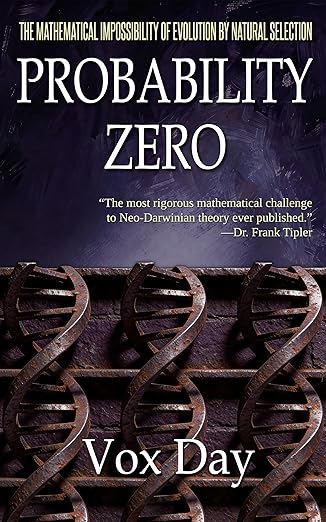
(Probability Zero, Castalia House, 2026.*)
*Day, Vox, Probability Zero: The Mathematical Impossibility of Evolution by Natural Selection, Switzerland: Castalia House, 2026 (Kindle edition).
Vox Day is one of the few defenders of Western Civilization who, while others whined and complained, did something to preserve our heritage. Rather, he’s done many things, including writing and editing a slew of books (SJWs Always Lie, Corporate Cancer, A Throne of Bones, etc.). Your reviewer has read Day, with great appreciation, since 2001 and his earliest days as a columnist at World Net Daily. He assembled the comprehensive taxonomy of the socio-sexual hierarchy (alpha, sigma, gamma, et al). He is the author of MITTENS, the Mathematical Impossibility of The Theory of Evolution by Natural Selection, an empirical demolition of Darwin’s theory of evolution and a core concept in Probability Zero. A Top 40 recording artist, he slings some mean beats and lyrics. Probability Zero is available from Amazon.
If the universe has a language, then its name is probably “math.” Heat rises unless it’s confined to a weightless vacuum. Men act rationally until they don’t. But two plus two always equals four. Math is beautiful and unforgiving. It is the driving force behind Probability Zero. The attendant mathematics absolutely obliterates the random propositions of evolution by natural selection. Professor Frank Tipler (Ph.D., Tulane) notes, on page 6, “Probability Zero represents the most rigorous mathematical challenge to Neo-Darwinian theory ever published.” It is certainly that, though it is, amazingly, more.
If it ever occurred to me, then it occurred rather loosely that evolution is or was just another plank in the misleading, inverted structure of the Enlightenment. Day’s Introduction is a fast summary of the failings of the Enlightenment, a series of supposedly glorious and progressive theories that, when applied in reality, deliver only ruination. The ultimate aim of the Enlightenment, akin to what Professor Alexander Dugin calls the first political theory, (macro) Liberalism, is to whittle away every facet of society, reducing everything down to the individual. Once separated from all that once defined his existence, the individual is then deprived of himself. The role of Darwinian evolution is to subtly deny the hand of God and, thereby, the existence of God. The Almighty is replaced with a shroud of smoke, high and scientific-sounding, but bereft of any substantiation—love and awe superseded by hollow falsehood.
While his argument touches briefly on religion (Christian, Islamic, etc.), Day maintains focus on the theories, words, and examples posited by evolutionists and faux light bringers themselves. He explains the pattern by which all of these dark fairy tales have been exposed over time, coming to rest upon Darwin’s theory, deeming it perhaps the most important of all similar concepts. Applying the pattern, again via a mathematical approach, Day systematically dismantles Darwin. And rather than taking it easy, Day builds a series of “Steel Men” arguments, allowing the broadest discretion in favor of the evolutionists, to make his demolition unassailable. A mathematical dissent against random evolution has existed since at least 1966, although until recently, it lacked the necessary observational proofs. Day completes the puzzle.
He begins with basic definitions and proceeds to explore and counter each and every proposition the selectionists have come up with (parallel fixation, etc.). Using the pre-existing argument that humans and chimpanzees had, at one time, a common ancestor, and using all available parameters, Day asks, on page 23, “…given the total number of generations available and the observed rates at which mutations spread throughout populations, is there enough time for 20 million mutations to have reached fixation in the human lineage?” The answer is a resounding “no.” Evolutionary biologists should have reached the same conclusion, except that, as Day notes, they evidently do not understand basic math and statistical analysis. And as the biologists put it, they don’t even use experimental data in their experiments; scientists do not practice science.
If they did, then they would find, in accordance with MITTENS, that the number of (human from chimps) generations, divided by the required number of generations per mutation, reveals a total number of fixed mutations several orders of magnitude insufficient to support their theory. Kindly running the math for the biologists, Day discovered that the odds against evolution by natural selection are ten raised to the (negative) one hundred seventy-second-millionth power. That staggering number, a statistical absolute zero, is what Day terms a “Darwillion,” a factor 1.72 million times larger than the already astronomical Googol. A common ancestor being thus explained by natural selection is, as Day puts it, page 103, “beyond impossible.”
Day goes much further, proving, among many other things, that in addition to being impossible, at least one of the biologist’s pet conceptions, “drift,” is self-disproving; drift, rather than beneficially mutating a species, would, if true, exterminate the species. (Failure to math might have dire consequences!)
Day then proposes the theory of Intelligent Genetic Manipulation (IGM) (Dr. Tipler labels the new hypothesis the “Gray Day Theory,” after Day and botanist Asa Gray (1810-1888)). As random, undirected natural selection is impossible, any and all detectable genetic modifications must be caused by a directed, programmed plan. IGM does not identify the manipulator, nor does it have to in order to supersede Darwin’s fancies and trickery. From page 212: “The fingerprints of manipulation, which consist of genetic changes that could not have fixed naturally in the available time, look the same regardless of whose fingers happen to have made them.” Day finds this principle consistent with Aristotle’s notion of the Unmoved Mover and Saint Thomas Aquinas’s First Cause of theism. Day has given himself plenty of room to build upon his new theory, and evidently, he is hard at work doing just that. Atheists and Enlightenment mongers will, of course, deny that such intelligence is or was possible. They just won’t hang their objections on any concrete proofs or workable formulas.
Regardless of one’s mathematical abilities—assuming one is not a biologist—please read the book in order to fully understand its devastating, yet straightforward proofs. (Your reviewer’s experience is limited to a “B+” in college calculus, and even I found the going easy and even thrilling.) If one seeks material with which to refute what one’s children are (mis)taught in their schools, even their Christian schools (some of them), then read the book. If one enjoys making a righteous mockery of profane travesty, then please read the book. Probability Zero is the scientific innovation of the year, and possibly, of the century. The probability that it will be useful is infinite.
*Many thanks to Vox Day for writing Probability Zero and for graciously allowing me to use the foregoing quotes and cover image.
17 Saturday Jan 2026
Posted in fiction
≈ Comments Off on BTTA: The Impossible Is Done
Tags
Chris Orcutt has done the impossible. Bodaciously True & Totally True, Episode One, Bad Boy, debuts this coming Tuesday, January 20th! Orcutt posted a brief look at what went into writing this monumental work of literature.
For over ten years, or 3,697 days to be exact, I’ve been working on a novel about teens in the 1980s. The novel eventually became so long (over a million words, and twice the length of War and Peace) that I had to split it into nine books or episodes.
The result, Bodaciously True & Totally Awesome: The Legendary Adventures of Avery “Ace” Craig, An ’80s American Teen Epic, dramatizes the lives of Ace and his friends in a rural-suburban high school setting. (By the way, it’s much better than I’m making it sound; I’m terrible at condensing my million-plus words into book jacket copy.)
I wrote Bodaciously to be a story for and about my generation—Gen X—a generation that has long been unappreciated, marginalized, and misunderstood. I wrote it to give people my age an escape back to a simpler time, a time when all of life was ahead of us and we didn’t have the internet, AI, tracking, and algorithms in our lives. I wrote it to give the younger generations (and future generations) some idea of what it was like to be a teen in the mid-1980s. And I wrote it for readers, not critics—for people who just want an enjoyable book that keeps them reading.
Read the whole thing at Chris’s blog. Then get ready for the ride of the century!
PS: Chris recently sat down for another interview, and it is one of the best of its kind I’ve heard.
09 Friday Jan 2026
Posted in Other Columns
≈ Comments Off on Victory! — The Final (Regular) Column
Tags
Happy 2026, dear and intrepid readers. I drafted this one before Trump decided to prop up the Petrodollar via Venezuela. Or whatever he’s doing. After contemplating some analysis, I’ve decided against it. Rather, this special column merely represents my official proclamation of what has already essentially come to pass. Per Ecclesiastes 3:1, “All things have their season, and in their times all things pass under heaven.”
Twenty-four years ago, I launched the first of my editorial columns. While my scheduling consistency has been, at times, lacking, I’m calling it a quarter century of word slinging. Ever posting away at my blog, I’ve written in and for a large number of publications and forums, including Reckonin’ and Geopolitika. I’m most grateful to everyone who regularly reads my words, and I hope I have contributed something valuable every once in a while.
Of course, lately, over the past six months or so, the publication basis of those words has become somewhat irregular. What was once a column a week has dwindled to every other week, once a month, or whenever I can get to it. There’s also the matter of some things I write not being that popular or conventional, a condition that sometimes limits syndication.
I’ve read and watched over the past decade-plus as a few of my columnar heroes have reached the same conclusion that I have. Here, I’m thinking about Vox Day, Patrick Buchanan, Andrei Raevsky, and Fred Reed, all imitable writers and thinkers. Each man had his own reason(s) for ending the weekly love note posting. One of them, Day, continues to write, though in a more select and purposeful manner. And that is what I have decided is best for me. I’m also taking a page from the imperial Yankee playbook and declaring, just like the title says, victory! Mission accomplished. Et cetera.
I hereby announce my immediate retirement from regular column writing. I’ve kept waiting and wondering, and I’ve decided the timing is right. Think of it as dialing this habit back a bit. Quite a bit, I suppose. Like those who have come and gone before me, I find that I am aging as we are prone to do. And as Reed put it, no one really changes one’s mind based on what some pontificator writes. Whether the subject is (geo)political, economic, cultural, or something else, I now find that my interests and efforts are better served through other forms of communication. I still regularly post news articles, with or without short commentary, on my Telegram channel. Join me there if you’d like to see which current events I find interesting. In the future, I still intend to submit occasional book reviews, topical essays, and short stories. But the bulk of my attention shall be devoted to writing books, in particular, novels.
Here’s a little preview of what the coming months and years may hold. Before too long, Tom Ironsides will ride again in AURELIUS, a hard-charging action novella. Then, scheduling considered, I think the next one will be another romance; I have a finished first draft which, of course, is simmering before publication. It is a modern Southern love story, and it includes a book within a book, one that should excite all. About eight more novels and short story collections are under development. I also have the seed ideas for one or more nonfiction books. All in due time, my friends.
All good things must come to an end. Or, rather, in cases like mine, good things must evolve into better things. Thank you, dear readers, for being a large part of the fun thus far. And I invite you to join me as the stories continue!
Signing off for the time being, and only for the time being, affectionately and sincerely, I remain,
Yours truly,
Perrin Lovett
January 2026
Deo vindice!
07 Wednesday Jan 2026
Posted in News and Notes
≈ Comments Off on Merry Christmas Once Again
Merry Christmas to my Russian and assorted Orthodox friends!
Once again, please enjoy the 2025-26 Christmas story.
05 Monday Jan 2026
Posted in Legal/Political Columns
≈ Comments Off on Petrodollar 2.0?
Tags
Over the weekend, I remarked to a select email group that the empire’s attack on Venezuela might be a ploy to reinvigorate the dying petrodollar. Two heavyweights appear to agree.
Richard Werner explains the reason for the US attack on Venezuela:
The US coup in Venezuela is also to help the petrodollar system, established by Henry Kissinger’s 1974 deal with Saudi Arabia requiring global oil sales in USD, which creates artificial demand for the currency & funds American hegemony – but which has been in its death throes.
Venezuela, with the world’s largest oil reserves, challenged the $ by selling oil in yuan, euros, rubles, bypassing the $, & building alternative payment channels with China.
Historical precedents include the overthrow of Saddam Hussein in Iraq for switching to euros, Muammar Gaddafi in Libya for proposing a gold-backed dinar. The invasion counters accelerating global de-dollarization led by Russia, China, Iran, and BRICS, as nations shift to non-dollar settlements and alternatives to SWIFT.
But it signals desperation, potentially hastening the petrodollar’s decline as the Global South resents US reliance on military force to maintain currency dominance.
Yeah, this move seems assured to transform BRICS and its financial system into a full-blown military alliance. Which might be fine, if the USA is simply attempting to lock down its hemisphere as per the new Donroe Doctrine. But this interpretation does tend to leave the Middle East hanging, which doesn’t seem likely for the so-called “Trump” administration.
My SG comment: “The Trump has been practically screaming it. If so, then I think the 2.0 system burns out far faster than another 50 years. With more war. Deo vindice.”
01 Thursday Jan 2026
Posted in News and Notes
≈ Comments Off on Happy New Year 2026
Tags
Happy New Year’s, all!
2026 will be, here, another year dedicated primarily (I hope) to novels and fiction. Stay tuned!
Perrin
31 Wednesday Dec 2025
Posted in News and Notes
≈ Comments Off on Talking BODACIOUSLY
My review of Bodaciously True and Totally Awesome, Bad Bad, ran today at Geopolitika.
Also, Chris gave a great interview to Positive Talk Radio:
31 Wednesday Dec 2025
Posted in fiction, News and Notes
≈ Comments Off on 2025: The Year That Was
Tags
Here’s to a happy 2026.
Traffic here at the blog has been much better this year than in the past 5+ years. Thanks! My crowning achievement of 2025 was Judging Athena, my first critically acclaimed novel. Sales haven’t been quite what I wanted, but they’ll get there.
If one reads carefully, then Athena answers a lot of questions. For instance, Laurent Guyenot recently wrote an ode to the “sun god.” Think what one will, but Athena herself explained him and all of pagan legend. Also, Athena deals with family formation; the opposite is unfolding in the US and the EU, as this story explains – VPN and translation may be required. Mine is a better alternative to postmodernity. If you haven’t already, then now’s the time to buy it and check everything out, great story and all!
Next year? Well, the next novel is already with the publisher. And I have two more finished (first/second) draft novels behind that. And then, there’s more.
See you in the new year!
Perrin
26 Friday Dec 2025
Posted in Other Columns
≈ Comments Off on BOOK REVIEW: Bodaciously True & Totally Awesome, Episode I: Bad Boy by Chris Orcutt
Tags
1980s, America, Bad Boy, Bodaciously True and Totally Awesome, book review, Chris Orcutt, fiction, literature, novels
Review by Perrin Lovett
As this review concerns a novel about America during the 1980s, allow me to open with a poignant quote by the great philosopher Meat Loaf: “It was long ago, and it was far away, and it was so much better than it is today.”
I will admit upfront that this review was a splendid challenge to write. The subject book is so wonderfully rich that it is, for a reviewer, a bit of a paradox. It is rich; there is a complexity to it. And yet, it is simultaneously a transcendental simplicity, a force that kindly but commandingly pulls one in and reveals a comprehensive dream reality. The reader has no choice but to understand and enjoy the experience. The book, to a member of America’s Generation X, isn’t a fanciful memory recalled through good storytelling about the 1980s; it IS the 1980s. And the reader is literally there once again. The book is Bodaciously True & Totally Awesome, Episode I: Bad Boy.
(Cover design by Victoria Heath Silk with image by Guiliano Del Meretto.)
*Orcutt, Chris, Bodaciously True & Totally Awesome, Episode I: Bad Boy, New York: Have Pen, Will Travel, 2026.
In July 2025, based on my study of his blog, and upon reading One Hundred Miles from Manhattan and Perpetuating Trouble, I described New York-based American novelist Chris Orcutt as “an artist as dedicated to the craft as may be found anywhere.” Now, only a few months later, that vignette feels like a foolish understatement. Orcutt is a remarkable craftsman, one who inspires awe from even those of us familiar with the laborious process of writing. He pays great and continuous homage to the legends of literature. But there is something distinctively different about Orcutt’s habits, writing, and wisdom. This is an extremely rare case of a literary heir apparent who, in many ways, joins the ranks of the greats. And, even more astonishingly, in other ways, Chris Orcutt leaves them behind. If literature is like a tall tree, with each author a branch, then the greats reach up from the very top in search of sun and air—a high limb for Homer, Ovid, Chaucer, Shakespeare, Pushkin, Gogol, Murakami, et al. As with those rare boughs, Orcutt’s branch has forced its way outward towards the light.
A long-time resident of New York’s Hudson River Valley and a writer for more than three decades, Orcutt has been called “The American Tolstoy.” And now, he is poised to (re)prove or even surpass that lofty moniker via the release of his magnum opus, the American teen epic, Bodaciously True & Totally Awesome. The novel, with over one million thrilling words, will be released in nine segments. Orcutt says: “[A]ll 9 books will be published between January 2026 and November 2027—about one book every twelve weeks. This means that, unlike with series including Bridgerton, Harry Potter, or Game of Thrones, you and other readers won’t have to wait years for the next installment!”
Based on my good fortune of reading the first portion in advance, I suggest readers won’t want to wait a single day between releases. However, be schedules what they may, here is a brief look at the first installment of Bodaciously…, Bad Boy. Per the challenge I mentioned—as wonderful a difficulty as any reader or reviewer could imagine—because there is literally a whole world packed into 386 pages, this review will barely scratch the surface. I also wrote this review before conducting my Interview with Chris Orcutt (please read it), and I have left this examination largely as originally drafted to maintain a fresh initial perspective. With those caveats, here goes!
Bad Boy flows like a roller coaster. A good one. A really, really good one. Let one find a memory of such a ride from the ‘80s, from childhood—The Mindbender, The Cyclone, Space Mountain, [your choice]—and that’s the way this book moves. High speed, ups and downs, hard turns, feelings of both negative and super-positive gravity, uncertainty, and fun, fun, fun until the end. Once it’s over, one will invariably want to ride, or, rather, read it a second time.
If the story itself is akin to a coaster’s track, the necessary component that gets a reader from the beginning to the end, then Orcutt’s very unique writing style is the force that propels the experience. Few people have the mental clarity and technical precision to become good writers. And even good writers sometimes fail to reach beyond proper but mechanical language and solicit the reader’s authentic participation. Orcutt reaches the heart and mind in a way so natural that the reading experience comes off as a genuine extension of one’s self, like seeing one’s own original thoughts in print. The effect is so rare, it is a marvel. Also, Bad Boy is miraculously empowered by a spirit or theory, a palpable presence unexpounded by forced expression.
Suspecting that any individual’s exact retrospective, introspective interpretation might differ from mine, or even Orcutt’s, I leave the discovery of that thoughtful phenomenon to the reader. I will say, however, that throughout so many of the scenes, references, and conjured memories in Bad Boy, I found a deep, reflective philosophy that magnified the whole experience. The young characters feel or sense it too, though, like most teenagers, they don’t know precisely what they’re encountering. In my estimation, they handle it all very well because Orcutt allows them the freedom to do so—yet another interesting facet.
The youthful protagonist, Avery “Ace” Craig, is a James Bond fan. And his adventures kick off with an action sequence to make Ian Fleming proud. More action follows, along with drama, romance, humor, intrigue, more romance, turmoil, thrills, even more romance, and so much more. And it is all bound together in a simply mesmerizing fashion. It’s part hero’s journey. Avery is a hero, one who saves several days. He effortlessly makes friends with and impresses powerful and famous characters. He beats down or outwits adversaries. He’s eccentric, and he can afford it. He’s brilliant, especially when it comes to verbal skills and multiphase operational-tactical thinking. He has the athleticism to put his plans into hard action, and it pays off for him. He’s loyal almost to a fault. And he gets the girl. And the other girl. And a few more girls. And, uh … he’s one of the best ladies’ men in modern literary history! At the end, readers are left with several concurrent cliffhangers, adventurous and potentially dangerous, action-oriented and frantically passionate. All of it will leave the reader predicting, picking sides, hoping, fearing, laughing, and holding on tight. A word of warning: the wait for Episode II: True Blue, as short as it might be, will probably be a little agonizing.
Bad Boy is riddled with numerous references to the better elements of our generational past. Orcutt does something remarkable with those elements, a matter of living incorporation. One such instance happens off the bat in chapter one. I’m not going to give away the sequence, although I really want to! But what Orcutt does is take a cultural reference from the ‘80s and define it by using it as a comparative example that both illustratively describes the reference (Heck! It’s Princess Leia from The Empire Strikes Back!) and seamlessly furthers the life and depth of Avery’s world. I keep going back to the scene and a few like it and wondering. Looking around literature, I tried to remember another writer who does something similar. Think of, if one will, Bram Stoker’s inclusion of then-cutting-edge technology references—all of them true to the 1890s, by the way—in Dracula, and that’s kind of it. Or not really. Stoker’s examples, nifty as they are, feel a little mechanical by comparison. Orcutt’s technique is uncanny.
Orcutt makes another series of references in a way rather unusual for most fiction; he uses footnotes. These roll right along with the text, and readers will naturally follow and enjoy them as they occur. They serve a few purposes, namely acting as deeper reminders for those of us sporting some gray hairs, and as novel descriptions of some things perhaps previously unknown to younger readers. They work brilliantly! They capture the cool factor of Tolkien’s use of footnotes in The Lord of the Rings—and that is saying something!
Among the many shining lights in Bad Boy, one that clearly illuminates characters and weaves them tightly together, is Orcutt’s keen command of and fluent usage of multiple layers of human psychology, especially in the case of the resident teenage characters, the dimensions of the sociosexual hierarchy. The novel is a deep journey into the world of the young adult, with many stops at all of the accompanying nuances, those revolving around young men and women in particular. Mine, of course, was a male perusal and reminiscence. However, as I read, I sensed a repeated lure that would capture a woman’s interest. It is a coming-of-age story, far better, far grander, and more true than any of the very best of the genre movies from the period. (I know of exactly zero books concerning the same or, rather, zero worth considering by way of analogy.) Avery is, as he acknowledges, as readers will surmise, as famous older dominant characters accept and appreciate, and, most importantly, as girls recognize, an “alpha.” Yet he is just stepping into this role, absorbing the thrills, chills, punches, successes, and problems, all while doing his best to understand who he is and what’s happening to him. He is very resourceful and takes the reins more naturally, openly, and excitedly than do the other young characters, certainly any of the other young men. Yet he has correlation limitations and few sources of direct assistance or peer mentoring. So it is extremely refreshing that, when least expected, he reaches out for a little Supreme guidance. It is not stated, but the boy knows, per 1 Corinthians 13:11: “When I was a child, I spoke as a child, I understood as a child, I thought as a child. But, when I became a man, I put away the things of a child.” In Bad Boy, and he can be one, Avery is just getting started in his transition from boy to man. But he does a darned good job of getting off the line!
Such an incredible and meaningful depth is felt on every page that one may come to a slight and occasional rational explanatory impasse, temporarily reading more with the heart than with the brain. As an example, I became increasingly invested in a certain matter, an affair of the heart, throughout chapter fourteen. A short series of little review notations indicates my rapt attention to the theme, bread crumbs across the pages. A little clarity or relief happened on the first page of chapter fifteen, taking the form of a simple two-word sentence. I circled those words and left a smiley face beside them. (And I do not normally mark or notate fiction!) I strongly suggest that readers will experience this kind of reaction repeatedly. It is a genuinely encompassing and immersive emprise, one that will have the mind (and heart) buzzing for some time once the reading stops.
One of my many buzzing reflections, one I thought of during and after reading Bad Boy, is what I’ve termed “poly-temporal thought and emotion,” an astounding contemplative outlook. I was there in the ‘80s. I remember bits of what Orcutt recreates perfectly. And I had the luxury of reliving it again thanks to his efforts. How do I sum this up? There were parts of the story where I essentially thought, “I did that, some of it. Maybe I shouldn’t have done as much as I did … but I wish I’d done a little more.” Avery’s story is a masterful exploration of what was and what sometimes is, all odds or cautions or inputs aside. While reading, I was at once a sixteen-year-old me again, deeply enjoying the ride as young men do, AND I was the older, “wiser” me of today, smiling while thinking the way a father does. I suspect others, from many generations, may have a similar experience: seeing what life was like for us, then, while also reflecting either upon their own youthful lives or on their present perspectives. I struggle to convey the staggering impact of this notion. But I suspect it will cement Orcutt’s book in the echelons of timeless literature, not just as historical fiction, not merely as an epic, but as a large kernel of universal truth and appeal.
Another thing that blew me away once I realized what Orcutt was doing—and this is another element I can’t recall anyone else using, or using so well—is his multiplicitous use of music in Bad Boy. Recall that the pop music of the 1980s helped define the era. As such, and as another component in the tactic of references as world-building and enlivening devices, Orcutt places song titles throughout the book, little mentions that move along and enrich narration and dialogue. But he does something else! It took reading a few of them for me to get it, but somehow, by some genius, he uses song titles, set off properly, in both quotation marks and little music notes, as a striking form of punctuation! Scene settings or boundaries, if one will. This has the most intense effect of bringing the song to mind while highlighting or augmenting whatever situation is at hand. It might have been the song-as-punctuation accompanying those two words I noted that elicited the smiley face. 🎵“Take Good Care of My Heart”🎵 =)
I could go on and on, without ever quoting anything specific, and all I would do is internally trigger more material I’d love to cover. I cannot accurately estimate the instances where Bad Boy personally spoke to me in ways large and small. I trust gentle readers of all adult American generations (and many of our friends from afar) will find the novel a similar mental adventure and heartfelt escapade. In short, whether via personal memory or hiraeth, the reader will “be there,” be a part of the story, and want more!
Now, with any book, what matters the most is all the stuff, all the ideas expressed with ink on paper, between the covers. But those covers matter too. Accordingly, I offer a word of praise about the physical construction of Bad Boy. My 6X9-inch paperback is a stern and noble thing of beauty. The cover is sturdy and smooth, the margins are ideally trimmed, the spine is solid, firm but flexible, and rugged enough to endure many openings. The typesetting is attractive, perfectly-spaced and formatted, and easy on even fifty-year-old eyes. The cover design looks like something that would have rested comfortably on the front shelves of a B. Dalton or Borders store back in 1986. The entire package is of an ultra-high quality, coupled with a dashing, becoming appearance. I also happen to have a new hardcover—a magnificent luxury item! The Kindle version, no doubt, promises excellence and electronic ease.
January 2026 rapidly approaches, so kindly keep an eye on both Orcutt’s Upcoming Works Page and his Amazon Author Page. Bad Boy is available for pre-order from Amazon right now, and the wise reader will want to buy a copy and start enjoying the ride. I don’t just recommend this book, I’m mandating it. This outstanding novel is about to prove that, even now, as Night Ranger once reminded us, “You can still rock in America!”
 PERRIN LOVETT
You must be logged in to post a comment.