• About
  • Blog (Ext.)
  • Books
  • Contact
  • Education Resources
  • News Links

PERRIN LOVETT

~ Deo Vindice

PERRIN LOVETT

Tag Archives: book review

Thanks, Walt

03 Sunday Sep 2023

Posted by perrinlovett in Other Columns

≈ Comments Off on Thanks, Walt

Tags

book review, Confiteri, Walt Garlington

Walt Garlington was kind enough to post my review of Eschatological Optimism on his top-tier Confiteri site.

Apophatic Apologetics: A Review of ESCHATOLOGICAL OPTIMISM by Daria “Platonova” Dugina

By Perrin Lovett

I also owe Walt for giving me the heads up the book was coming. Y’all do check out his site, please.

COLUMN: Apophatic Apologetics: A Review of ESCHATOLOGICAL OPTIMISM by Daria “Platonova” Dugina

31 Thursday Aug 2023

Posted by perrinlovett in Other Columns

≈ Comments Off on COLUMN: Apophatic Apologetics: A Review of ESCHATOLOGICAL OPTIMISM by Daria “Platonova” Dugina

Tags

book review, Daria Dugina, Eschatological Optimism

Apophatic Apologetics: A Review of ESCHATOLOGICAL OPTIMISM by Daria “Platonova” Dugina


There are few things more intellectually agreeable than a well-reasoned treatise that forces one to continually think, that offers both reassurance and challenge. If such a work is both inspiring and captivating, then it becomes an even finer rarity. So it is with today’s subject, a proper exposition of the good, the true, and the beautiful: 

Dugina, Daria “Platonova”, Eschatological Optimism. Tucson, Arizona: PRAV Publishing, 2023. 

The book is the posthumously collected essays and lectures of the brilliant Daria (also to some, Darya) Dugina, as masterfully edited by John Stachelski and fluidly translated into English by Jafe Arnold. This review and all page citations are based on the Kindle edition; for reference, I use the pagination rather than positioning provided by my Kindle reader. One may and should order a copy either from PRAV or from Amazon.

Eschatological Optimism is extraordinarily well-structured. Given topics that some might otherwise present with a stuffy, stilted, or disjointed complexity, the innately smooth format instead flows verbally and mentally like a gentle stream. This is a credit to the skills of the editor and, for the English-reading audience, the translator. Yet there is something more remarkable at work, which speaks to the prowess of the author and which is highlighted and magnified by the fact the posited chronicle is a compendium of smaller annals. One encounters a series of repetitions of the title theme and related matters. Plato’s Allegory of the Cave, for example, is mentioned in multiple places. Yet at no time does the recurrence become stale. Rather, the litany has a reinforcing cumulative effect. As such, the presumed editorial joining and rejoining of various matters exposes a deliberate composition to engender delight, awe, and perhaps even envy. This phenomenon speaks most highly of the mind behind the assembled words, of an intellect active, engaged, and engaging. A concentrated will and organization obviously guided all of Dugina’s script, understanding, and reflection. 

The book will be of great interest to Orthodox Christians, Russians, and Neoplatonic thinkers. It will also be of great interest to all other Christians, non-Russian nationals, Aristotelians, and anyone else who enjoys exercising his brain. Along with the thoughtful rendering of its nominal philosophy, Eschatological Optimism allows for subtly divergent, if parallel consideration of the component parts or conclusions of the stated theory by the reader. Pouring through the pages, a wonderful idea of complementary synthesis builds in the mind, a congruency. Commodious space is provided for individual intellectual maneuvering; though one need not precisely follow every attestation or predication of the text, one should, in my estimation, be able to reach a pleasingly similar denouement. Your reviewer is, for the sake of disclosure, an eschatological optimist. All Christians should be as well, for we know and trust that even as our plodding way may be rough, our ultimate destination and salvation are assured. For almost every interested party, there is something to be learned from Dugina’s book. She forced me to remember things forgotten, consider things in new ways, and to consider entirely new concepts. She has opened a wide and well-lit door. She did so, admittedly, from a distinctly and naturally Russian perspective and the very different (from the “ordinary”) outlook of the philosopher. Regardless of disposition, all of the types of readers I just noted should feel or foster towards each other a kind of camaraderie and respect as each approaches that door. It leads to something and somewhere rewarding.

“Eschatology,” of course, concerns the final end of the world, and for Christians, the Second Coming. “Optimism” is a favorable perspective. Together, as Dugina explains on page 34, the combined terminology is “rather dangerous and complex.” It’s also rather positive, informative, and even enchanting. Two approaches to the philosophy are delineated along with the defined assertion that the eschatological optimist, while accepting that terminal change in the world is imminent, nonetheless soldiers on by consciously and purposely living. On page 54, Dugina provides perhaps a clearer and more actionable definition: 

…eschatological optimism is the consciousness and recognition that the material world, the given world which we presently take to be pure reality, is illusory: it is an illusion that is about to dissipate and end. We are extremely, sharply conscious of its finitude. But, at the same time, we maintain a certain optimism; we do not put up with it, we talk about the need to overcome it.

A dialectical Christian may or may not hone in on the illusory aspect. For my part, I hope he does, wrestling with the notion of being in but not of the illusion. If I failed to mention there is great thrill and fun in the reading, then know that there is. The wallop is far-ranging, as one will find numerous examples from history, theology, and literature. For instance, like the author, I still ponder the questioned optimistic potential of Edgar Allen Poe. Was the raven’s perch of choice supposed to suggest to us something of deeper ancient character?!

In many ways, Eschatological Optimism is a grand refresher for those who previously studied Plato (and other classical philosophers). If one is not well-acquainted with Greek thought, then it is a marvelous introduction. Platonism is well-explicated across the course of some twenty-five centuries and from various points of view and understanding. The reader will be reminded of the linkage and harmony across socio-theological realms regarding ontology, hierarchy, and more. Dugina covers many subtopics very well, a list too multitudinous to recount here. I touch only upon a few of many interesting points.

Apophatic theology, intricately bound to Orthodox tradition and general Christian thought, lies at the heart of eschatological optimism. As opposed to, or rather, in addition to, direct cataphatic orientation towards God, the apophatic is a path to comprehension (of the ultimately incomprehensible) via negation or indirect appreciation — trusting that which cannot be seen clearly in this world. It is reasoned yet mystical faith, not “blind” as it is guided by a form of structured logic. Beyond Eastern Orthodoxy, the apophatic has been part of Catholic doctrine since the Thirteenth Century, as embraced and expressed by Saint Thomas Aquinas, who was deeply influenced by Areopagitic thought. The root of (apophatic) Christian Platonism — see page 301 — comes from the fusion of Greek philosophy with Christian Patristic tradition forged by Dionysius the Areopagite. That coalescence of religious and Platonic thought is expounded thoroughly and even poetically.

Given the current state of the corporeal world, the same as it ever was, some of Dugina’s attention turns to the unpleasant aspects of human existence since the expulsion from Eden. She writes, correctly, on page 67, “Evil is easy to find and easy to see.” Much energy and time would be saved if materialists would acknowledge this truth and cease wasting their efforts attempting to explain evil as merely “bad” and if they would limit their tangible reactions to what are primarily spiritual concerns, even those, especially those that intrude into our illusory “real” world. War is presented as a necessary righteous rebellion against the false order of the world, a conflict of what is “below” against God and His order above. In and around that context, and among other timely, cogent observations, Dugina correctly calls out the sad misunderstanding by the postmodern West of nature, life, love, war, and peace. Set against the great spiritual conflict that envelops all of us whether we understand it or not, Dugina delivers a call to resistance the likes of which is rarely if ever heard today, a call made so clearly, passionately, and appropriately. From page 102:

In the conditions of the modern world, any stubborn and desperate resistance to this world, any uncompromising struggle against liberalism, globalism, and Satanism, is heroism.

That passage alone should cement the value of Dugina’s book, her theories, and her bold place among the champions of Christian civilization. She goes on to call for cultivating the warrior within. This is the clarion call for our times.

A fascinating discourse occurs concerning the differences between the legitimate feminine principles (of Russia) and the faltering postmodern feminist attitudes of the West. There is such a thing as “Christian Feminism” and I leave to the reader the joys of exploring its place in sane sociosexual relations. In my estimated summary, men and women were literally made for each other, separate but equal, and utterly compatible. In this, not a minor front in our war, we must reclaim the joy that satan and his minions have stolen or attempted to pilfer.

The various fractures of the natural hierarchy between God and man, between man and man, and between man’s sociopolitical entities and himself are examined in keen detail. Ultimately, what Dugina calls for is a return to or continuation of the grand traditions of our past, to the turning of backs to the disorder of the postmodern world. By doing so, she bravely imagines — and I think she is correct, we can (re)ignite the optimist’s spirit. And we may do so in a way both intelligible to us and pleasing to God. Elsewhere, others have commented at length about the combining of the noble pagan Greek thought, as exemplified by Plato, and the just doctrine of Christianity. Dugina’s detailed look into the life and times of Emperor Julian the Apostate, along with the “Justinian” reaction thereto and thereagainst, and our ensuing history, provides a spectacular example of what works, what does not work, what mystifies, and what may or must happen in order to maintain clarity of thinking (the Platonic way) without sacrificing any of the absolute Truth of Christianity. 

Emperor Julian is presented under “Political Platonism.” On page 277, Dugina quotes W. R. Inge regarding the emperor being “a conservative when there was nothing left to preserve.” There is something familiar in those words for today’s Westerner, particularly for today’s American. Those of us in the West have suffered tremendous damage from the faux Enlightenment, which Dugina proportionally dismisses, including libertine calls for nebulous openness and false freedom. As she notes, true light comes only from Jesus Christ. In it, and only in it do we find genuine comfort and cause for optimism.

Herein, I have painted very broadly and just enough to cover the bare corners. Needless to say, I highly recommend Eschatological Optimism. The reader will be delighted, astounded, and … saddened.

Reading through, roughly articulating a mental outline for this review, I resolved to omit any painful mention of Daria Dugina’s tragic and untimely death. That resolve dissipated upon reading the Afterword written by Daria’s mother, Natalia Melentyeva. Noting the broken character of our world, Mrs. Melentyeva spoke of Daria’s courage and spirit, of the kind of mental and spiritual effort necessary to restore our civilization. She candidly answered the terrible question I feared to broach on page 364:

To the question, “Who killed Daria Dugina?”, there is one final and true answer: “the enemy of humankind,” the modern world, the dark spirit waging eternal struggle against the Light, against the Intellect, against the sublime and the noble.

Despite the wicked endeavors of mankind’s truest, darkest enemies, Daria Dugina is (is, not was), as her mother wrote, “the ever-rising star of Russian thought.” A beautiful, optimistic star to help steer our course.

Да благословит и сохранит тебя Господь, Платонова.

Please Stand By

30 Wednesday Aug 2023

Posted by perrinlovett in Other Columns

≈ Comments Off on Please Stand By

Tags

book review, delay

Another book review column is coming, probably tomorrow or Friday. It’s 99% ready, and I am just attending to a few interesting, extraneous things. It’s gonna be good. In the meantime, please enjoy whatever hoax they’re running today! Thanks. P

COLUMN: A Review of SCHOOL FOR GENIUS

09 Wednesday Aug 2023

Posted by perrinlovett in Other Columns

≈ Comments Off on COLUMN: A Review of SCHOOL FOR GENIUS

Tags

book review, education, ETH, SCHOOL FOR GENIUS, Tom Moore

A Review of SCHOOL FOR GENIUS


What’s genius got to do with it?! What did Tina Turner have in common with Boston’s Bunker Hill Memorial Bridge? That’s right! Sensing the impending final chapter of American history approaching, the late, talented, and wise Turner removed herself to Switzerland, settling comfortably in a magnificent chateau just down the lake shore from a school most Americans may not have heard of. And one will literally drive over the engineering legacy of that same school as one heads north on I-93, passing TD’s new Garden, perhaps lamenting the loss of the old Garden, and slowly realizing the Red Tavern up in Methuen has been closed for twenty years.

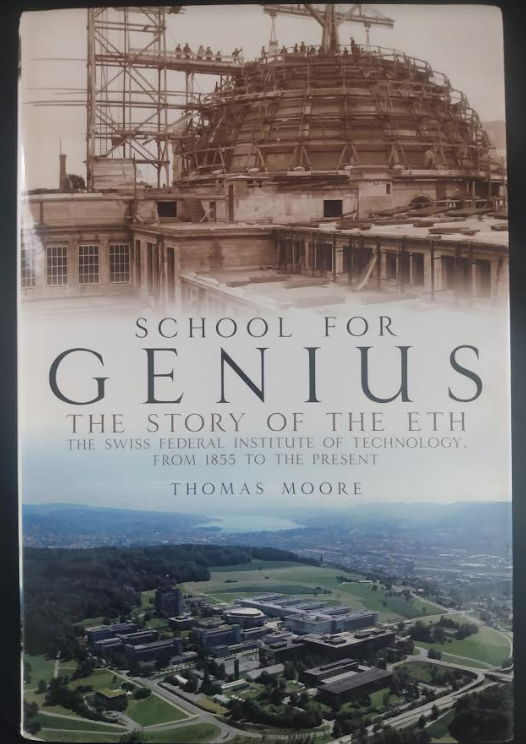
Hello. It’s another book review. Today we briefly examine School For GENIUS: The Story Of The ETH – The Swiss Federal Institute of Technology, from 1855 to the Present, Front Street Press, (2005/6). ETH, short for the Allemand “Eidgenössische Technische Hochschule,” is that famed engineering school in Zurich with which some might not be familiar. It’s also sometimes referred to simply as “the Poly.” It is Switzerland’s and Europe’s preeminent technical school and consistently ranks as one of the world’s top ten universities.

(© Front Street Press. Photo by PL.)

I purchased School for Genius for two very special, personal reasons. First, I am giving the book as a gift to a most important person who may choose to study at ETH in the near future. Second, it is yet another fine work authored by my dear friend, my brother, and our champion of the West, the late, great Thomas G. Moore. That last point alone should sell this review to my readers. 

As many know, Tom and I first met at a school. Many might not know that Tom held three advanced degrees from two European universities. The man understood academia. He knew Europe. Previously, I was vaguely aware of ETH, and he and I had discussed the book and his resident process of researching and writing it. Reading it was nonetheless eye-opening.

As usual, Tom did something utterly fantastic with ETH. He crafted an authoritative history, apology, and exposition that flows and reads like one of his thrilling fictional narratives. It’s not quite like reading an Erik Larson book; one need not constantly remind oneself that Albert Einstein and Carl Jung were real men and not novel characters, but it’s somewhat close. 

The book opens with words of knowledgeable praise from Hon. Faith Whittlesey, a two-term former US Ambassador to Switzerland. Tom begins with a bit of history and culture, wherein he compares the ancient and functional idea of Swiss “diversity” with the doomed and deadly buzzword of late American fame. He then moves into the school’s genesis as it was founded based on the established principles of Paris’s École Polytechnique (another school someone might consider). 

The rise of ETH coincided with, was governed by, and helped steer the rise of the industrial revolution and the modern world. Tom beautifully covers how a decent and intelligent people bridged the transition from a rural agrarian culture to an advanced industrialized society while maintaining the best elements of both. Repeated emphasis is given to the stubborn independence and decentralization that has marked the Swiss people and their Cantons for centuries. He also delves as deeply into the copious scientific and academic contributions and achievements the school and its score-plus Nobel laureates have given the world as 270 pages will allow. 

Here I will stop and highly recommend School For Genius. If not for my two privy circumstances, I might not have ever developed an interest in the subject matter. It is, I suppose, a niche study. Yet, if you or someone you know has an interest in educational history, engineering, math, Tom Moore prose, or the continuation of civilization, then do consider adding the book to your reading list. 

As for gifted young American students who might contemplate ETH as their future alma mater, Tom perhaps outdoes even his own general curiosity and kindness. He dedicates a short section towards the end of the book to just those American kids who might follow Mrs. Turner toward Zurich. The requisite standards are high. Therefore, so too should be the intellectual caliber of the potential scholar. If one is qualified, and one decides to pursue this select excellence, then the process is doable. At Tom’s original press time, the annual cost of attending ETH was approximately $950. This year, it is closer to $1,500. That figure applies to all students, domestic and international. Compare that price to the tuition at MIT. Compare Zurich to Boston, and the CH to the US. ETH is oftentimes referred to as the “MIT of Europe.” That moniker might be reversed. 

For general education buffs, Appendix II provides a cursory examination of the general Swiss school system. As one might guess, compared to what passes for schooling in the US, the CH’s approach is, in a word, “better.” In a self-propagating system of merit and advancement, ETH does its part to keep the cycle spinning much like CERN’s ETH-affiliated Large Hadron Collider. The adventuresome American pupil might further assist this grand process. Learn much more in Moore’s School For Genius.

A special note: Based on my outstanding experience, I also highly recommend Booketeria of San Antonio, Texas as a used bookstore of great worth. If you order School For Genius or any other preowned book from Amazon, do look for them as a source. At their website, they maintain an independent catalog of titles. For the ridiculously low price I paid for my copy, what was delivered bordered on the unbelievable. My mint condition book arrived early and double wrapped like a Christmas present. I sincerely thank these good people for their extreme dedication to quality and service.

Up there in Heaven, I once again thank you, mon frère. Really miss you.

Deo vindice!

Tom Ironsides is a New Hero

20 Saturday May 2023

Posted by perrinlovett in fiction

≈ Comments Off on Tom Ironsides is a New Hero

Tags

book review, The Substitute

Don’t take my word for it. Another new review came in for THE SUBSTITUTE. Says the lovely, intelligent Lynne Neal:

New hero!

Tom Ironsides is a new hero…a man’s man…politically-incorrect…highly intelligent…multi-talented.

As he takes on the failed public school system, the reader lives through a school year with him, his family, his romantic escapades, and winds up cheering him on as Tom implements his ideas for a completely different type of education, built upon classical studies.

Flashbacks to Tom’s time in service to the empire provide more excitement and inspiration from our hero.

Excellent novel. MOST enjoyable! I’m ready for the follow-up!

This may be the best, most succinct summary of the novel yet. Many thanks to Lynne! And don’t just take her word for it. Snag a copy yourself (or, better yet, 10).

COLUMN: Hummingbirds for Hedgehogs, Cats for Mice: General Commentary AND a Review of LA POUDRE AUX YEUX by Justine Reix

10 Wednesday May 2023

Posted by perrinlovett in Other Columns

≈ Comments Off on COLUMN: Hummingbirds for Hedgehogs, Cats for Mice: General Commentary AND a Review of LA POUDRE AUX YEUX by Justine Reix

Tags

book review, ecology, France, government, Justine Reix, La Poudre Aux Yeux

Hummingbirds for Hedgehogs, Cats for Mice: General Commentary AND a Review of LA POUDRE AUX YEUX by Justine Reix


Late last week, I learned that SBU stormtroopers had arrested Gonzalo Lira again in Kharkov. He stands accused of, much like Julian Assange and Edward Snowden, telling the truth. Here’s praying for the best for him, his family, and his friends. I suppose emailing Tony Blinken the suggestion Lira is really a lesbian basketball druggie will not help as, of course, he and all other honest men can expect zero assistance from the imperial Yankee government. Today’s book review deals with government incompetence, dishonesty, and callous disregard – getting there in just a moment. Just the other week, all three characteristics were on full display when Joe Wilson (R – South Israelina) dropped House Res. 322, which might as well be known as the “Hey! While We’re Being Totally Wicked And Stupid, Let’s Declare (Unwinnable) War On Russia Act Of 2023”. Don’t worry, you, your children, and your grandchildren will pick up the potential tab for that.

Also, not too long ago, I learned of a terrible misdefinition of the “Sigma Male” of Socio-Sexual Hierarchy (SSH) fame. Many a right-winger, including the author of the original taxonomy, were amused at the reporting on the subject by one writer at VICE. She got it wrong, obviously, but I’m not entirely certain it was all her fault. Many illegitimate sources have out-of-the-blue claimed expertise in all things SSH. It may be a case of her not looking deeply enough, instead becoming satisfied by what she saw blathered all over creation (and TikTok). There was also the subtle feeling of Gekaufte Journalisten at work. Some SSH ideas help the heterosexual male members of the right and are thus anathema to Clown World. Regardless, writers like her get paid to produce content. Given everything, I found it difficult to fault her too hard.

But I did look into her, finding this:

(Multiple Twitter Picture Postin’s).

What a beautiful … book!

It turned out to be not such a bad book either. Here’s my,

Review of La Poudre Aux Yeux: Enquête sur le Ministère de l’Ecologie by Justine Reix, JC Lattès (2022) (US) (FR). 

La Poudre Aux Yeux, (Powder in the Eyes), is the tandem call for better ecological policy, and a discovery that government does not necessarily work as promised. It is not, as of yet, available in English. That may deter the casual non-French reader. However, I am told that multiple digital parties have assembled easy-to-use translation services. So there is hope for the intrepid reader. 

My Amazon review, below, essentially summarizes most of my thoughts on Reix’s book. However, I will first share a few more specific revelations for readers of my blog and, especially, the gangs at Reckonin’ and Abbeville. After all, agrarianism is a major theme for Southern People. It even received titular and topical treatment in Alan Harrelson’s (hey, bub!) doctoral dissertation at MSU, Native to the Soil: Twentieth-Century Agrarian Thought in the Upland South. Agrarianism is inescapably linked to ecology and environment matters. We all have to live somewhere, and most of us would like our somewheres as pristine as possible. Over the past few years, for reasons related to chemtrails, railroad fires, DNA-altering “vaccines”, and more, many on the right have changed their thinking about environmental issues. We all remain at least somewhat suspicious of the government and its (often corporate) owners.

A primary expertise of mine is in spotting and understanding evil trends in political matters, which is very, very easy. This helped markedly in appreciating Reix’s realization that France’s Ministry of Ecology might not do the best job of representing the interests of the French people. For her part, I suppose she is and was an idealistic, liberal young woman who perhaps thought things semi-worked as advertised. I was relieved to see, despite coming around to the harsh truth, she never lost her fire regarding her core concerns. 

However, many of my readers may not know it, but I was briefly, for one class in one college quarter, a student of Eugene Odum, the “father of modern ecology”. The class might have been entirely conducted by a graduate student, and I may have forgotten 97% of what I learned, but there’s still that 3%, right? There’s also the fact that I appreciate a clean environment. Many of the principles of modern “climate change” ecology I not only disagree with but know to be disproven, observably and mathematically. Reix covers some of that, but innocently and not in any raging or pushy fashion. I do agree with her on many of the other matters she discusses. Much of her caution and advice, especially as to what individuals and families can and should do, is sound. The great geostrategic and economic changes of the past year are literally forcing some of her proposals on the world; she called for a lessening of globalization, and that’s what we’re getting. Families in rural Doubs, France, and in rural northern Alabama are already practicing better ways that look suspiciously like traditional ways. 

For the Amazonians, I noted one particular point that I and Reix both found saddening – the fact that many young people are actively foregoing family formation and children out of fear of damaging the planet. There are other factors, economic and cultural at work, but this trend is real. I hope it ends immediately. Our greater ecological risk is damaging ourselves more than or to a higher degree than the Earth. And the only people who should have to fear are the people who have wrecked our fields, streams, towns, schools, economies, DNA, tranquility, sanity, and nations. Kids, that is not you; have no fear. Get out there, be happy, and have a bunch of children!

Also, keep those children out of organized schools and, to the greatest extent possible, out of the dying postmodern culture. While discussing potential corrective ecological approaches, Reix quotes a Léo Cohen, p. 138 (Kindle), on a similar entangled subject: “Quand on oblige les parents à mettre leurs enfants à l’école dès l’âge de 3 ans , on ne parle pas d’éducation punitive . Il y a une bataille culturelle à mener (When we force parents to put their children in school from the age of 3, we are not talking about punitive education. There’s a cultural battle to be fought)”. I do talk and write about “punitive” education, all the time. The schools in France, as-is, work much better than those in the former United States. However, they still force parents to send their children to be forcibly instructed in whatever the force of the state decrees appropriate. Interestingly, many of Reix’s personal suggestions, such as buying, growing, and living locally, appear most compatible with the concepts of homeschooling and parental (not state) control over children. 

There are other points I could make, though I think those work here. So now, please read my (5-Star) review submitted to Amazon, in French (translation follows):

Colibris pour Hérissons

Soixante ans après SILENT SPRING, nous avons peut-être un digne successeur à Rachel Carson.

Justine Reix a accompli deux exploits remarquables dans LA POUDRE AUX YEUX, plaidant de manière éclairée et sensée pour la gérance de l’environnement, tout en rappelant simultanément au monde la cupidité, l’insouciance et la léthargie systémiques endémiques dans les domaines intimement liés de la politique et de la corporatocratie.

Problèmes environnementaux. Même moi, un Américain de droite, j’ai trouvé un terrain d’entente avec les questions centrales abordées par Reix. Bien que je ne sois pas exactement d’accord avec toutes les politiques et slogans actuels associés à l’écologie moderne, je reconnais que nous avons tous des problèmes. Nous avons également tout intérêt à résoudre ces problèmes afin de pouvoir, selon les mots d’Eugene Odum, favoriser << des relations plus harmonieuses entre l’homme et la nature >>. Nous devons, pouvons et allons le faire. Au milieu de discussions sur de nombreux sujets et stratégies d’amélioration, Reix énumère des solutions véritablement réalisables, en particulier certaines de celles qu’elle oriente vers la prise de décision individuelle.

Calamité ministérielle. Reix doit être félicitée pour ce qui a dû être un processus d’enquête ardu dans la compilation matériel de base. Et elle aurait pu facilement transformer ses découvertes exploratoires en un traité sur n’importe quel ministère ou département de n’importe quel gouvernement de n’importe quelle nation. Tous les gouvernements sont soumis à certaines tendances bureaucratiques, et tous finissent par succomber à un abaissement et à un déplacement des loyautés et des efficacités. Étant donné que mon pays est dans un état aussi mauvais, voire pire que la France, le seul conseil que je pourrais donner est de persévérer.

Méfiez-vous également quelques des experts et des responsables, au sein et en dehors du gouvernement, en particulier ceux qui s’appuient sur un état constant d’alarme rhétorique. Il y a un grand cycle à l’œuvre, et ses différents auteurs changent fréquemment de rôle, résolvant un problème, dont la résolution crée un nouveau problème, qui continue encore et encore. Les préoccupations écologiques sont étroitement liées aux préoccupations économiques, de stabilité sociétale, etc. Ce réseau de soins interconnectés devrait intéresser tout le monde, car la plupart des groupes ont plus en commun qu’ils ne le pensent indépendamment. Reix couvre magistralement cette vérité; à titre d’exemple, j’ai été réconforté par le mention de forger un lien potentiel avec les gilets jaunes.

Une chose m’a causé une inquiétude supplémentaire dans la lecture, une tendance que j’ai lue ailleurs. Reix note et déplore certains hommes et femmes plus jeunes qui décident <<de ne pas faire d’enfants par peur de l’avenir>>. J’encourage tous les membres des jeunes générations en France, aux États-Unis et au-delà, à ne pas céder à la peur et à renoncer ainsi à tout bonheur familial, dont la poursuite n’est pas seulement sous l’ordre de Dieu mais qui procure également une grande joie personnelle. Certaines des propositions simples de Reix, correctement mises en œuvre, devraient encourager plutôt que décourager les familles harmonieuses. Ce n’est pas le chemin le plus facile à parcourir, mais des auteurs comme Justine Reix proposent le début d’une feuille de route décente.

La composition narrative de Reix se lit également très facilement, coulant de manière transparente d’un concept à l’autre. J’ai été entraîné, captivé et ma maîtrise du français, ma deuxième langue, fait un peu défaut. Quoi qu’il en soit, un argument convaincant et convaincant ressort des paroles de Reix. Elle est honnête mais passionnée, audacieuse mais raffinée, sage mais pleine d’esprit. Je note qu’elle a ouvert et fermé son livre avec des analogies allégoriques animales, une touche délicieuse. Elle a une belle voix et un style belletristiques, et j’aimerais la voir se développer davantage, ou, plutôt, la libérer à l’avenir. Quelques feux, humble colibri, ça paye de continuer à brûler !

Une série de messages importants dans un livre merveilleux.

English:

Hummingbirds for Hedgehogs

Sixty years after SILENT SPRING, we may have a worthy successor to Rachel Carson.

Justine Reix accomplished two remarkable feats in LA POUDRE AUX YEUX, making an informed and sensible case for environmental stewardship, while simultaneously reminding the world of the systemic greed, recklessness and lethargy endemic in the intertwined areas of politics and corporatocracy.

Environmental problems. Even I, a right-wing American, have found common ground with the central issues addressed by Reix. While I don’t exactly agree with all of the current policies and slogans associated with modern ecology, I recognize that we all have issues. We also have a vested interest in solving these problems so that we can, in the words of Eugene Odum, promote “more harmonious relations between man and nature”. We must, can and will do it. Amid discussions of many topics and strategies for improvement, Reix lists some truly workable solutions, especially some of those that she steers toward individual decision-making.

Ministerial calamity. Reix is to be commended for what must have been an arduous investigative process in compiling source material. And she could easily have turned her exploratory findings into a treatise on any ministry or department of any government of any nation. All governments are subject to certain bureaucratic tendencies, and all eventually succumb to a lowering and displacement of loyalties and efficiencies. Since my country is in as bad a state, if not worse than France, the only advice I could give is to persevere.

Also beware a few experts and officials, inside and outside government, especially those who rely on a constant state of rhetorical alarm. There is a great cycle at work, and its various authors change roles frequently, solving one problem, the solving of which creates a new problem, which goes on and on. Ecological concerns are closely related to economic concerns, societal stability, etc. This network of interconnected care should be of interest to everyone, as most groups have more in common than they realize independently. Reix masterfully covers this truth; as an example, I was comforted by the mention of forging a potential link with the yellow vests.

One thing caused me additional concern in reading, a trend I’ve read elsewhere. Reix notes and laments some younger men and women who decide “not to have children for fear of the future”. I encourage all members of the younger generations in France, the United States and beyond, not to give in to fear and thus renounce all family happiness, the pursuit of which is not only under the order of God but which also brings great personal joy. Some of Reix’s simple proposals, properly implemented, should encourage rather than discourage harmonious families. It’s not the easiest road to travel, but authors like Justine Reix offer the start of a decent roadmap.

Reix’s narrative composition also reads very easily, flowing seamlessly from concept to concept. I was driven, captivated and my fluency in French, my second language, is a bit lacking. Regardless, a compelling and convincing argument emerges from Reix’s words. She is honest but passionate, bold but refined, demure but witty. I note that she opened and closed her book with allegorical animal analogies, a delightful touch. She has a beautiful belletristic voice and style, and I would love to see her develop it more, or, rather, release it in the future. A few fires, humble hummingbird, it pays to keep burning!

A series of important messages in a wonderful book.

In closing, I gently correct Mademoiselle Reix. Lovely little hummingbird, ignoring the learned wisdom of the TikTok kings, while Bateman may be a Sigma gone maliciously insane, there are two more plausible classificatory explanations. First, if the story of American Psycho was fictitiously “factual”, then he is most likely an Alpha gone maliciously insane. Second, if the tale was a delusional dream, then, to me, it appears more likely than not he is a delusional Omega (possibly a delusional Gamma) gone maliciously, delusionally insane. Nonetheless, thank you for your dedication and spirit clearing away the powder.

COLUMN: A Review of THE CONSTITUTION OF NON-STATE GOVERNMENT: Field Guide to Texas Secession by T.L. Hulsey

03 Wednesday May 2023

Posted by perrinlovett in Legal/Political Columns, Other Columns

≈ Comments Off on COLUMN: A Review of THE CONSTITUTION OF NON-STATE GOVERNMENT: Field Guide to Texas Secession by T.L. Hulsey

Tags

book review, government, sortive democracy, T.L. Hulsey, Texas, The Constitution of Non-State Government

A Review of THE CONSTITUTION OF NON-STATE GOVERNMENT: Field Guide to Texas Secession by T.L. Hulsey


*Note: TL; DR? A concise, Amazon-friendly review resides at the end of the following.

Political science – in the future, the present, and the past. Gubmint. Hello, it’s another book review. Before we get going, I’d once again like to drop an analogous quote that I often attribute to the late, great philosopher, Joe Weider, from a 1980s essay on weight training: “In bodybuilding, everything works, but nothing works for long”. That is, as any student of the iron can relate, true. And so it is with politics and most other public human affairs. As many have noticed over the long centuries, just about any form of political association and governance, regardless of how one feels or thinks about it, can and does work for some duration. But then, just as free isolating the biceps provided a route to growth yesterday, at some point stagnation and even regression sets in. A change is necessary and, generally, inevitable. Many iterations of the cycle of the state have posited; pick one (or three) and observe the patterns.

Evidence circulating in early 2023 suggests that the West, or what the West has allowed itself to become has run its course. The legitimate foundations of Christianity, the Greco-Roman legal traditions, and the heritages of the various European nations are today and for some time, wholly ignored and, in fact, shunned. The allegedly liberating replacement ideology has also fallen flat. Emulating the great, original lie as told in the Garden, every last facet of the Enlightenment has proven a malicious deception. If one seeks both a comprehensive summary of how this process unfolded, trapped, and affected America, AND one wants a highly plausible way forward, then I am happy to report we have a new guide of great worth:

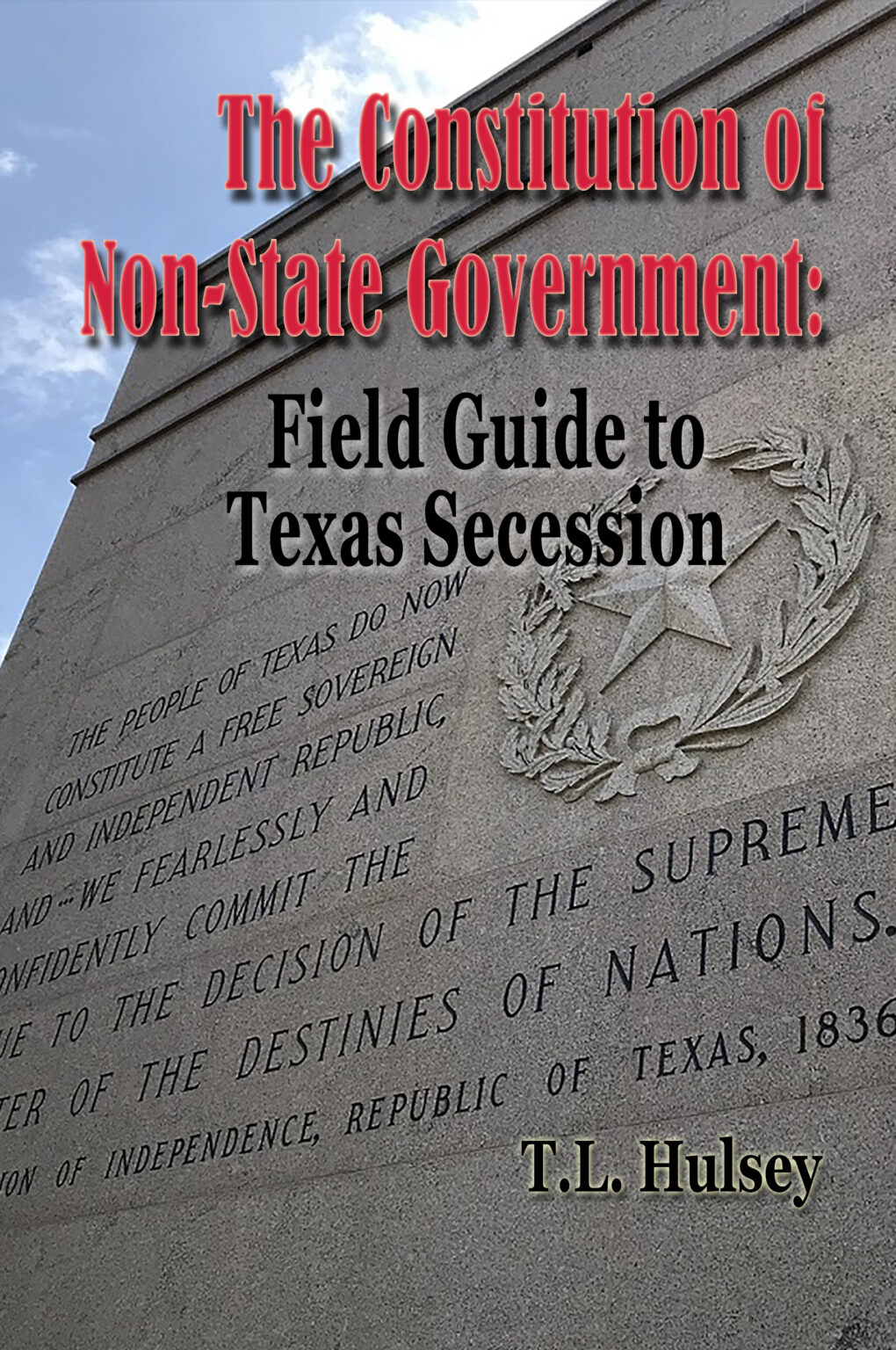
T.L. Hulsey, The Constitution of Non-State Government: Field Guide to Texas Secession, Shotwell (2022) (Shotwell) (Amazon).

© Shotwell / Hulsey.

Preliminary Notes

A few points of initial clarification:

First, I must gently refute the author’s kind, self-deprecating autochthon assessment, from page 15 (Kindle):

Every line is mine alone – someone with no degree whatsoever from any university, whose loftiest state imprimatur, unique in my entire family, is a high school diploma. Thus the reader will not find in me any argument from authority. I have abundantly referenced others who might be more informed on particular matters, but ultimately the reader must face the harrowing challenge of having to think for himself.

One will certainly be forced to use one’s mind, a challenge and a reward. Hulsey’s authority to present such a challenge may casually defy Max Weber’s trinitarian taxonomy, though I think he leans strongly towards “charismatic” influence, as bolstered by ample subject-matter historicity and implicit, fluid construction of creative ideas. In other words, it is a fully displayed case of Bloom’s logical taxonomy on and of the seventh order. In other other words, Hulsey writes to us in both a thinking and thoughtful fashion. In case one is wondering, that is rare. Who needs lower academic credentials when one has such a book? As I noted in my much shorter Amazon review (below), in The Constitution of Non-State Government, Hulsey presents “a doctoral-level dissertation”. Here, I will note the book appears to have been partly intended, perhaps subconsciously, for an audience with an average Mensa minimum standard IQ. It is so drafted by someone I suspect of personally being at least a standard deviation north of that already lofty mark. None of this, by the way, should deter the new reader. It is, rather, encouraging evidence of the value of the author’s “harrowing challenge”.

Now, something that temporarily vexed my hard head, and which doesn’t really comport with the modern/post-modern notions of political science: what is a “Non-State Government”? These words cut through the neoliberal idiocy of our day. One may have noticed, even if one is unwilling to yet admit the realities, that the era of ideology is over. Hulsey’s is a book that graciously accepts the correct order of man’s nature, with identity first, followed by society or culture, and then, and only then, by politics – with attendant political labels. This book looks beyond the concepts of the modern “state”, an artificial construct, allowed by the laws of physics to work for a time, but, like all constructs of disingenuous modernity, destined to fail. Regardless of what some hold for propositional truth, a nation is no more than a defined group of somehow-related people. They necessarily have to live somewhere, and so the true state or nation is but an expression of their existence, together, and in the corporeal world. Hulsey more than explains the differences between the real and the faux, and the reader will do well to dispense with his preconceived ideas about the who, what, why, and how of government. In brief, what’s proposed is a government – just not the kind we’ve been lied to about all our lives.

Next, Texas. The Lone Star State and Republic is as fine a place as any to examine Hulsey’s ideas. In fact, given its relative uniqueness, it may be the best place to do so. Given the author, it all certainly makes sense. However, just as one shouldn’t remain hung-up on “isms”, one should understand that Hulsey has really novelized a generally applicable solution. His ideas, while based on natural, universal axioms, are largely Western in origin. While the implementation of his plan might not be universally practical, it is universally advisable to consider many of the points made. Polygenesis aside, people, one might have noticed, are different. What works for the European may or may not work as well for the African or the Asian. That said, what is offered is a blueprint, which may be modified as needed or if needed. These are concepts that could effectively serve many populations, if not exactly to the same scope or degree. They are certainly, as expressed, compatible with 21st-century Texans, and probably also with contemporary Carolinians, Germans, Poles, and other Westerners. It really depends on who, precisely, accepts Hulsey’s afore-noted challenge.

One last thing: religious argumentation. In now ancient Anglo-American jurisprudence, there is or was a maxim of constitutional or statutory analysis that held strict assessment of some questioned law or thing, against a founding, “absolute” authority, should be withheld as a “nuclear option” of last resort. For example, if a court is asked to decide whether a new law violates the First Amendment’s prohibition against fettering the press, the wise judge(s) would first see if the law might be confirmed or condemned by some lesser measure, like the concept of being voided via vague language. The armchair lawyer will make of this approach what he will, and he is informed if he realizes it was a rationalized thing of the past, with our existing “state” governments having succumbed to Tully’s admonition, “the more laws, the less justice”. Herein, as he masks his genius, Hulsey also openly states he has avoided religious authority in grounding his otherwise reasoned and logical designs. He succeeds in doing so. Yet, what he conceptualizes is highly harmonized with religious, particularly Christian thought. This is, in my mind’s eye, highly synonymous to Tolkien’s constant downplaying of Christian analogy in his works. One can only reply: “Yes, yes, as you say, professor. It’s not overtly there. It merely suggests itself to the mind and heart repeatedly and honestly”. This reviewer finds the result pleasantly remarkable and further proof of intellectual veracity.

Construction and Style

The Constitution… is divided into two essential parts. There is more through them both, rather than between them, a transitioning nexus that acts more as a bridge than a barrier. The first part deals well and fully with the philosophical nature of man, his attempts at society and government, and a few of the follies of our long history. This is the part that may challenge the casual reader the hardest. If one reads from Kindle, then make use of the defined terminology feature. Otherwise, have ready a sound dictionary. Hulsey uses, correctly, almost every term in our doctrinal vocabulary. In fact, about the only one I missed was “ochlocracy”. He uses, instead, the self-defining synonym “mobocracy” on page 136 (K). 

The second part, which I will examine hereafter semi-concurrent with the first, is an actionable how-to guide for building a new and better society. Over the years, in more than a few columns, this reviewer has given reader assignments regarding preparedness in one area or another. Most of these calls have gone publicly unanswered. Yet, Hulsey has entertained what I previously thought were critical structural issues – and then some. Best of all, his instructions are based on a whole-process reality. The casual reader will find this section more relatable and, hopefully, inspirational.

The transition, as I’m calling it, which flows from cover to cover, is a cogent summary of many historical trends, deeds, and misdeeds that have led us in the United States to our somewhat uncomfortable present. One will get a decent examination of the paradoxes, hypocrisies, double standards, and inexplicable stupidities that have come to define that thing on the Potomac and its relationship with us. 

As for style, Hulsey deploys an authoritative and entertaining methodology that seamlessly blends itself into all concepts throughout the book. In two words, it is “well written”. Like a river, it has a current, understated but strong, that pulls the reader along. Rather than being tempted to overanalyze the copious information, as encountered, one is advised to assume a floating position, head up, and enjoy the educational ride. And, by “copious”, I mean the literal sense of the word. For a shorter-to-average-length book, this one stuffs everything but the proverbial kitchen sink into one package surprisingly commodious and uncluttered. How Hulsey managed that is a bit of a mystery. Just know that it works. And delightfully well.

Philosophy Leading To Action

Herein, I had originally thought I wanted to step-by-step review my assorted notes in order to paint an accurate and lauding portrait. However, once I exported my remarks and highlights, I found I had assembled 22 pages(!) of them. That dog won’t hunt, so, for a better examination, I have condensed a few things. Looky here:

At the end of the day, the reasonable and responsible, the kind and the wise, are after justice, particularly in matters of law, economy, and political construction. I quote myself (and a better mind) from 2013:

An exhaustive examination of natural law was one of the central themes of St. Thomas Aquinas’s great Treatise on Law, part of his larger Summa Theologica.  Expanding upon Plato and Aristotle’s “outside the box” approach, Thomas concludes, with reference assistance of Saint Augustine, that law “which is not just seems to be no law at all.  Hence a law has as much force as it has justice.”  St. Thomas, Treatise on Law, R.J. Henle, S.J., editor, pg. 287, U. Notre Dame Press, 1993.  St. Thomas goes on to say that a civil or earthly law with conflicts with natural law is a perversion rather than a law.  Thus, did Walden and others, claim a basis for civil disobedience to repugnant laws.

Aquinas simplified man’s relationship with God’s determined order: “Divine law is not in conflict with natural law, but it reaches human beings by a different route, revelation.” And, so on to positive, man-made laws. And, with all history as a guide, what “reaches human beings” is, at best, muddled, both by our various mental incapacities and by our, ahem, nature. See any and all attempts by man to govern himself for examples of our natural perversions.

Within his first explanatory segment, Hulsey, via a header, defines exactly what (and to a surprising degree, “why”) he’s interested in:

Only a non-state form of government can avoid totalitarianism, by sublimating destructive envy, diffusing Interest with symbiotic reason, avoiding the deontology/consequentialism dilemma with virtue ethics in a system of sortition, and devolving power to the sovereign people by means of the absolute right of property and the right of secession.

Hulsey, p. 146 (K). 

A mouthful? Yes, but with deep instructive meaning. More on that in a moment.

First, lock up the sacred cows of modernity! Hulsey has come for them. In addition to dismissing the enlightenment modern state as dead, much like the extinct auk (big penguin), he specifically notes the passing of the United States as we knew, remembered, or mythologized it. He is particularly hard on the Fourteenth Amendment and the overall transformation of the old American Republic (before Evil Abe) into the US Empire. The former United States, he boldly, rightly deems it. Let none forget nor neglect the fact the tyrant Lincoln murdered two (modern) super-states. Congratulations, Yankees … you, too, lost.

While quickly but keenly surveying Western culture, economy, and philosophy, Hulsey notes that the roots of all manifestations of such esoteric ideas are not products of the ideas, but of our identities. The roots are ancient, and if history has shown us anything, it is that if those roots are to lead to flowers, there must be a degree of planning involved as to how, theoretically and actually, things work in the real world. Libertarianism is one of the “isms” easily, steadily shown the door. If libertarians, conservatives, liberals, and other ideologists would simply look at the present changing world order, they would see several of Hulsey’s points already in action. China and Russia are two different countries full of different people. Yet they both have adopted a somewhat amalgamated “whole process” approach, as to economics and political structure, that works for them by cobbling in what is proven and excising that which is not. Again, the labels matter less, much less than the substance. 

The “proposition nation” fantasy of false Americanism is slaughtered. Lysander Spooner is in there too. There’s so much more. This little book is a home for vindicated rebels. And for those who do learn from past mistakes and want to move on. Part of this process recognizes three concepts I hold dear, and which should have been used a little more frequently: interposition, nullification, and, of course, secession (p. 142 (K)). 

Back to the heavy heading: Hulsey proposes (and not in any way a novel suggestive sense) a Kleristocracy (note “ww”, p. 295 (K)). That means, and one will have to read along somewhat carefully, a “sortive democracy”. That means, and it all really does flow beautifully concept-to-concept, a well-defined and regulated lottery selection system. Again, silence objections – all justifying groundwork is meticulously built and cited, including copious, irrefutable legal justification. It works, it will, and it has previously. 

Why is it critical? “The political machines of the modern state have institutionalized democratic elections to simultaneously pander to the democratic ideal while narcotizing its realization”. P. 116 (K)(emphasis mine). “VOAT(!)”, everyone practically screams every two to four years. And where, exactly, has all that electoral mania led us? We have been pandered to and narcotized. And worse. As Hulsey noted, channeling John C. Calhoun, the pandering effect brought about a noticeable “tyranny of the majority” which gave way to a lingering illusion truly ruled over by an (evil) oligarchy. The historical truth is the opposite of what all scream these days: “Sortition: the [random, organized selection] appointment of magistrates by lot is thought to be democratical [sic], and the election of them oligarchical”. P. 177(K)(quoting Aristotle). 

If one desires to unwisely argue with THE Philosopher, that is one’s own business. Just know that this, to us, seemingly incomprehensible system has, in fact, worked very, very well for several high societies throughout history. Chief, in this reviewer’s mind, among them was the Venetian Republic, which lasted and, mostly, thrived for 1,100 years! P. 148 (K). 

The way Hulsey breaks down the admittedly complex process of Venetian government is methodical and, to some, I suppose, humorous. As is this meme, appropriated from Vox Day, which, in deeply, slap-the-CONservatives fashion, essentially makes the same point(s):

(SDL, Darkstream Meme Review, UATV, 2023).

That is,

The symbiotic reason of the Venetian republic consisted of self-enforcing aristocratic rules. The republic is usually dated from the election of the first doge in 697 until its conquest by Napoleon in 1797 – 1100 years. Its prosperity attracted people from all over Europe, so that from 1050 to 1650, Venice was one of the five most populous cities in Europe. Daniel J . Smith describes it: Venice had no formal documented constitution [;however, informal] constitutional constraints included the dispersion of power through overlapping committees, complex election procedure, strict term limits, and a ducal oath of office.

Hulsey, P. 167 (K).

Having fun? This book and its viable ideas are fun. To further quote Hulsey, p. 152 (K)(double emphasis mine):

We must now turn to constituting these general axioms in a kleristocracy , or sortive democracy. Ultimately we will breathe life into them as the kleristocratic Republic of Texas.

The reader will quickly move through various defensive supporting positions: from the blatantly modern obvious, back to the genuinely philosophical, to the (comfortable and otherwise) Christian justification. The good, the bad, the ugly, and the positively optimistic.

What is proposed is a form of monarchy, though one “closely watched” and checked against abuses. A system that curbs “elective majoritarianism with the use of sortition – random selection of officeholders”. P. 169. Officeholders each with “skin in the game”. P. 170.

One will admit this or virtually anything else, is preferable to the dead or dying status quo. Hulsey, in his final drafting and revision during 2022, made some astounding predictions regarding the collapse of the postmodern US order. One regarded the letters “TX” and “AU”, which I will leave to the reader to joyously discover – simply put, what he theorized is now happening. He also semi-predicted, by a suppositional ponder, “the crisis that will prompt the final self-destruction of the American Empire”. P. 215. “That fatal crisis, entirely of the Empire’s own making, might be ignited by the replacement of the dollar as the primary world reserve currency…”. Id. Done and dusted, as of April 2023; the triggering event(s) likely being the Empire’s retarded move to kick Russia out of SWIFT and into the Sino-Russia briar patch of MIR-CIPS, coupled with the realization of half the nations of the world that the US is simply not a safe, sane place to leave valuable reserves. Entirely of its own making…

Part Two, “Instantiation”, is perhaps more relatable to the average reader. And in it, one finds the seeds of the new Texan Kleristocracy. The “how-to” really kicks in around page 300, Kindle. Therein, Hulsey deals squarely and comprehensively with things like public education (lower and higher), criminal justice, military matters (to include 21st-century issues like cyber warfare), energy, agriculture, trade, industry, and (gold) money. He puts forth very concrete ideas, many of which the reader may have previously dared to think about, yet without finding anyone to explore them. You’re in luck today!

One matter that I have previously wondered about, that few others appear to have considered at all, is what happens to nuclear weapons and related problematic issues in the inevitable event of the breaking or Balkanization of the (former) United States. Hulsey has the answers. Read this and more of his “future” assessment. Read, too, the extensive history at the end of the book of literally all prior secessionist movements – from all fifty states.

There is a lot to this book, all of it informative, entertaining, and inspiring. Before I close, I include my 5-Star review as previously sent to Amazon. One supposes they will post it according to their schedule, God willing and the AI don’t rise.

An Excellent Guide For A Sovereign, Prosperous Future

As always, the world this century is changing. A realignment has occurred internationally, creating new geopolitical, economic, and moral opportunities. Domestically, the United States, if one is entirely honest, has seen much better days. Texas, ever home to bold, determined men and women, is forging ahead. In early 2023, legislation was proposed in Austin that would create a sovereign gold-backed State currency. When this happens, Texas will have the first sound money between Mexico and Canada in over half a century. This remarkable phenomenon is one of several accurately predicted by T.L. Hulsey in the drafting of his fine book, a year or so before it happened.

The Constitution of Non-State Government is packed with remarkable, inspiring information on many subjects, all woven together into a moving tapestry that lays hold of the reader and does not let go. This book was written by an author with a keen understanding of philosophy, religion, morality, economics, and history. Within the well-designed layout, the presentation is also constructed in essentially two larger or overarching parts. The first is a doctoral-level dissertation about … us, about our nature – our social and political inclinations and interactions as humans – the good, the bad, the, yes, ugly, and the plainly mysterious. The reader will recall some of what has been forgotten while learning entirely new subjects and terminology. Then there comes what this reviewer calls it a transitioning, though it is seamlessly integrated throughout the entire text, a transition from ancient, medieval, and pre-contemporary history, to the present, with a full recounting (and it’s hard to think of something Hulsey left out; how so much was packed into a relatively short book is a riddle!) of the exact methods and episodes that transformed the Founders’ America into what it has become today. Many misconceptions are gently if keenly corrected along the way.

The second great part is an actionable blueprint for a grand, proud, and peaceful new nation, The Republic of Texas. One should please hold any preconceived objections until after one has read through the legally, morally, historically, and mathematically-justified proposals. A new nation formed of ancient wisdom and structure. Grab a hat; the reader is going to Venice! Though the matter is well explained, sua sponte, the interesting title refers to the formation of something other than the kind of “modern” nation-state gifted to the West by the (un)Enlightenment. The plan is to avoid the traps that have rendered many or most modern and post-modern countries archetypal factories of oppression, dissension, chaos, and dystopia. More misconceptions are put to rest, including so many misdirected “-isms” and “-cracies”. It will all make sense upon a full reading – and then some. Perhaps best of all, should one wish to substitute another state or area for “Texas,” then one will find a system that, while perhaps not universally perfect, will provide the starter seeds for a strategy that many, many good and proud peoples will find beneficial. A marvel.

Hulsey also deploys a writing style that is both professorial and deeply affectionate. And, furthermore, attention-getting. There is a palpable sense of both a honed fire and a learned kindness in his words. Those, all of them, one would do well to begin reading now. This is a rare and masterful work. Bravo!

Bravo, indeed. Change is not coming. It is here. Regarding the term “secession”, like it or not, we may well have it forced on us. Thus, it would pay to be prepared in advance. In parting, Hulsey’s work is like a socio-political tree, a mighty oak: The copious philosophical and historical basis acts as the root system; the structure of the new state as the sturdy wood stuff above ground, and; the be-greened and flowered towering majesty? That is up to us, up to you, dear reader. Read The Constitution of Non-State Government: Field Guide to Texas Secession, green up, and flower into the future!

A Review of THE SUBSTITUTE

01 Monday May 2023

Posted by perrinlovett in fiction

≈ Comments Off on A Review of THE SUBSTITUTE

Tags

book review, Clyde Wilson, The Substitute

Dr. Clyde Wilson surprised and flattered me with his assessment of James Bond’s replacement:

A Southern James Bond Goes to School
By Clyde Wilson | May 1, 2023 | Blog

Southern fiction has a new hero—Tom Ironsides makes his appearance in book form in Perrin Lovett’s work The Substitute (Shotwell Publishing, 2023). Sequels and prequels are in the offing.

Ironsides is a sort of James Bond, but a much better man. He is a master of his former craft as a CIA operative, although he has progressively developed a realisation that he had not really been defending his country but rather the worst people in it. Lovett describes his paramilitary adventures vividly and more realistically than Bond fantasies.

Ironsides has seen much of the world and has lived a good deal abroad, including as a college professor in Slovakia. Like Bond, he drinks and likes women (and additionally is a cigar connoisseur ). He is also a Christian, a genuine classical scholar, and feels deeply a duty toward his declining country and people. Ironsides was born and bred in the snows of New Hampshire, but is a happily adopted South Carolinian.

…

Read the whole thing.

Six 5-Stars: An Omnibus Book Review

25 Tuesday Apr 2023

Posted by perrinlovett in News and Notes

≈ Comments Off on Six 5-Stars: An Omnibus Book Review

Tags

Addicott, book review, books, Hudson, Macris, Martin, Martyanov, Morrissy, read

Six 5-Stars: An Omnibus Book Review


While I’d like to take the time to give each of the following works independent consideration, I do not have that time. Instead, I’ve assembled a short list of short reviews of five six (of so many) more recent books I highly recommend. Each part will be accordingly pushed at Amazon. There were five, but I added one more to the end. (Amazon is, for some odd reason, a little slow to add a few of these, but we shall see).

Getting right into it:

Andrei Martyanov, Disintegration (2021)

Almost daily, Mr. Martyanov provides learned, insightful commentary on various geostrategic matters that all thinking Westerners (and others) need to consider. Even if, especially if they do not want to. His book reads a bit like The Decline and Fall of the Roman Empire, if Edward Gibbon had lived during the 5th century, and had Gibbon addressed the process as it unfolded. Post-modern America has essentially rejected everything that once made it excellent. It has shunned Western Civilization itself. In fact, it increasingly shuns any civilized standards. This book keenly examines multiple “whys”, some of which go far beyond Martyanov’s usual military expertise: mindset, morals, economics, and more. The military adventurism, if one is honest, provides perhaps the most highly visible evidence of the decline. Yet, as the author notes, the United States is undeniably gripped by the “historical, psychological, and anthropological centrifugal forces of disintegration”. Before one can hope to salvage something for the future, it is important to understand what has led to the present. This book is a fine summary starting point.

Michael Hudson, …and forgive them their debts (2018)

Were one honest, and one wanted to claim a single book to demonstrate the vampiric effects of mass financial capitalism on a modern or postmodern economy, then this work would be very high on the list of available options. Hudson traces the history of usurious destruction across the ages. Time and again, the same patterns play out, a tale of credit, overextension, misaligned allegiances, corruption, decline, poverty, and immiseration. One thing that will stand out to the Western and/or Christian reader is the repetitive Biblical calls for sound economics and necessary periodic debt forgiveness. No civilization that fails to curtail financial excesses and protect its people therefrom ever lasts. Ours is no exception. But, while the contrary might seem true, it is never too late to do the right thing. In 2023, half the world is already breaking from the broken werewestern system of lies, theft, and enslavement. May the other half follow. This book lights the way.

Alexander Macris, Running On Empty (2022)

At the moment, as I write this review, de-Dollarization is all the rage around the globe. This will have ramifications for all populations and for generations to come. Some will benefit more and sooner than others. Macris’s excellent short book examines a nearly-hidden, or, rather, oft-ignored reason behind the rise, fall, and changes to and behind the Dollar Almighty. The Petrodollar was a first in world history, and perhaps a “worst” so far as economic ideas go. Instituted as a kind of emergency stopgap, it indeed served a temporary purpose for a select few beneficiaries. Their day has now ended, and many will pay the (over)due bill. It’s remarkable that many of the predictions in this book, written but a few months before my review, have already come to pass. And then some. If one wants to rapidly catch up, this is a fine place to start.

Padraig Martin, et al, The Honorable Cause (2023)

By the current, hysterical counter-reactions, one would never know or even suspect that the cause of Southern Nationalism and identity was lost. Mr. Martin and his associates have assembled a wonderful collection of short essays on the very-much-alive-and-needed cause. Herein, one will find others frequently talk about yet seldom deliver with sincerity, clarity, or intelligence – diversity. Read a grand assortment of diversity of thought concerning a People and their rightful place in the modern/post-modern pantheon of nations. While each of these presentations will or might strike the reader differently, they all point in the same, forward direction. As Martin correctly summarizes near the end, “we need to create functional parallel societies”. Given the general decay and collapse around us, that is an imperative notion. The great news for Dixie is that they, we, rather, already have such a society. In time, perhaps sooner than most imagine, we will only need to hone it a bit further and then turn it loose. Even better news: the ideas expressed in The Honorable Cause are not necessarily exclusive to Southerners. It is understood, if unpopular to admit, that many other demographic and geographic groups yearn for independence and sovereign peace and prosperity. I encourage members of all identifiable parties to consider the hopeful and honest expositions herein.

Mary Morrissy, Prosperity Drive (2016)

Humanity. Morrissy has delivered eighteen gripping short stories about, ultimately, the human condition. This book is a little outside of my ordinary reading. As such, beyond the author’s high and deserved reputation (including the esteemed recommendation of a close mutual friend), I had few expectations. Refreshingly, both expectation and reward were forged hard and fast as I plowed through the pages. There is an element, or so I gather, of feminism in the collected works – of what wave I cannot say. Yet, without saying, I was happily pulled along by the current. We people are not always pretty, pleasant, kind, or worthy, and neither are all of the characters contained between these covers. But they are all real; they feel real, recognizable, and memorable. One will find a little of many mortal commonalities herein: the beautiful, the sorrowful, the pitiful, the startling, the regrettable, the disdainful, and the mundane. There is also a recurrent notion of familiarity as the various well-painted actors revolve around the title location. One may not exactly “find” oneself in the text, though one can expect to trace a few memories, perhaps in homage to the old Welsh concept of hiraeth, the longing for a home or place that one may have never even visited before, or which is not so clearly recalled. For instance, for those who venture but a few pages in, my grandfather (not father) kept his mint-conditioned old American car in a garage packed full of lawnmowers of all things (scores of them – a hobby I suppose it was). For a moment, before being shocked, again, by the depths of human nature, I was taken back in time. It’s a fascinating ride, made all the more enjoyable by Morrissy’s flowing, alluring poetic prose. Go for it. Cruise Prosperity Drive.

Jeffrey Addicott, Union Terror (2023)

It’s remarkable to consider, in the early 21st century, that in the middle of the 19th, the only world power that gave substantial material support to Lincoln’s Union was Russia. I sometimes wonder if modern Russians consider the irony that Czar Alexander’s support for nascent US terror helped give rise to the empire that would deliver similar tactics and operations to the American Indian Tribes, Nagasaki’s Immaculate Conception Cathedral, the good people of the Donbass, and many others. Professor Addicott delivers a tour de force about a tragedy that has afflicted populations far and wide beyond the borders of Dixie. I encourage all to carefully consider, among many other points, what Addicott says and implies about the wisdom of Karl von Clausewitz, against whom there really is no intelligent arguing. A must-read for all peoples of goodwill and open minds.

COLUMN: A Review Of RECLAIMING THE CATHOLIC CHURCH by Giuseppe Filotto

15 Wednesday Mar 2023

Posted by perrinlovett in Other Columns

≈ Comments Off on COLUMN: A Review Of RECLAIMING THE CATHOLIC CHURCH by Giuseppe Filotto

Tags

book review, Christianity, Giuseppe Filotto, Reclaiming The Catholic Church

A Review Of RECLAIMING THE CATHOLIC CHURCH by Giuseppe Filotto


The times are interesting, though they are also Blessed. We’ve had more than a few extremely important books published this young century. I herein present a brief look at another one of them.

Giuseppe Filotto, RECLAIMING THE CATHOLIC CHURCH: The True History of Vatican II and the Visible Remnant of the Real Catholic Church now that the Vatican is a Pederast Infested Hive of Impostors, Warrior Monk (2020) (Amazon).

© Giuseppe Filotto.

Lately, I keep hearing variations of one kind or another, from Catholics and others, of the question, “What is going on with the Catholic Church?” Something is happening. Because something happened, something changed. While most people appear capable of sensing something is wrong, it took Reclaiming The Catholic Church to explain what went wrong, how it happened, and who was and is responsible.

Roundabout, via following Vox Day’s writings for years, I learned of Giuseppe Filotto, a very interesting Italian writer, engineer, and philosopher. Like so many of us, he wandered around for some time, only to come home to the Catholic faith (There is great meaning and truth in the play-on-words title of another book, Scott Hahn’s Rome Sweet Home). The good news for us, regarding the esteemed Mr. Filotto, is that when he came home, he brought his energy, his style, and his keen wit with him! I’ve been reading his blog for a while now. I’ve also seen a few of his video presentations. His is a knowledgeable style, measured, rational, and considerate, all with an edge and a fire about it. It is indicative of both stern character and higher intelligence. It works and remains likely that it took someone like Mr. Filotto to research and write such a book – which I recommend in the highest regard. All Catholics should read it along with anyone else who considers himself a Christian of any stripe.

Reclaiming The Catholic Church is 500+ pages of substance. I read it on Kindle where, thanks to the ease of digital operation, the reader may immediately access reams of additional, supporting information from other works, original and meta-analytical. The material presented and discussed is exhaustive. Filotto’s literary approach is as humorous as it is intellectual. I found the entire book, in addition to being almost overly cited, to be extraordinarily well laid out. Beyond mere structure, it naturally developed a smooth “flow” for lack of a better word. This may have been intentional on the author’s part, or else Filotto has an innate storyteller’s ability. It could be both cases. It could be, it most certainly is, that Filotto makes fine use of the Gifts given to him by the Holy Spirit. In exposing the plans of the enemy, he exhibits a fearless resolve sanctioned by Scripture. “Behold, I have given you power to tread upon serpents and scorpions, and upon all the power of the enemy: and nothing shall hurt you.“ Luke 10:19. All that said, here is the beginning of why this book is a critical work of Christian thought.

Filotto’s interspersed side commentary lends an aura of readability and humanity to the work. On page 58 he implores Catholics: “Face reality and deal with it sensibly…”, further noting that “Life is hard.” It is. And most Catholics, most Christians, and most Westerners have been woefully prepared to deal with it. In fact, they have been intentionally counter-prepared for a kind of unreality. The architects of this false existence are the same wicked degenerates that have ruined or attempted to ruin literally everything on planet Earth, especially Christianity.

On page 43, as if channeling Harvey and Laurie Bluedorn, Filotto writes, in explanation of Catholicism and Catholic thought: 

Be Able to Think Rationally and Logically. Although in essence this is already implied in the first two aspects of Catholic thought mentioned above, it is worth noting it separately and individually because training in formal logical thinking is nowadays so rare that you will most likely have to learn how to do it on your own. As well as teach it to your children. 

Rational thinking is a formal process. It is not taught today. Rather, its evil opposite is drilled into the brain. This is one primary reason why no sane, decent adult should ever allow any child near anything called a modern “school.” Another reason has to do with the nature and purpose of the schools – to break the family unit, and the nations, and to ultimately corrupt and undo Christendom. What passes for modern education is only a part of the centuries-long onslaught against Christian civilization, the capping achievement of which was the coup in Rome, a subject well and thoroughly explained in Filotto’s book.

The problems we face go far beyond any Church building or any one group of our assorted peoples. The reader may discover a personal attachment either through acknowledgment of the core principles or just from one of many darkly humorous cultural references. For example, Filotto is about the only author I have ever read who knows this anecdotal story from faded Dixie (unless it also happened elsewhere). From page 50, emphasis mine: “…so many Protestant “Pastors” seem to subscribe to the personal prosperity “gospel” that to all appearances is something like: “Throw your money in the air! What stays in the air you keep, the rest, is for me!” My grandmother used to tell of such a “Pastor” and his washtub collection plate with which he engaged in this exact abomination. I found the recitation charming, even as it serves as an indictment for much of modern Churchianity.

The whole point of Filotto’s book is that Christianity means Catholicism. As he points out, this was universally understood for approximately 1,000 years. The Christian Church is the Catholic Church. Unlike the book, which covers semi-tandem subjects in detail, my review will skip over Protestantism and Orthodoxy. I, for one, have a deep affection for many members of both of these groups. However, the schisms among Christians are not the kind of division Christ desired. Through His plain statement, Jesus Christ came to divide His Followers from the failed, collapsed faith of the Pharisaical Jews and from the general darkness of the fallen world. Upon Saint Peter, Christ founded His Church, upon which, per Matthew 16:18, the gates of hell shall not prevail. Yet, the past 2,000 years have demonstrated time and again that hell continues to crash against the Church, even if in vain. Satan’s attempts, we know, are ultimately futile, though they have had a discernible transient impact. Thus, out of alarm or ignorance, people keep asking the above-referenced question. Every attempt (and temporary minor success) in dividing the Faithful from the Church is the work of the devil.

Filotto concentrates his considerable knowledge and talent on the freemasonic infiltration of the Roman Catholic Church, over time, particularly, during the mid-20th century. The underlying premise of the book is something we are all familiar with. Men are weak. We are prone to stray. Christ had no more Ascended into Heaven than the Nicolaitans immediately began to forge a blasphemous cult of Bacchus atop the Holy foundation of the Church. That attempt was rapidly stamped out by the earliest Church Fathers. Filotto, to his great credit, gives numerous examples of other inspirational men rising to the challenge and defeating the impulses left in us by original sin. He does, indeed, continuously exhibit a Crusader’s spirit, which is rather appropriate for a Christian man. Christ was a fighter! As must be His followers.

The major premise of the book revolves around the seeming fall of the Church, to luciferian infiltration, which culminated with the publications of the Second Vatican Council (“Vatican II”). This matter, this deception, is a personal matter for all Christians. I encourage them to read Filotto’s book! Like my former self, most of them likely do not know and have not read a single word of the Vatican II documents. This is a terrible mistake, but a correctable one.

Today, later-day, fake apologists, the ones who barely contain their luciferian contempt for Christ and His Church, try to rhetorically turn the situation around. They claim that any Catholic who rejects Vatican II is a heretic, a schismatic, or both. Or worse. The truth is the opposite. The uninitiated will be introduced to two words they may have previously heard, but which they likely do not understand: “Sedevacantist,” and “Sedeprivationist.” The “Sedes”. More I leave to the intrepid reader, but Filotto well explains the definitions (and the difference) on page 249:

The only material difference between a Sedeprivationist and a Sedevacantist today is in the fact that a Sedeprivationist is saying that the Seat of Peter is not in fact “empty”, because an impostor is materially filling it, preventing a legitimate Pope from doing so. As well as preventing many nominal Catholics who have been badly catechised (or not catechised at all in many cases) from being able to grasp that the impostor is a fraud. Having an impostor in the Holy See is in fact worse than merely having no one in it at all.

Vatican II provided the schism, by way of heresy. Any Ordained official who does not reject Vatican II, tacitly endorses it. Publicly supporting heresy, legally means those leaders automatically lose their ordination and authority. So, we are left with only a Papal question of emptiness versus usurpation. The Sedes are the only Catholics fully, advisedly holding the devoted line, regardless of how one answers the question.

Along the way, Filotto does a grand job of explaining the real history of Catholicism, sometimes as a refutation of various slanders told against it. “Inquisition!” they shriek. It was real and it was really not what we’ve been told. Chart after chart of cases, with dispositions, is included. They paint a portrait of a just and charitable Church punishing evildoers while concurrently exuding Christ’s Grace, Wisdom, and Kindness. At one point, with a particular set of heinous crimes, I found myself mentally criticizing the author for being too lenient! However, he atones for himself and causes his reader (or caused this one) to stop and consider true justice and equity. I do believe there are miracles within this work! I leave their exact discovery to the joy of the reader.

Chapter Four is dedicated to explaining the precise meaning of each of the sixteen main points of Vatican II. All amount to base heresy, except for one part that is also blasphemous, and another that is, at best, meaningless and unnecessary. The entirety of the new false doctrine has the effect, as Filotto notes, of rendering the whole of the modernist, post-Vatican II Church a fraud, and essentially just another Protestant denomination. The build-up to this ruinous evil is explored in painstaking detail. All points and matters are presented, by necessity, by astute summation. However, all issues discussed are backed by full authority and are conveniently linked (especially through Kindle) for the reader’s instant or delayed perusal. 

Understanding what Vatican II (and its architects) did to the Church, necessarily leads to rejecting Vatican II (and its architects!). What it all means is that the majority of what most consider to be the “Catholic Church” is an intentionally misguided imposter, and all “popes” after Pious XII died in 1958 are imposters. This was and is a great rebellion. These people, the ignorantly misguided and the overtly evil, left the Church. But like all other attempts, this one will fail. The gates have not and will not prevail against us because of the supernatural Protection of Christ. Filotto’s book is beyond important. It is a fun, necessary, and exciting call to the Good, the True, and the Beautiful. We needed the explanation this book provides. An accurate description is all the more needed as evidence of the problem, in an unexplained state, is all around us.

Information has surfaced of late that reinforces the truth of “Sede” Catholicism, as the secret police of the former United States have designated “Radical Traditionalist Catholics” or “RTCs” as domestic terrorists and a threat to globalism and satanism. Guess who qualifies as an RTC? This kind of calculated insult is in reality the highest form of praise, and it is proof of Christ’s wisdom concerning the world hating us as expressed in John 15:18-19. Part of the US DOJ’s [SIC] definition of “RTC” revolves around insistence on the Traditional (pre-Vatican II) Latin Mass ( or “TLM”).

The TLM is under direct assault worldwide by the modernists and their anti-pope(s). If you are Catholic, the odds are that your local Diocese has recently ordered the termination of TLM at all Parishes. Why? The National Catholic Register even ran an opinion piece a few years ago explaining how the Latin Mass became a cult of “toxic tradition”. That is an exemplification of the Church balefully conforming to the ways of the fallen modern world. It is also what is referred to as projection. One need only read most any news story out of Rome these days to discover what a real cult of toxicity looks like. It looks the way it acts. There is a distinct perfidious nature in the modernist Church. Aside from becoming an open, teeming hive of sodomites and pedophiles, it does things like request its own school boys go to Washington, DC to protest against infanticide. By itself, such a call is exactly what the Church should do. It should do much more. However, in American unreality, when stalwart young Catholic men answer the call, only to be met with savagery and slander, the same “Catholic” leadership quickly throws them under the proverbial bus. The 1960s modification of the Church, to fit in with contemporary moral standards and behaviors, has been a success that renders the modernist Church little different in character than the average social justice warrior or neo-Trotskyite. 

Filotto labels Chapter Five “the core and heart” of the book. It is. That is the chapter where is presented the majesty of the Code of Canon Law of 1917 and the resulting Catechism. This is where the differentiation between valid Christianity and the “values” of the new anti-Church becomes manifest. I have suffered through reading a few trollish attacks on the legitimate Church, often misusing the very language of the Code of 1917. Anyone who makes it through Filotto’s fifth chapter and still rejects the eternal wisdom of the pre-masonic Church is either dull-witted or possessed of a dark ulterior motive. For their sake, I sincerely hope it is the former.

One reasonably acquainted with real Church history knows that, sadly, this kind of betrayal and alienation has happened before. For those living in times of Ecclesiastical fissure, the process is understandably discomfiting. Yet, rest assured that history also repeatedly shows that momentary breaks in our orders inevitably give way to renewal. Our quest is to both understand, and then get through the unpleasantries. We should, of course, be thankful at all times, for all things – even, or especially those things that cause us disquiet.

For those attempting to separate the real from the false, a “witch test” is presented on page 244:

It is really easy enough to know if a Cleric is indeed a Catholic or not. Ask him if he rejects everyone and everything that does not reject Vatican II and its antipopes in totality. If they do, then they may well be actual Clerics, if not, they are most certainly not.

It is – all of it – a shocking revelation. But it is true. And one need not fear the truth. We are reminded on page 320 that “Catholics are NOT given to a spirit of fear”. We’re not. And the first step toward doing the brave first thing is to know what is going on. Start by reading Filotto’s book. Think long, hard, and critically about what is explained. Be bold! The next step is finding a valid Catholic church home. This reclamation will proceed one Catholic at a time. All one has to do, all one really can do, is to look, think, and then make a commitment. To begin the process, commit to reading Reclaiming The Catholic Church.

← Older posts
Newer posts →

Perrin Lovett

From Green Altar Books, an imprint of Shotwell Publishing

From Green Altar Books, an imprint of Shotwell Publishing

Perrin Lovett at:

Perrin on Geopolitical Affairs:

Archives

  • May 2026
  • April 2026
  • March 2026
  • February 2026
  • January 2026
  • December 2025
  • November 2025
  • October 2025
  • September 2025
  • August 2025
  • July 2025
  • June 2025
  • May 2025
  • April 2025
  • March 2025
  • February 2025
  • January 2025
  • December 2024
  • November 2024
  • October 2024
  • September 2024
  • August 2024
  • July 2024
  • June 2024
  • May 2024
  • April 2024
  • March 2024
  • February 2024
  • January 2024
  • December 2023
  • November 2023
  • October 2023
  • September 2023
  • August 2023
  • July 2023
  • June 2023
  • May 2023
  • April 2023
  • March 2023
  • February 2023
  • January 2023
  • December 2022
  • November 2022
  • October 2022
  • September 2022
  • August 2022
  • July 2022
  • June 2022
  • May 2022
  • April 2022
  • March 2022
  • February 2022
  • January 2022
  • December 2021
  • November 2021
  • October 2021
  • September 2021
  • August 2021
  • July 2021
  • June 2021
  • May 2021
  • April 2021
  • March 2021
  • February 2021
  • January 2021
  • December 2020
  • November 2020
  • October 2020
  • September 2020
  • August 2020
  • July 2020
  • June 2020
  • May 2020
  • April 2020
  • March 2020
  • February 2020
  • January 2020
  • December 2019
  • November 2019
  • October 2019
  • September 2019
  • August 2019
  • July 2019
  • June 2019
  • May 2019
  • April 2019
  • March 2019
  • February 2019
  • January 2019
  • December 2018
  • November 2018
  • October 2018
  • September 2018
  • August 2018
  • July 2018
  • June 2018
  • May 2018
  • April 2018
  • March 2018
  • February 2018
  • January 2018
  • December 2017
  • November 2017
  • October 2017
  • September 2017
  • August 2017
  • July 2017
  • June 2017
  • May 2017
  • April 2017
  • March 2017
  • February 2017
  • January 2017
  • December 2016
  • November 2016
  • October 2016
  • September 2016
  • August 2016
  • July 2016
  • June 2016
  • May 2016
  • April 2016
  • March 2016
  • February 2016
  • January 2016
  • December 2015
  • November 2015
  • October 2015
  • September 2015
  • August 2015
  • July 2015
  • June 2015
  • May 2015
  • April 2015
  • March 2015
  • February 2015
  • January 2015
  • July 2014
  • June 2014
  • September 2013
  • August 2013
  • July 2013
  • June 2013
  • May 2013
  • April 2013
  • March 2013
  • February 2013
  • June 2012

Prepper Post News Podcast by Freedom Prepper (sadly concluded, but still archived!)

Blog at WordPress.com.

  • Subscribe Subscribed
    • PERRIN LOVETT
    • Join 41 other subscribers
    • Already have a WordPress.com account? Log in now.
    • PERRIN LOVETT
    • Subscribe Subscribed
    • Sign up
    • Log in
    • Report this content
    • View site in Reader
    • Manage subscriptions
    • Collapse this bar

Loading Comments...

You must be logged in to post a comment.