
Ultra Heavy: Tower of Death by Tim Kirby
Review by Perrin Lovett
Tim Kirby has done it again, delivering a solid and amazing sci-fi novel that is at once hyper Russian and turbo Christian. Here follows a brief look at his excellent second installment in the Ultra Heavy series, Tower of Death.
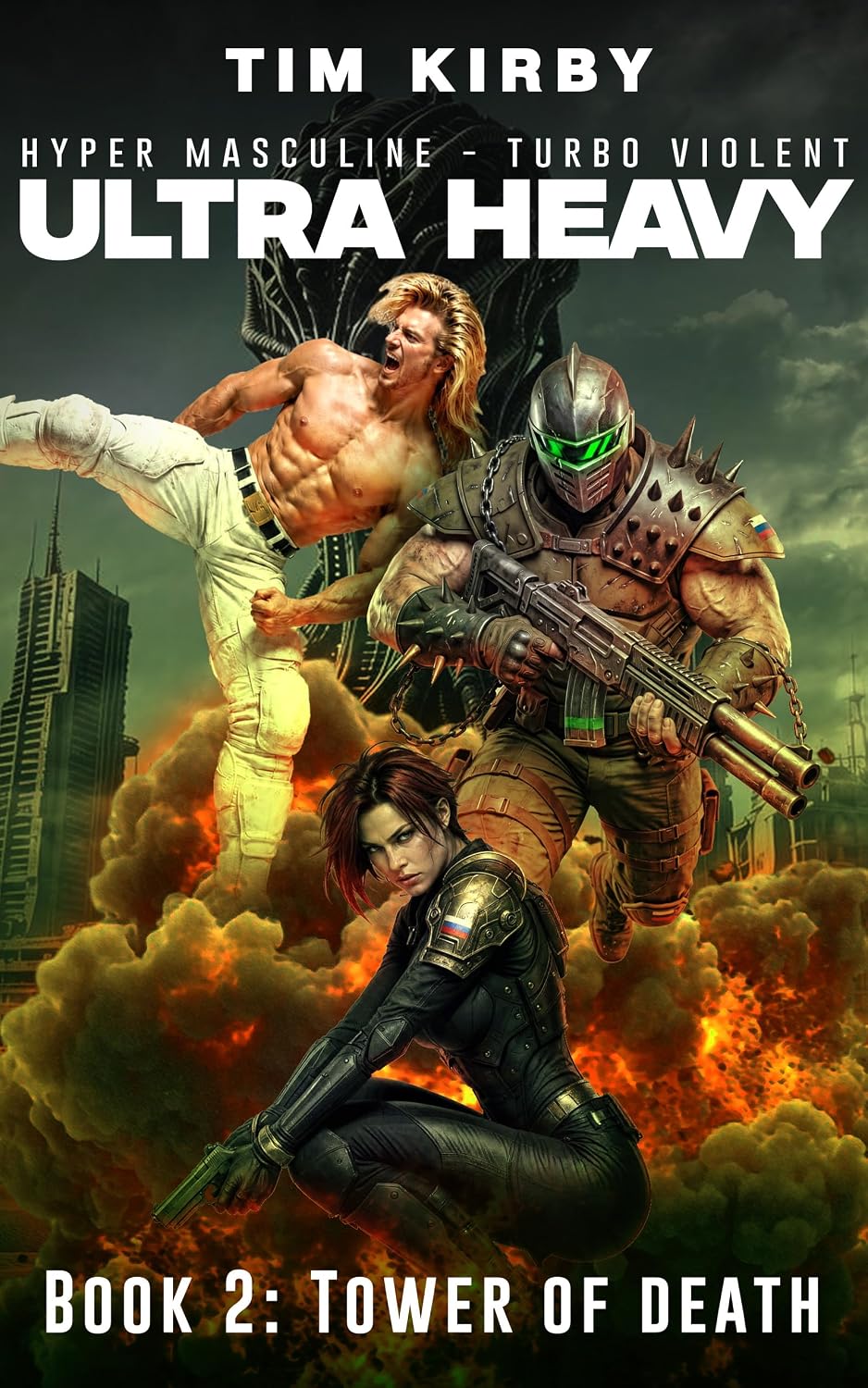
(© Multipolar Press)
Kirby, Tim, Ultra Heavy: Book 2: Tower of Death, Multipolar Press, 2026 (Kindle Ed.).
Tim Kirby lives and works in Russia; he is full of surprises. Please see my review of Ultra Heavy: Book 1: Edge of Empire. Tower of Death is available from Amazon.
Like Edge of Empire, Tower of Death is set within a fictional Russian empire far in the future. This time, the action is on Mars, a heavily populated and long-since terraformed world. All is not well, however, on the Red Planet. Like Theseus into the Labyrinth, a trio of Ultra Heavy warriors climbs into the titular tower, there to do battle with the seemingly unholy. To complicate matters, they are accompanied by an unusual woman and a peculiar new acquaintance. The fate of the planet, and perhaps more, hangs in the balance. Kirby writes very well, within and without the action or sci-fi genre. Realistic action sequences, in your reviewer’s estimation, must be carefully crafted; they have to cover multiple facets, angles, or views quickly and while moving the plot forward. Think about the Mazarbul battle in Tolkien’s The Fellowship of the Rings or the D.C. pool fight in Orcutt’s Bad Boy. Kirby makes it work smoothly like those examples, though he furnishes so much more than the average swashbuckler.
In this book, as in its predecessor, Kirby artfully combines sci-fi, militaria, a hint of mysterious fantasy, and something greater. Tower of Death is simultaneously a straightforward, entertaining action thriller and a high-caliber philosophical treatise tightly interwoven with history and Orthodox Christian principle and belief. Without being preachy and, in fact, being integral to the otherwise superb story, Kirby laces the adventure with shades and odes of reverence, blasphemy, the power of iconography, the power of prayer, and the extant possibility of miracles. The reader will think hard about honor, fraternity, bigotry, romance, repentance and conversion, and ideological questions like someone’s “paradoxical nature of … being both Darwinist and socialist at the same time.” See page 98. To top it all off or, rather, to end it, Tower of Death concludes in a football stadium. For whatever reason, perhaps given the masculine nature of this series, that final smile-inducing scene reminded me of the inscription at Harvard Stadium, which might also fairly summarize Kirby’s book: “Dedicated to the Joy of Manly Contest.”
Manliness, increasingly unknown in much of the fallen West, is part of the famed, even fabled “Russian Spirit.” Throughout literature, one will find bits and pieces of the spirit manifested in works as lighthearted as “The Nose” by Gogol and as deep as And Quiet Flows the Don by Sholokhov. Tower of Death has it; the whole Ultra Heavy series does. Read it today.
 PERRIN LOVETT
You must be logged in to post a comment.