Tags
Pig makes a decent argument for staying uninformed. (And acknowledging the, uh, downgrade in DC).

Patis

24 Friday May 2019
Posted in Other Columns
≈ Comments Off on Pearls’s Blissful Ignorance
Tags
Pig makes a decent argument for staying uninformed. (And acknowledging the, uh, downgrade in DC).
Patis
23 Thursday May 2019
Posted in Other Columns
≈ Comments Off on Restoring the Promise Review Preview
Tags
I have just finished reading Richard Vedder’s Restoring the Promise. It’s good, spot-on in many places. Vedder is an economics professor so his take on academia is geared as such. Many, may charts and graphs, but most of the astoundingly worthwhile variety. He goes well beyond a purely financial analysis and he isn’t afraid of the tougher social issues. He essentially lays out two paths of redemption: the “conservative,” and the radical. Guess which one I favored?
More on this when I have time. There’s going to be a lot more, from me, on education.

Vedder.
22 Wednesday May 2019
Posted in Other Columns
Tags

21 Tuesday May 2019
Posted in Other Columns
≈ Comments Off on Return with Me to Middle Earth — Mere Inkling
Tags
Rob Stroud offers excellent thoughts on a new Tolkien TeeVee series, with or without Peter Jackson. Either way, as with all things “screens,” I think I’m out.

J.R.R. Tolkien’s tales of Middle Earth will once more be displayed in all of their digital radiance when a new series begins in two years. Yes, I said “series,” because it will not be coming to theaters. Instead it will be developed for subscribers to Amazon’s subscription service. Some fans of Tolkien are understandably wary. […]
18 Saturday May 2019
Posted in Other Columns
≈ Comments Off on Vedder Vets the Academy
Today, I began my foray into “Restoring the Promise, Higher Education in America,” by Richard Vedder. I’m only the “praises,” the introduction, and chapter one in so far. And, so far, so good. This is a preliminary review preview, but for the most part, I like what I’m reading.
Sayeth Amazon and the Publisher:
American higher education is increasingly in trouble. Universities are facing an uncertain and unsettling future with free speech suppression, out-of-control Federal student aid programs, soaring administrative costs, and intercollegiate athletics mired in corruption. Restoring the Promise explores these issues and exposes the federal government’s role in contributing to them. With up-to-date discussions of the most recent developments on university campuses, this book is the most comprehensive assessment of universities in recent years.
An initial thought: The forward is a list of quotes by industry “leaders,” heavies in academia, many from government or NGO-ish positions, like Bill Bennett. That’s fine and to be expected. However, many of these folks have been around the business for a long time – all while the problems worsen. Not blaming, just saying. Vedder too, by his admission, is a seven-decade veteran. I’m wondering if those who are certainly in the know, because of their long involvement, also know how to extricate from the current dilemma (if that’s even possible). On the other hand, when a deep insider recognizes systemic failure, that says volumes.
We shall see. More on that, here, later.
Amazon/Independent Institute/Vedder.
PS: And, I mean HERE. Amazon would not run my (Amazon custom) review of A Fatal Mercy, allegedly because it linked back to my review here. There’s also the “Terms” thing about authors not doing reviews, which never made full sense to me so long as one refrains from reviewing one’s own book(s). Anyway: Stars (only and only so long as that’s allowed), there, and review text, here (the CH thing with WP…). I am also wondering if this is part of the SJW/Tech push to shadowban. Promise and Fatal Mercy are both right-of-center. I note no reviews for either, even as I’m prompted to enter at least a star review, immediately upon purchase and without the benefit of reading. Odd.
18 Saturday May 2019
Posted in Other Columns
≈ Comments Off on Trevor Horn “Raps”
Tags
Another musical interlude. Horn, for my money, one of the most underrated pop composers/performers of an era (not sure which), keeps shaking up his MTV launch tune. “Rapping” commences around 4:10 herein:
16 Thursday May 2019
Posted in Other Columns
≈ Comments Off on Another Installment of the Piano Rock Kick
Tags
This wonderful woman not only plays but she sings! Just excellent, I think. Have a listen (watch):
On a related note – Rumor has it that I’ve discovered even more newly added lyrics for “Video Killed the Radio Star,” maybe in a live performance. More on that, perhaps, at a later date. Maybe a TPC “Perrin’s Music Minute?”
16 Thursday May 2019
Posted in Other Columns
≈ Comments Off on Social Media is Terrible for All Generations
Tags
Selena Gomez, whom I’m not familiar with – beyond her rather cute appearance, spoke honestly about all the Insta-Face-Tweeting the kiddos are into.
The singer and actor, who with more than 150 million followers is one of the world’s most popular figures on Instagram, said at a press conference for her new zombie comedy The Dead Don’t Die that it had become “impossible at this point” to make social media platforms safe for users, and called on young people to take a break from social media if they were feeling overwhelmed.
“For my generation specifically, social media has been terrible,” Gomez said. “I understand that it’s amazing to use as a platform but it does scare me when you see how exposed these young girls and boys are. I think it’s dangerous for sure.”
When asked whether as one of the most prominent social media figures she had a responsibility in making platforms safer, the 26-year-old said that it was “impossible to make it safe at this point. I’m grateful I have a platform. I don’t do a lot of pointless pictures. For me, I like to be intentional with it. I see these young girls … I’ll meet them at meet-and-greets, and they’re just devastated by bullying and not having a voice.
“Impossible to make it safe.” I agree. Delete the accounts, kids of all ages. Except for the Boomers, of course. They need the platforms to communicate, nursing home to nursing home, talking ’bout their g-g-generation.
Some other celebrity idiots, present at some film “festival,” babbled on about climate warming and 110-year-old women on Farcebook. Or something. One of them suggested a corporate boycott. I agree; I’m boycotting the film and social media industries.
15 Wednesday May 2019
Posted in Other Columns
A Review of “A Fatal Mercy, The Man Who Lost The Civil War,” by Thomas Moore
The boy had it right in quoting his grandfather: “courage and fortitude are never in vain … no good cause is ever lost because all good causes are lost causes.” Even if he didn’t exactly understand the last part of it, that quote expresses an oft-felt theme, if not a rule, of life and of a higher civilization. It is the theme of his grandfather’s story from 1863 through 1913.
Was Drayton FitzHenry the man who lost the War for Southern Independence? The man himself certainly thought so, perhaps with good reason. Then again, the reader can, likely will, come to understand that there may have been a good reason behind the losing. The story is simple in its complexity, and visa versa.
Moore has really written two books in one. A Fatal Mercy is an in-depth study of the human condition and of Christian morality, Western in origin – Southern by the grace of God. On the one hand, the book is a stirring rendition of The War. In that alone, it is fantastic martial fiction, at once woven by an elegant and commanding imagination and steeped in painstakingly researched history. The story is compelling, riveting.
That is especially high praise from me. Unlike my father, I am not a “Civil” War buff. As a child, the old man dragged me from battlefield to battlefield, constantly uttering information gleaned from his (separate) War library. I certainly gained a respect – and the good manners to at least phrase “Civil” with those all-important quotation marks – but I never developed the … obsession. This book, all through its 727 pages, engendered some of that. This is a work my father would have read – and liked. Those of you who knew him, know that is higher praise.
Perhaps highest of all, is what that aforementioned history and the associated culture, presented alive and burning, generates with regard to what I see as the second grand interpretation, a thoughtful, reasoned, and unapologetic defense of relevant antiquity, classical knowledge, honor, and the grandeur of Western Civilization.
I am a student of classical Greco-Roman tradition. Here, Moore writes as well and true as any: “One reason we study the Classics, apart from the value of the knowledge itself, is for what they may teach us about our times.” With this sentiment, Cicero concurs: “To be ignorant of what occurred before you were born is to remain always a child. For what is the worth of human life, unless it is woven into the life of our ancestors by the records of history?”
Today, most Americans, Southerners included, are ignorant of history, children easily led astray from their ancestral heritage. Moore addresses this issue, with direct examples, slightly dramatized, through the eyes of his protagonist. Drayton’s book-long dilemma revolves around a momentary eye of the storm at Gettysburg. Rather, around the eye of the fish hook, as Shelby Foote put it if we stretch Foote’s geographic definitions to include Little Round Top (and it is, topography-wise, a sub-eye). See: The Civil War, a Narrative, Stars in Their Courses, p. 479, Random House, New York (1963).
Of that terrible battle and its defining outcome, Bruce Catton wrote: “There was no pattern to any of this, except for the undesigned pattern that can always be traced after the event.” Never Call Retreat, Encounter at Gettysburg, p. 186, Doubleday, New York (1965). If this is true – and who doubts Catton – then Drayton’s dilemma is understandable. Drayton lived out the maxim: “Iniuriam facilius facias quam feras – Easier to do a wrong than to endure one.” – Syrus, Maxims. As he refrained from the former, so he endured the latter. Both counts are attributable to – and tribute to – his wisdom and honor.
And, there is an honor, and a wisdom, about Drayton FitzHenry that is rare among literary creations. Odysseus has it, as does Frodo. That wisdom moves beyond the narrative of the War, the horrors of Reconstruction, and into the following age. Along with other, innumerable truths, a lesson and a warning speak directly to us. It finds different ways of expression:
Moore’s articulate, enrapturing characters witness the end of a Republic. We stand at the very possible end of an Empire. Then, in the fable, and now, in our reality, both intelligent free will and resolve to honor Providence properly combine. Sayeth the poet: “Flectere si nequeo superos, Acheronta movebo – If I can’t move Heaven, I’ll raise Hell.” – Virgil, The Aeneid, VII, 312. The men at Gettysburg, of both sides, did exactly that. A Fatal Mercy does the same, does both in fact, recalling the horror and heroism of combat while instilling pride in the genteel, the cultured, the learned, the respecting, and the respectable. It is all of powerful magnitude.
The Author states: “My principal goal was not just to write the best contemporary novel of the War, but also to place my protagonist in an excruciating moral and emotional dilemma and see how he would resolve his inner conflict.” Moore has done that, and greater still. This book is a timeless Classic.
Also: The letters… The burning of the letters, Chapter Seventeen, moved me. The reader will, I trust, understand soon enough.
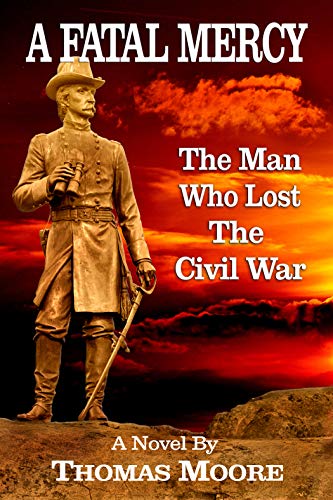
(Picture: Amazon/Green Altar Books – Shotwell/Moore)
A Fatal Mercy, The Man Who Lost The Civil War, Thomas Moore, Green Altar Books, Columbia, SC (2019).
14 Tuesday May 2019
Posted in News and Notes, Other Columns
 PERRIN LOVETT
You must be logged in to post a comment.