
Tags
book review, Christianity, Dr. Aaron Walden, The Formation of the Bible: A Defense for the Deuterocanon
The Formation of the Bible: A Defense for the Deuterocanon by Dr. Aaron Walden
Review by Perrin Lovett
Sixty-six? Or Seventy-three? How many books are in one’s Bible? Why is there a difference? And does it matter? All of these questions and more are resolved in today’s subject book. As He ascended into Heaven, Jesus did not momentarily pause, poke His head through the clouds, hand down a book, and say, “Here’s your Bible.” While divinely inspired, the Christian Scriptures were assembled by men on earth via the great gift of assistance of the Holy Spirit. They have since been read, rearranged, and debated by the Faithful, a process that continues today. Dr. Aaron Walden has given us a guide that, with high authority and handsome presentation, explains that process.
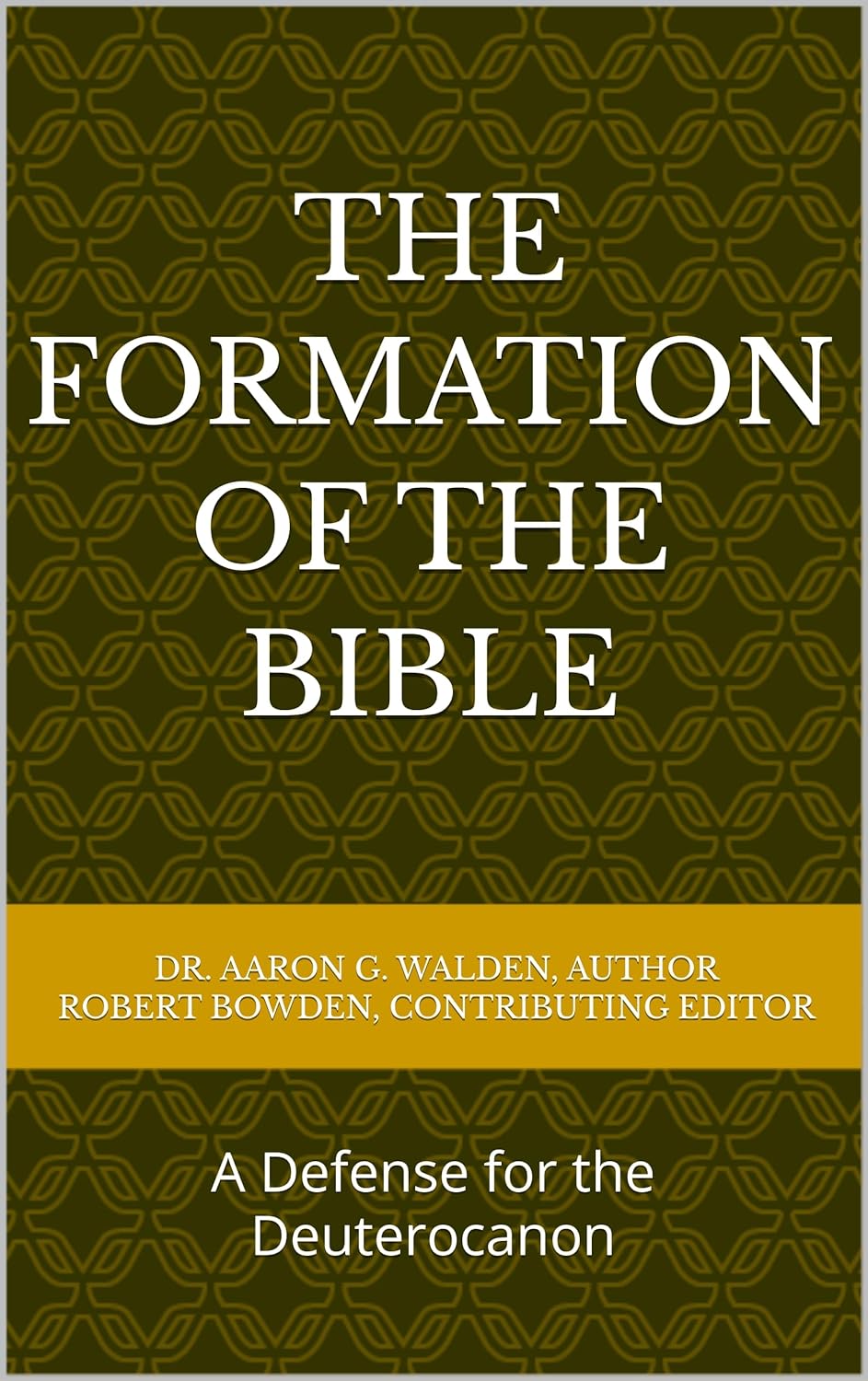
(© Dr. Aaron Walden and Northwood Biblical Studies)
Walden, Dr. Aaron G., The Formation of the Bible: A Defense for the Deuterocanon, Augusta: Northwood Biblical and Canonical Studies, 2026 (with Robert Bowden as Contributing Editor)(Kindle Ed.)
Dr. Aaron Walden, D.Min., “a biblical scholar, teacher, and Catholic content creator,” is a man of many talents and one holding true fidelity to Jesus Christ and His Church. Walden possesses extreme scholarly prowess concerning scriptural matters. And he has an uncanny way of presenting his research in a manner both informative and easy to read, a phenomenon on display in the subject work of this review. This new book is, to your reviewer’s knowledge, Walden’s first published tome, though it is not the first of his Biblical writings I have had the privilege to read. (I remember Ruth, Dr. Walden!) The Formation of the Bible is available at Amazon.
Robert Bowman is an excellent editor. And in his introductory remarks, he appropriately sums up the principles that make The Formation of the Bible work: “This book on the formation of the Bible may be read with confidence, as its historical treatment, theological reasoning, and overall framing stand comfortably within the Church’s received understanding of Scripture and the canon.” The book is a survey, not an argument. And while it is geared towards Western Christianity, and proceeds primarily from a Western history, it is an accurate representation of the title matter. Therefore, for those interested in why certain editions of the Bible contain books that others do not, it is an indispensable resource. Bowman also did a fine job of assuring clarity and continuity of thought and organizing the book in a way that is authoritative and relatable.
Noting the proper placement of the deuterocanonical books into the Bible, in his Preface, Walden is candid about his purpose and intentions: “I wrote this book to serve readers who, like the man I once was, hunger to understand how the Bible came to be yet lacked access to advanced theological libraries or formal academic training. … This book is intended for serious readers of Scripture, both clerical and lay, who seek historical and theological depth presented in plain language.” He then delivers what he promises.
There is a tacit assumption at work that the reader is a pre-existing Christian of some denomination, or is a potential convert actively seeking reference guidance. There is no stern push towards one camp or another. That is refreshing in a Christian world where theological or doctrinal pronouncements are too frequently “my way or the highway.” Walden merely presents what came to be, along with the attendant hows concerning the whats.
Walden begins with necessary definitions and subtle differentiations. He then proceeds to ground the superseding Christian doctrine on the ancient Hebrew Scriptures as observed before the miraculous fact of Christ’s birth. Next, he walks through the fulfilling words, actions, and ways of Jesus and His Apostles, including the fitting in of the deuterocanon. Then he works into the early patristic life within the Great Church. A key passage comes on page 38, concerning the approach of the early Fathers to the deuterocanonical books:
Their approach to Scripture was profoundly ecclesial. The canon was not a private academic puzzle for individuals to grasp, determine, or interpret on their own. It was a matter of lived faith within the communal life of the Church, expressed primarily in liturgy, catechesis, and the continuity of apostolic tradition. The Fathers read the Scriptures in the Church, through the Church, and for the Church. Their frequent and authoritative use of the deuterocanonical books demonstrates that they did not regard these writings as marginal or secondary, whether in a scholastic or merely devotional sense. Instead, they saw them as integral components of the Christian scriptural inheritance, faithfully continuing the apostolic witness received from the generation before them.
Walden’s book is also a pristine defense, explicating without preaching, of the mandatory importance of participatory life within the Church, Christ’s Bride. He deftly harnesses history, debate, linguistic analysis, and more in his reasoning and exegesis. Moving through the Christian centuries, he notes various paths walked here and there by Believers. A wonderful subsection, “The Harmony of Faith and Reason,” is found in Chapter 8. I say “wonderful” because Walden does a beautiful job of presenting and reconciling the somewhat divergent but necessarily integral conditions of the logical and trusting approaches to Christian faith and involvement.
“Harmony…” sets the stage for Walden’s treatment of the Reformation, centered on the Continental takes of Luther and Calvin. He does a fantastic job of explaining why certain edits were made to Protestant Bibles, as well as providing the Catholic response of 1546 at the Council of Trent. He also artfully links the adherence to the doctrine of Sola Scriptura with the fragmentation of Protestantism. Walden notes, on page 79: “The irony was profound. In seeking to restore the Bible’s authority, the Reformers removed themselves from the very tradition through which the Bible had been transmitted for centuries.” This is somewhat similar to Leonid Savin’s brief examination of Protestantism in Ordo Pluriversalis (2020), though, whereas Savin expands his review into political and economic matters, Walden limits his analysis to the divergent traditions of the various Scriptural doctrinal principles.
In his conclusion, Walden speaks, on page 87, to the importance of fidelity to the Scriptures, including the deuterocanonical volumes among them:
The Church did not create Scripture; she received it. Yet she alone possesses the divine commission to guard and interpret it faithfully. The canon did not emerge from private study. Quite the opposite, it was received through public worship. The Scriptures were recognized as inspired because they were prayed, proclaimed, and lived in the life of the Church. The liturgy itself served as the proving ground of inspiration, as it was the place where the faithful encountered the living Word of God and still do today.
The appended materials are a plethora of guiding summations. In them, among other information, the reader will find easy-to-follow canons of the Protestant, Catholic, Orthodox, and even Coptic Christian faiths. Appendix G: “Common Objections to the Catholic Canon and Responses” is worth reading in its own right. The book ends as it begins, with a glossary of definitions and a comprehensive list of citations.
Nothing in Walden’s book is a condemnation of any Christian’s particular route to appreciating the Bible. Rather, it is a synthesis, lovingly exhibited in order to foster better and congenial understanding. One day, by the grace and power of God, all fractured Christian sects will be reunited. But we are under a duty while we wait to live, worship, commune, and fathom as best we are able. Aaron Walden has just helped us out in this paramount endeavor.
The Formation of the Bible is available in paperback and digital formats. It is a needful and wonderful resource that will benefit any and all Christians, along with anyone else who desires more information about the processes that led to the published editions of the Bible today, whether Protestant, Latin Catholic, or Orthodox. I strongly recommend that the reader add it to his library.
 PERRIN LOVETT
You must be logged in to post a comment.