• About
  • Blog (Ext.)
  • Books
  • Contact
  • Education Resources
  • News Links

PERRIN LOVETT

~ Deo Vindice

PERRIN LOVETT

Tag Archives: book review

BOOK REVIEW: THE WATER DANCER by Ta-Nehisi Coates

01 Saturday Nov 2025

Posted by perrinlovett in Other Columns

≈ Comments Off on BOOK REVIEW: THE WATER DANCER by Ta-Nehisi Coates

Tags

book review, The Water Dancer

THE WATER DANCER by Ta-Nehisi Coates

Review by Perrin Lovett

Back in March, Professor Hamid Dabashi wrote an article for Middle East Eye wherein he recommended four books related to Gaza and the plight of the Palestinian people. Of the two I read, The Message (2024) by Ta-Nehisi Coates spoke to me the most. While reading it—and I recommend others read it as well—I was struck by Coates’s writing talent and storytelling ability. Naturally, I wondered if he had ever written a novel. Yes, he did! It is now my pleasure to give you, gentle reader, a very brief glimpse of that novel, The Water Dancer.

(Cover design by Greg Mollica.)

*Coates, Ta-Nehisi, The Water Dance: A Novel, New York: One World (Random House), 2019.

Ta-Nehisi Coates is an extraordinary writer with a grand imagination. A graduate of Howard University, one who considers his alma mater his “Mecca,” he currently serves as Sterling Brown Chair at the school’s Department of Writing and Literature and as Writer-in-Residence. A contributing editor at Vanity Fair, his work has been distributed in a wide array of publications. He is the author of six books. The Water Dancer is available in multiple formats at Amazon. 

Early in my reading, I privately remarked to someone that The Water Dancer was kind of like Alex Haley’s Roots mixed with some spirit of C.S. Lewis’s Chronicles of Narnia. It is like that, kind of, but with many other good and endearing qualities. The book is Southern historical fiction with a unique dose of fantasy. 

Coates’s story is told through the eyes of Hiram “Hi” Walker, a slave on an antebellum Virginia plantation. An excellent—sometimes cursory, sometimes in great depth—look at the various lives of that mid-nineteenth-century society is provided from a vantage point many readers might not expect or be familiar with. Hi repeatedly makes decent and even poetic observations about the races, ranks, and classes of that society, both in and of themselves and as they relate to each other. And because of his rather unusual parentage, Hi’s outlook and interrelations are exceptional to say the least.

His mother, a Black African-American slave, leaves him a mystery and a powerful gift. His White father, the master of the plantation, does something similar, giving Hi a classical education while also tasking him with the burden of playing manager and batman to his White half-brother. A tragedy opens the process of revealing Hi’s hidden ability, the art of “Conduction,” a starkly fantastic power that requires water and memories. 

The book is blessed with repeated human touches and reflections. There is a universality about it, something that reaches beyond the very interesting and compelling story and even past notions of freedom, honor, trepidation, and responsibility. Part of the rare appeal—amid drama, history, adventure, and fantasy—concerns Hi’s romantic prospects. Coates works a deep, meaningful romance into the narrative, one that, like so many in real life, bends with the ups and downs of living. In the end, there is a scene and a sense not unlike Odysseus’s homecoming to Penelope (minus, of course, the competitive Greek violence).

I drifted into the novel as described above. And I found Coates’s debut fiction refreshingly, even alarmingly good. Accordingly, I highly recommend The Water Dancer. 

BOOK REVIEW: THE THORN AND THE CARNATION by Martyr Yahya Al-Sinwar

13 Saturday Sep 2025

Posted by perrinlovett in Other Columns

≈ Comments Off on BOOK REVIEW: THE THORN AND THE CARNATION by Martyr Yahya Al-Sinwar

Tags

book review, Palestine, THE THORN AND THE CARNATION, Yahya Sinwar

THE THORN AND THE CARNATION

by Martyr Yahya Al-Sinwar

Review by Perrin Lovett


This review concerns a novel that I became aware of during the Palestinian Genocide (2023—). It took a while before I found a seemingly trustworthy English translation. As with all Palestine-related books I have read over the past few years, this one commands respect. It dramatically narrates a horrible episode of shameful history and it does so through an incredible and gripping story. 

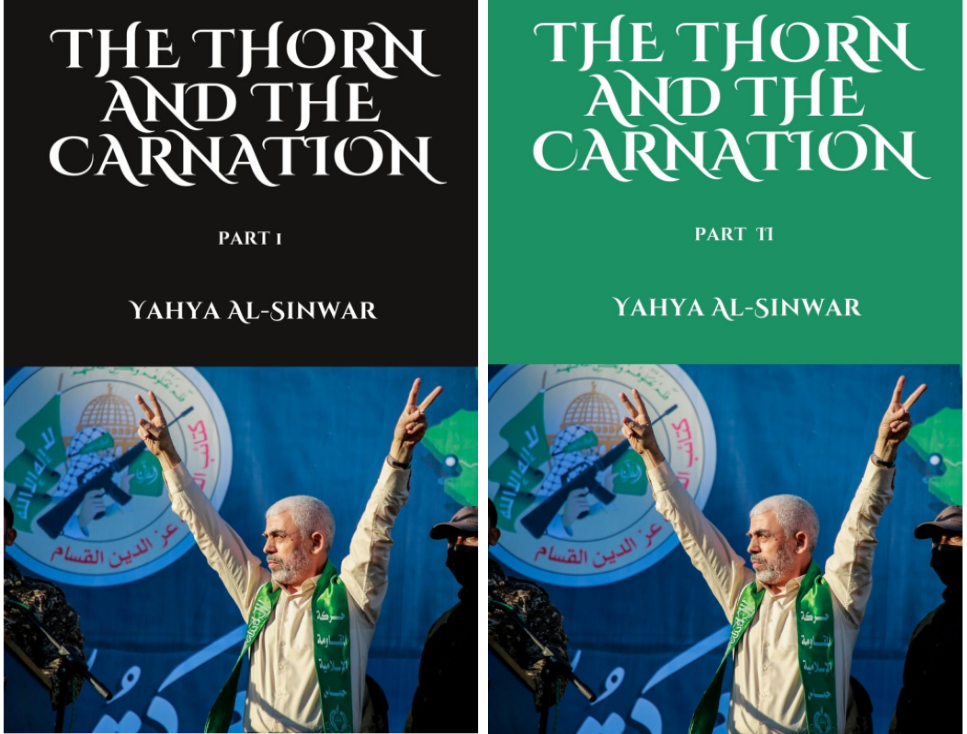
(2024 English translation covers.)

*Sinwar, Yahya, The Thorn and the Carnation, Algiers: TASQ, 2004 (English translation, 2024).

Yahya Sinwar was the fourth leader of the Hamas political party in Palestine and Hamas’s resistance leader in Gaza. During the Palestinian Genocide, he was murdered by “Israeli” Occupation forces on October 16, 2024. Perhaps already mortally wounded, he rested quietly in a chair in a bombed-out apartment. When approached by an Occupation drone, he greeted it with a cold look and a thrown stick. So was born “Sinwar’s Stick,” a neological proverb for sumud defiance against all odds, without surrender even at the end. Sinwar lived the spirit of his posthumous eponymous maxim his entire adult life. He wrote The Thorn and the Carnation while in a Zionist prison. 

The book has been called autobiographical or semi-autobiographical. It has also been described as a collection of thematic stories. I call it reality-informed historical fiction—drama tinged with action, romance, and suspense. Reading it, one may have difficulty separating the author from his characters. In this case, such conflation adds rather than detracts or distracts. Your reviewer also kept comparing the flowing story in the book to the ongoing saga in Palestine. I had a similar experience while reading and reviewing Yarwa Hawari’s The Stone House, another excellent dramatization. These stories are, of course, part of the moving history of West Asia; as even the publisher notes in a Goodreads summary: 

The Thorn and the Carnation serves as a clarion call to comprehend the Palestinian reality—a narrative penned by those who refuse to be silenced, speaking directly to the heart of the global community. It is a narrative of resistance, of profound cultural identity, and an unyielding quest for freedom and justice, echoed in the authentic voices of its characters.

The entire tale is extraordinarily well-written, a feature that shines through translation. And it is compelling both of its own accord and because it was written by an author who provided the authenticity of an expert, a witness, and a participant. The story begins in 1967 during the “Setback” and runs until the turn of the century. The plot is largely narrated through the eyes of Ahmad, a boy who grows into a man as fictional time progresses. Sinwar went to great lengths to build a convincing world for Ahmad, his brother, Mahmoud, the rest of their family, friends, conspirators, enemies, and historical figures. 

So much of the story reminds me of everything I’ve read and learned about Palestinian life: the heroic optimism, dedication to family, faith, and tradition, and all. Sinwar successfully weaves all elements together in a way that showcases local life, the ordinary and the unusual, all while furthering the plot and its theme, resistance. This is summarized in chapter twenty, concerning the evolution of the Palestinian cause during the 1980s: “He envisioned the rebellion turning into a constant state of resistance, becoming the main focus of Palestinian life, with all other aspects, including education, work, and health, adapting to support this central goal until the occupation is defeated.”

Several aspects of this vision, in the book, and as I’ve observed during the literal conflict, jump out at me: there appears to be an unconquerable spirit within Palestinians grounded heavily in their faith, centered in family life, empowered by education, and propelled by constantly doing what has to be done. That theme and spirited dedication should inspire the entire world (even those few Americans still possessed of faith, wits, and muscle). The story ends with another of those localized tragedies that Palestinians perpetually turn into triumphs. Twenty years after that fictional ending, the genuine story of Palestine—Gaza, the West Bank, and beyond—still defies the odds, ever pressing onward towards victory.

I highly recommend and laud The Thorn and the Carnation. It is yet another excellent volume for any Palestine-centric library and a worthy tome of general literature. Please consult Goodreads for obtainment options.

(Original Arabic cover: Al-Shawk wa’l Qurunful (“Thorns and Carnations”), 2004.)

Another Look at the RADICAL LIFE

21 Monday Jul 2025

Posted by perrinlovett in Other Columns

≈ Comments Off on Another Look at the RADICAL LIFE

Tags

book review, Daria Dugina

Professor Dugin reposted my review of his Dasha’s striking little diary compilation. God bless the Dugins! Please read the whole review on Alexander Dugin’s Substack!

Image

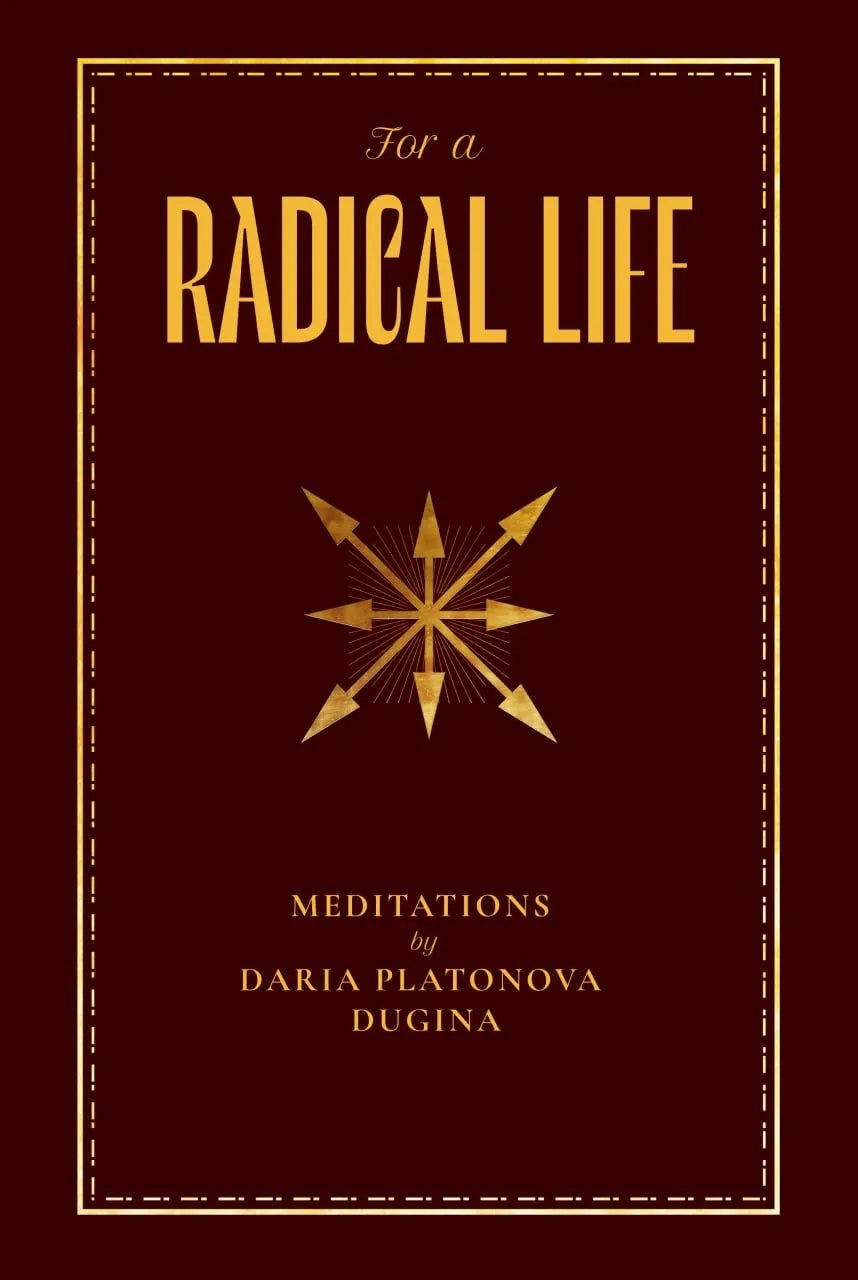
Dugina, Daria, For A Radical Life: Meditations By Daria Platonova Dugina, Tucson: PRAV, 2024. https://pravpublishing.com/product/for-a-radical-life/

Last fall, I had the privilege of reviewing Eschatological Optimism by the late Daria Dugina (1992-2022), a book I learned of thanks to a very good friend. Earlier this year, I was reminded by another great and lovely friend that a second posthumous Dugina book was forthcoming in English from PRAV. One simply cannot have enough literarily in-tune friends in this life. Nor can one get enough of Russia’s brilliant and ever-rising star of intellect and steely determination.

It’s a shorter work, only 70 pages. Yet each and every sentence in it, every word lifts the spirit, touches the heart, and engages the mind. It is a compact gem, expertly translated, compiled, and edited by Jafe Arnold and John Stachelski. I strongly recommend it to anyone interested in life, death, philosophy, and the eternal battle between Divine good and lowly evil. I also suggest the book would make a fine gift for, say, a college student or a young adult. Or for anyone.

…

Walt Garlington Reviews JUDGING ATHENA

19 Saturday Jul 2025

Posted by perrinlovett in Books For Sale, fiction

≈ Comments Off on Walt Garlington Reviews JUDGING ATHENA

Tags

book review, JUDGING ATHENA, Walt Garlington

In his very direct review, Walt Garlington is overly kind and beautifully descriptive.

Southern novels for many years have been heavily marked by violence and cursing.  This story is refreshingly different.  One is able to enjoy mundane things like the taste of pancakes, or walk amongst the summits of Orthodox theology, showing how husbands and wives contribute to the salvation of one another, without unnecessary shocks to the soul.

Returning to Mr Poe, his combination of melancholy and beauty is one of his most powerful contributions to literature.  Mr Lovett’s use of this device elevates it to new heights at the end of his story:  The tragic beauty of those scenes sears the heart with descriptions that the reader will not soon forget.

Judging Athena is a truly redemptive and rewarding novel to read.  We recommend it to all.

Please read the whole thing at Confiteri. Thanks, Walt!

BOOK REVIEW: ICON by Georgia Briggs

16 Wednesday Jul 2025

Posted by perrinlovett in fiction, Other Columns

≈ Comments Off on BOOK REVIEW: ICON by Georgia Briggs

Tags

book review, Georgia Briggs, ICON, Orthodox Church

ICON by Georgia Briggs

A Review by Perrin Lovett


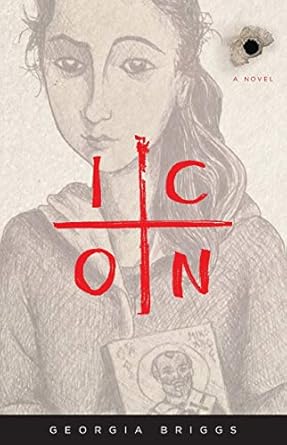
Today, my friends, we owe a debt of gratitude to the wonderful Matushka Emma Cazabonne for recommending I read a relatively new novel by a talented young Southern author. (Thanks, Emma!) The book is a new take on an old story, or, rather, an old and persistent threat to civilizational states, especially those grounded in Christianity. It is a somewhat disturbing look at an alternative contemporary or near-future Alabama and America. 

(Cover and interior artwork by the author.)

*Briggs, Georgia, Icon, Chesterton: Ancient Faith Publishing, 2017.

Icon, by Alabama author Georgia Briggs, is a stirring dystopian story told from an explicitly Orthodox Christian point of view. Briggs succeeds brilliantly in melding her faith with her genre. If I am not mistaken, this was her first novel, ergo, her success is an amazing achievement and a great testament to her ability. Icon is available from the Ancient Faith Store and Amazon. Also, please visit Briggs at her website. 

In Icon, young Euphrosyne learns that an innocent mistake at school quickly leads to death, oppression, and terror. Some might find the plot initially confusing, especially since it unfolds in the new and grand “Era of Tolerance”. However, others will wisely recall that tolerance was one of the chief sins of King Jeroboam. 

Euphrosyne, her family, and her friends find themselves living in an occupied state that tolerates everything … except Christianity. Clinging to tradition in this new age results in brutal and relentless intolerance. Briggs does a fine and fascinating job portraying how the repression transpires and how it affects those caught in the crosshairs. That she does this so convincingly from the primary perspective of a twelve-year-old girl is very impressive. But the choice of Euphrosyne’s eyes should not necessarily be surprising because, while all people suffer under tyranny, perhaps none are so afflicted as children. The real world gives us constant, daily reminders of that sad fact for those willing to see them.

I will leave the hows and whys behind the rise of Brigg’s draconic fool’s paradise for the discovery of the reader—and the reader will thoroughly enjoy the journey of revelation. Yet I will say I thought Briggs’s moniker for those in control of the new Alabama and new America was a poignant bit of genius. She took an old and famous name from America’s nineteenth-century transcendent enlightenment and progressed it forward to a fanciful but very natural and plausible zenith.

Plausibility. Interestingly, Briggs wrote Icon in 2017, eight years before I read it. Those eight years have been packed with incidents and trends that should have dropped the veils or blinders from many American and Western eyes. In short, only the truly blind (or the complicit) do not, at this point in our history, begin to at least suspect that something has gone very wrong. A century before Briggs’s pen crafted her tale so artfully, J.B. Bury was busy lauding what he thought were the then-present achievements of the Enlightenment and the coming golden age of free thinking and tolerance, the triumph over Christianity and tradition. See A History of Freedom of Thought (1913). As the entirety of the Enlightenment was a lie and a rank inversion, things didn’t work out exactly as promised. Instead of a peaceful, happy Shangri-la, today’s America sees Christians beaten and imprisoned for praying in public. America openly and even proudly supports, funds, and participates in war and genocide against multiple parties of the innocent around the world, a sizeable portion of them Christians. It is not too far a stretch, certainly within fiction, to foresee an America that openly exterminates Christians.

In addition to a moving, alarming story of warning, Briggs also provides an antidote. At certain points in Icon, particularly at the end, I found myself silently hoping for stern physical retaliation from the oppressed or liberating action from outside parties. I will divulge that as the Orthodox Believers of Alabama are hunted, Russian Spetsnaz troops do not arrive to save the day. But Briggs had a far better idea. Someone does show up at the end, and there is no earthly substitute for the deliverance and compassion he brings to Euphrosyne. It is a miracle in a book full of miracles. Just when all feels lost, the young protagonist wins the ultimate fight, via her Christian faith and her acknowledged (if not so-named) eschatological optimism. “[Y]ou lived well,” she is told. Indeed, she survives in glory and learns the true meaning behind Jesus’s reassurance when He said, “If the world hate you, know ye, that it hath hated Me before you. …[B]ut I have chosen you out of the world…” John 15:18-19. 

Briggs salvages eternal beauty out of tragedy and perfidious horror. Her plot, purpose, scenes, and settings are vivid, valid, and believable. Her characters bring to life the best and worst of human behavior and capability. As for the good potential within Christians, she delivers with convincing eloquence stern adherents to our faith who are, despite all else, joyous, reflective, defiant, zealous, and selfless. For a shorter work, and one marketed for the young adult audience, the spiritual lessons within Icon are astounding. Oh, and THE icon is as much a character, as much a hero as he is a title! 

For all these reasons, and for those the reader will find beneath the cover, I happily recommend Icon by Georgia Briggs. I also recommend buying a few extra copies to give as gifts to children, grandchildren, students, parish friends, neighbors, or any other young people the reader might know and care about. Help spread the word. 

Deo vindice.

BONUS! When I submitted the review to Geopolitika, https://www.geopolitika.ru/en/article/icon-georgia-briggs, I was informed that ICON Is already available in Russia, and that it won the Enlightenment book prize. See this excellent interview with the author [RUS].

JUDGING ATHENA Review at Words And Peace

11 Friday Jul 2025

Posted by perrinlovett in fiction

≈ Comments Off on JUDGING ATHENA Review at Words And Peace

Tags

book review, Emma Cazabonne, JUDGING ATHENA, Words and Peace

Thank you 10,000 times over, Matushka Emma, for this incredible review!

If you are a common visitor of this book blog, you know by now that I review in a vast variety of genres, with a few exceptions. For instance, even though I am deeply involved in the Christian Orthodox Church, I have never read nor reviewed a Christian novel. And only very rarely do I read romance.

When Perrin Lovett asked me to review Judging Athena, “an inspiring tale of Christian romance”, my first reaction was, no Christian novel for me. But then, he specified that “It’s a rather innocent love story, steeled with Orthodox apologetics, and an unusual plot device/twist.”

So I had to take the plunge and try it! And I’m glad I did.
Reading Judging Athena has been one of the most unique reading experiences so far this year.

…

Read the whole review – really read it – at Words And Peace.

ATHENA Review Preview

10 Thursday Jul 2025

Posted by perrinlovett in Books For Sale, fiction

≈ Comments Off on ATHENA Review Preview

Tags

book review, Emma Cazabonne, JUDGING ATHENA

Many, many, many thanks to the esteemed Emma Cazabonne!

https://www.goodreads.com/review/show/7593766887

BOOK REVIEW: One Hundred Miles from Manhattan by Chris Orcutt

05 Saturday Jul 2025

Posted by perrinlovett in Other Columns

≈ Comments Off on BOOK REVIEW: One Hundred Miles from Manhattan by Chris Orcutt

Tags

book review, Chris Orcutt, One Hundred Miles from Manhattan

One Hundred Miles from Manhattan by Chris Orcutt

Review by Perrin Lovett


Your reviewer owes the late, great Tom Moore for helping discover the subject matter of today’s critique. I’m not sure if Tom ever read anything by Chris Orcutt, but I know that if he had, then he would have enjoyed it. As I have written before, Tom was an extremely good friend and my adopted big brother. He also served admirably as my mentor en écriture de fiction, wingman, and general conspirator. Sometime after his death, I stumbled across Orcutt’s website while randomly looking for new authorial inspiration. The first thing I read was his essay, “Being a Novelist Isn’t a Job, It’s a Lifestyle”. I approved. Tom would have approved. Read it yourself and you’ll catch a glimpse of an artist as dedicated to the craft as may be found anywhere. Now it is my honor to briefly examine one of his many novels, the fun, daring, and masterfully written One Hundred Miles from Manhattan. 

(Stately, eclectic cover design by Elisabeth Pinio.)

*Orcutt, Chris, One Hundred Miles from Manhattan, “Wellington”, NY: Have Pen, Will Travel, 2014 (2017 2nd Kindle edition)

One Hundred Miles from Manhattan has been occasionally deemed a collection of short stories. And it is. But isn’t every novel chapter a short story? Probably. So by linking a series of these things together, especially if they are well-linked, a legitimate novel—however we define “legitimate”—is born. Orcutt describes his book as a “modern novel”, see the cover above. That is true in the sense it is contemporary fiction and that it innocently defies certain conventions or preconceptions in a manner to make Gustave Flaubert or Julian Barnes proud. The ten stories or chapters offer ten different perspectives on a series of independent yet related tales. Orcutt sets up a fine plot of points, which are then connected by the reader’s immersed mind.

The book reminded me of a few other works. Orcutt’s stories, all of them vivid and engrossing, take place in the fictional town of Wellington, New York. That geographic commonality at once suggested, in my mind, Mary Morrissy’s Prosperity Drive. (You leave the Aussies intact, Lassie?) Characters reappear and themes recur here and there. And Wellington itself becomes a perpetual personality in much the same form and fashion as the titular character in H.P. Lovecraft’s “The Street”. And just like Morrissy’s Prosperity Drivers and Lovecraft’s Lane, albeit in distinctive locution, Wellington and its population are adroitly, entertainingly, and guardedly presented as offbeat.

Who doesn’t love to hate the rich? Jesus said, “It is easier for a camel to pass through the eye of a needle, than for a rich man to enter into the kingdom of heaven.” Matthew 24:19. Confucius said, “Wealth and honor are what people want, but if they are the consequence of deviating from the way, then I would have no part of them.” It’s not necessarily that the wealthy are wicked. Or it’s not that, in a sense of totality, money is evil. Part of the stigma of the well-to-do is that their fortune allows them the opportunity to engage in behavior inherent to all of us with unfettered ease and unadulterated excess. That alone might explain much of the universal caution against the trappings of great opulence. 

Forewarned or not, Wellington is overrun with wealthy people, both of the generational landed gentry and the nouveau riche Manhattanite yuppie kinds. Much of the narration involves horses. Horses are fine and noble beasts, yet horse people are about as weird as they come. If one knows, then one knows: from California to Kentucky to Florida, it’s the same pattern. Wellington’s “hilltoppers” are sterling examples of horse and general monied eccentricity. However, safely confined within the pages of a book, their various follies make for excellent fiction. 

Orcutt opens with a quote by Anton Chekhov. He then proceeds with a story about an unusual “shooting party”, one led by a rather determined woman. Her self-imposed exile at the end appears happier and less taxing than, say, tenure at a standard labor camp. Another tale delves deeply into the lethally neurotic absurdity of fighting over a literal pile of trash. Perhaps you, dear reader, have heard of or imagined such things? Yet another story reminds us that little to nothing will come between the hobby engineer and his model train set layout. Assorted cautionary themes run the length of the book. In a sense, perhaps an inverted sense, One Hundred Miles from Manhattan might be considered an American ode to the Russian village fiction of the twentieth century. Lavish as it is, there is a certain pastoral romanticism associated with Wellington. And in keeping with the spirit of Valentin Rasputin, et al, a level of hardship is keenly examined—though it is volitional hardship, not so much on the local peasantry but, rather, on the peculiar affluent residents. Some of the presented rural fascination is coupled with criticism of modernity, subtle yet palpable criticism delivered with ranged emotion. 

Orcutt’s writing is crisp, evocative, and arresting. He balances, very well, a technical precision with great relatability. Somewhere, he mentioned he writes stories he would like to read. He succeeds with aplomb, which is a testament to several factors (that I can think of): a deeply contemplative philosophical outlook, high creativity, and an ability to accomplish that hardest and most critical aspect of writing—being able to jot it all down in such a way that the reader not only understands but mentally makes the story his own. He’s noted in several places his admiration for different great authors of the past. If he ever tried to emulate some of their manners or tack—and all of us try that to some extent—then he has succeeded in channeling the best as required and where necessary; but, he has also developed a most unique and enjoyable style all his own. More of Orcutt’s rare distinctiveness is on humorous, insightful display in his 2017 book, Perpetuating Trouble: A Memoir, which is part biography, part story-telling, and part poignant writing guide. I highly recommend it, to writers and all, along with, of course, One Hundred Miles from Manhattan.

I’m also looking forward to 2026 and the coming first segment of Bodaciously True & Totally Awesome, a nine-episode novel, twice the heft of War and Peace, about Gen X and our glory in the greatest of all decades, the 1980s. Grab the Swatches and pop those collars! Evidently, Orcutt spent the past decade locked in the last functioning Aladdin’s Castle mall arcade researching and refining the chronicle. If dedication equals perfection then… Okay, honestly, I was there. Did that and all. Part of me really wants to relive the majesty. But part of me is a little wary that once pulled back … I won’t want to leave again! Rad.

BOOK REVIEW: A Theory of Europe by Daria Dugina

30 Friday May 2025

Posted by perrinlovett in Other Columns

≈ Comments Off on BOOK REVIEW: A Theory of Europe by Daria Dugina

Tags

A THEORY OF EUROPE, book review, Daria Dugina, philosophy

A Theory of Europe by Daria Dugina


Commonality. Your reviewer has discovered that just like England and America, Russia has its fair share of Francophiles. Setting aside warfare, economic and political differences, and religious doctrinal minutiae, there is a great shared history among the many European peoples, divergent, of course, though still linked together by a great overarching predominance that transcends language, local culture, and assorted ethnic heritages. Western Europe, France included, has fallen into disarray. Eastern Europe, while in turmoil, still stands, particularly where it stands under the Russian aegis, as a coherent civilizational state. In a book that examines the questions of Europae Restitutio, one particular Russian looks hopefully, through a unique Russian lens, albeit one curated by classical Greek-derived philosophy and copious cross-cultural experience, primarily to France and the emerging, evolving legacy of the Nouvelle Droite. It is an academic’s approach. It is, as the title suggests, a theory, or an amalgam of theories. However, it is also an optimistic lure of promise and potential and a fascinating, thought-provoking disquisition.

*Dugina, Daria Platonova, A Theory of Europe: A View of the New Right, London: Arktos, 2024 (Kindle edition)

Daria Platonova Dugina was the rising star of Russian intellectual thought, a powerful philosopher and gifted writer, artistically talented, who loved life and honored God. She was the daughter of Alexander Dugin and Natalya Melentyeva. On August 20, 2022, she was murdered by Western-backed Ukrainian Nazi terrorists. This is my third Dugina book review, following Eschatological Optimism (review) and For A Radical Life (review). A Theory of Europe is a masterfully-compilled set of lectures, essays, discussions, and interviews that move forward as one well-threaded narrative. For readers familiar with Daria Dugina, postmodern European political thought, and views that surpass mere “left” or “right”, it will serve as a wonderful summary of approximately half a century of studied rebellion against the prevailing rot. As with any work bearing the standard of Dasha Platonova, it contains new surprises and revelations to interest any mind. And as with Miss Dugina’s previous works, as posthumously translated into English, I heartily, even sternly recommend A Theory of Europe. Please obtain a copy from Arktos or Amazon. Herein, I examine just a few higher points for the reader’s edification.

The tone of the book is set in the Forward by Professor Dugin, who wrote of his daughter, on page 10, “Dasha believed in the New Right and was inspired by their views on the need for a great restoration of primordially European values—classical, ancient, and medieval.” Most or much of my usual audience is either European, European descended, European adjacent, or otherwise at least tangentially interested in Europe. Those in Europe and of European descent now face an epochal change, a choice between enduring or, by postmodern default, diminishing or even disappearing. One hopes Dugina’s take on the restoration of European values inspires them as well. 

She gets right to the heart of the matter on page 16: “…the French Nouvelle Droite represents a Traditionalist, cultural, conservative revolution. The New Right might be called the new encyclopaedists or the new European “Enlightenment”—Enlightenment 2.0—but in the reverse.” The original Enlightenment, one of the most persuasive con jobs in history, broke the traditions of Europe and Western European Civilization by insidious design. It represented the end of the traditional monarchies, the end of meaningful Western European Christianity, a recalculation of the Greco-Roman legal and philosophical legacy, and the alteration of the organization of European nation-states and polities. Going in reverse means ending the charade and lies of the past five hundred years and reestablishing the old order of Christendom.  

Reestablishing the lost order might require a coalition of what could be labeled strange bedfellows. In order to affect both politics and culture, those on the right need to consider at least tactical alliances with some groups on the left, including labor, the ecology-minded, and more—groups not frequently thought of as conservative allies. “For [Carl] Schmitt, politics is always a confrontation between different political units (groups and collectives of various scales) and presupposes a permanent multiplicity, which Schmitt calls the “pluriversum””. A Theory of Europe, page 24. Such a multiplicity counters the artificial universal hegemony imposed by liberal globalism. “[T]he modern West masks the pursuit of its agenda under the aegis of “establishing democracy” and “defending human rights”, Id., 25, while destroying both. By pursuing or pushing individuality as its primary subject, “Liberalism denies collective identity and proclaims abstract human rights, which leads to focusing only on the isolated individual.” Id., 43-44. So liberated from his traditions and culture, the individual finds himself in a vacuous state of self-destruction.

Another link the New Right, particularly Alain de Benoist, encourages and seeks to establish is that between Europe and the Third World. While such a proposition might initially sound strange, it makes sense as both populations, albeit in different ways, are victims of global modernity. Opins de Benoist,  “We are united in our common revolt against the hegemony of the West.” Id., 48. Europeans in both Europe and places like America and Canada should carefully consider this option, both out of deference to the aspect of tandem rebellion against the status quo and out of geographic convenience—whereas Europeans may find common ground with those in the Third World, they will also find those from the Third World already living among them. For those in America, perhaps particularly in Dixie, Dugina’s treatment of things like the 2017 Charlottesville, Virginia torch rally, page 117, might be of interest.

Dugina also examines the cooperative nexus of various religious elements. Europe (and America) rose under the auspices of Christianity. Many still consider Europe and America Christian, Christian majority, or Christian sympathetic. To some extent this is correct. However, vast swaths of the various European populations have delved heartily into atheism, cultism, heresy, and nihilism. The lingering Christian remnants, of whatever size, may have to make do with other allies previously unlooked for. To that end, Dugina notes the predominance of paganism in the echelons of the New Right. “There are rather many neo-pagans among the New Right, practically 90% of the movement.” Id., 66. She also hints at the previous East-West divergence in dealing with pre-existing folk (pagan) tradition: incorporation versus elimination. “Orthodox Christianity absorbed a rather large mass of ancient East Slavic beliefs. We have tighter ties with Indo-European tradition than Catholics do. Moreover, Orthodoxy is closer to Hellenic culture as it was preserved in Byzantium up to its latest eras.” Id., 67. Somewhat related to the idea of holistic incorporation of multiple cultural facets, she observes the close links between the New Right, de Benoist, and others, and her father’s Fourth Political Theory. 

She also explores the philosophies of America and how they have come to dominate much of European thought and economic-political discourse. While she labels the American way, “pragmatism,” Id., 84, others, like Dr. Michael Hudson, have bluntly dismissed America (and other post-Westphalian Western nation-states) as being nothing more than an agent for the international financial class (whose concerns, while generally cold and plausibly irrational in strategy, certainly are pragmatic as to the ultimate goals of enslaving mankind and stealing everything). 

Concerning the international rentier leeches, in Dugina’s included interview with de Benoist, after discussing how the system reduces man to a mere consumer, he remarks of (financial) capitalism:

Capitalism is a system of world government, a system that is driven by limitlessness, infinitude, and always needs more—more profit, more markets, more goods. The slogan of this tendency is: more is always needed. This means that in order to turn the planet into a gigantic market, it is necessary to eliminate all political, social, and cultural barriers, which means eliminating all differences. Id., 182

Summarizing the final effects of the Enlightenment, of the philosophy obsessed with “the end of history”, Dugian notes: “To sum up, today the West is dead. European culture has died. French culture has died along with it.” Id., 254. She ends the book by discussing how Russia’s Special Military Operation in Ukraine has thrown a wrench into the machinations of the luciferian globalists. Sadly, her life was stolen not long after the SMO began. Still, her early observations have proven prescient. Russia’s martial retaliation, along with the greater economic and geopolitical war waged by the sovereign world majority against the globalists, has demonstrated various glimpses, for those who can or will see them, of solutions to many of the quandaries scrutinized in A Theory of Europe. Huge parts of the world have already learned great lessons from the late rebellion. It remains to be seen, in full, if Europe and its New Right, along with associated movements elsewhere in the fading Combined West, will follow suit. Russia, China, et al have, at least, given anti-liberal dissidents a little breathing room and bought time if nothing else. Perhaps the gentle reader of Dugina’s fine treatise might make a positive difference in that regard. If nothing else, it will set the gears and wheels of the brain in motion. And as with any great book, it pays dividends just to read it. Kindly do that soon.

*I would be remiss as a reviewer and friend if I did not thank Professor Alexander Dugin for his excellent heartfelt commentary within A Theory of Europe (and for gifting us the author), Constantin von Hoffmeister for his editorial prowess, Jafe Arnold for his translation skills and his Preface, and Daniel Friberg of Arktos for permission to utilize the foregoing quotations. Thank you, gentlemen.

Deo vindice.

BOOK REVIEW: The Lightkeeper by Dr. Sherry Shenoda

09 Friday May 2025

Posted by perrinlovett in fiction, Other Columns

≈ Comments Off on BOOK REVIEW: The Lightkeeper by Dr. Sherry Shenoda

Tags

book review, Christianity, Sherry Shenoda, THE LIGHTKEEPER

The Lightkeeper by Dr. Sherry Shenoda

A Review by Perrin Lovett


Edith Hamilton, classicist and author of The Echo of Greece, once said, “Greece’s great men let all their acts turn on the immortality of the soul. We don’t really act as if we believed in the soul’s immortality and that’s why we are where we are today.” I read The Echo seven to ten years after my misspent undergraduate career and my belated studies of Athens and Rome. However, as they spoke to Hamilton, so the ancient philosophers, historians, and poets spoke to me. I strongly suspect they had a similar influence, formal or autodidactic, on the author of The Lightkeeper. In a book about Deuterocanonical Biblical Wisdom, the wisdom of the ancient thinkers is on display at the beginning of many chapters, also being embedded within them in an instructive, narrative fashion. Among other things, it is a book about the immortality of one particular unusual soul.

*Shenoda, Dr. Sherry, The Lightkeeper, Chesterton, Indiana: Ancient Faith Publishing, 2021. 

Dr. Sherry Shenoda, originally from Egypt, is a California pediatrician, wife, mother, and extraordinarily gifted storyteller. Learn more about her at her website. And please purchase a copy of her sublime novel from the Ancient Faith storefront. 

The philosophy of it all: there is a noble degree of Orthodox (Coptic) Christian apologetics behind the plot and message of The Lightkeeper. It is a beautiful and original explication of the very concept of (Lady) Wisdom, exploring the mysteries of that proverbial truism with stirring elocution. Herman Melville once noted that in addition to the tenants of Old Testament Hebrew faith, Wisdom is also laced with an appreciation of Platonism. More recently, Professor Alexander Dugin likewise explained a strain of the Platonic running through Judaic philosophy, as well as in Islamic reasoning, and, of course, the underpinnings of Eastern Christian Orthodoxy. The same strain grounds The Lightkeeper and provides deep impetus for the story, especially as to the protagonist’s journey. 

It is a book riddled with time travel. And it opens and closes with an entertaining, or even breathtaking loop (a Closed Timelike Curve to make Seth Lloyd smile) that provides closure for the characters, the reader(!), and for much of the apophatic trust through and beyond questioning that both hammers home the philosophy of the book and narrates the first two parts of the tome. From the outset, Shenoda’s Lightkeeper wrestles with questions about her identity and her purpose. She even wrestles with Wisdom in the literal sense. But via her righteous perseverance, she is eventually gifted true wisdom of the kind only God may dispense. And the entire storyline is incredible as it teaches, without lecturing, the value of patiently trusting and enduring; the twists and turns and mysteries presented eventually cobble together a compelling rendition of the lessons lived and learned by Solomon and Adam. Again, there is recurrent time travel throughout the tale, which, on its own, curves here and there, seemingly chaotically at first glance, but with an ardent purpose before the end. And the story even ends with a form of “wave collapse”. 

The ending, or rather, the third part through the satisfying conclusion, provides multiple completions both within the story and within the mind of the reader. Per the Biblical sapiential, the protagonist, already immortal, though still suffering doubt and mental anguish, finds true Life Everlasting in addition to the fulfillment of her real intended purpose. “It’s all for me,” she keeps repeating. And it is, though it is not without the influence of the Lady of Wisdom and the permitting glory of He Who is Above. And another he! He who tends the favorite lighthouse. What, really, are we mortals without a love story? And to that end, Shenoda delivers in a rather surprising, though very gratifying, disposition. I do not dare spoil the romance, instead, I advise the reader will find it riveting and rewarding. Of course, that latter description is one I shall apply to the entire work.

If I am not mistaken, The Lightkeeper is Shenoda’s second book and first full novel. One truly hopes for a second, third, fourth, and so on, as the author exhibits a keen ability to provoke thought and emotion with her exceptional literary fiction. The Lightkeeper is a gem for any Christian, any philosophically-minded individual, anyone seeking pleasant complexity, if within a gently read format, or anyone interested in a touch of eccentric fantasy or traditional romance. I applaud Shenoda and highly recommend her book.

← Older posts

Perrin Lovett

From Green Altar Books, an imprint of Shotwell Publishing

From Green Altar Books, an imprint of Shotwell Publishing

Perrin Lovett at:

Perrin on Geopolitical Affairs:

Archives

  • December 2025
  • November 2025
  • October 2025
  • September 2025
  • August 2025
  • July 2025
  • June 2025
  • May 2025
  • April 2025
  • March 2025
  • February 2025
  • January 2025
  • December 2024
  • November 2024
  • October 2024
  • September 2024
  • August 2024
  • July 2024
  • June 2024
  • May 2024
  • April 2024
  • March 2024
  • February 2024
  • January 2024
  • December 2023
  • November 2023
  • October 2023
  • September 2023
  • August 2023
  • July 2023
  • June 2023
  • May 2023
  • April 2023
  • March 2023
  • February 2023
  • January 2023
  • December 2022
  • November 2022
  • October 2022
  • September 2022
  • August 2022
  • July 2022
  • June 2022
  • May 2022
  • April 2022
  • March 2022
  • February 2022
  • January 2022
  • December 2021
  • November 2021
  • October 2021
  • September 2021
  • August 2021
  • July 2021
  • June 2021
  • May 2021
  • April 2021
  • March 2021
  • February 2021
  • January 2021
  • December 2020
  • November 2020
  • October 2020
  • September 2020
  • August 2020
  • July 2020
  • June 2020
  • May 2020
  • April 2020
  • March 2020
  • February 2020
  • January 2020
  • December 2019
  • November 2019
  • October 2019
  • September 2019
  • August 2019
  • July 2019
  • June 2019
  • May 2019
  • April 2019
  • March 2019
  • February 2019
  • January 2019
  • December 2018
  • November 2018
  • October 2018
  • September 2018
  • August 2018
  • July 2018
  • June 2018
  • May 2018
  • April 2018
  • March 2018
  • February 2018
  • January 2018
  • December 2017
  • November 2017
  • October 2017
  • September 2017
  • August 2017
  • July 2017
  • June 2017
  • May 2017
  • April 2017
  • March 2017
  • February 2017
  • January 2017
  • December 2016
  • November 2016
  • October 2016
  • September 2016
  • August 2016
  • July 2016
  • June 2016
  • May 2016
  • April 2016
  • March 2016
  • February 2016
  • January 2016
  • December 2015
  • November 2015
  • October 2015
  • September 2015
  • August 2015
  • July 2015
  • June 2015
  • May 2015
  • April 2015
  • March 2015
  • February 2015
  • January 2015
  • July 2014
  • June 2014
  • September 2013
  • August 2013
  • July 2013
  • June 2013
  • May 2013
  • April 2013
  • March 2013
  • February 2013
  • June 2012

Prepper Post News Podcast by Freedom Prepper (sadly concluded, but still archived!)

Create a free website or blog at WordPress.com.

  • Subscribe Subscribed
    • PERRIN LOVETT
    • Join 42 other subscribers
    • Already have a WordPress.com account? Log in now.
    • PERRIN LOVETT
    • Subscribe Subscribed
    • Sign up
    • Log in
    • Report this content
    • View site in Reader
    • Manage subscriptions
    • Collapse this bar
 

Loading Comments...
 

You must be logged in to post a comment.