
Probability Zero: The Mathematical Impossibility of the Theory of Evolution by Natural Selection by Vox Day
Review by Perrin Lovett
By meticulously researching, calculating, and writing Probability Zero, Vox Day has driven a stake through the vampire heart of evolution by natural selection, the last lingering, and possibly the most destructive concept of the failed Enlightenment. Here follows a brief overview of this new and fascinating scientific tour de force.
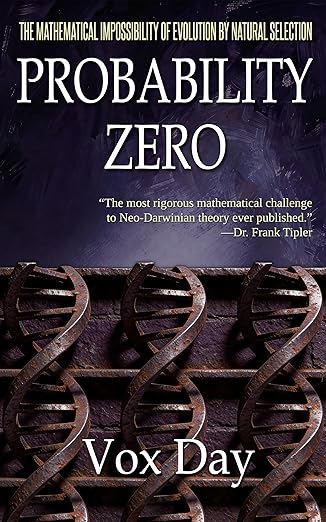
(Probability Zero, Castalia House, 2026.*)
*Day, Vox, Probability Zero: The Mathematical Impossibility of Evolution by Natural Selection, Switzerland: Castalia House, 2026 (Kindle edition).
Vox Day is one of the few defenders of Western Civilization who, while others whined and complained, did something to preserve our heritage. Rather, he’s done many things, including writing and editing a slew of books (SJWs Always Lie, Corporate Cancer, A Throne of Bones, etc.). Your reviewer has read Day, with great appreciation, since 2001 and his earliest days as a columnist at World Net Daily. He assembled the comprehensive taxonomy of the socio-sexual hierarchy (alpha, sigma, gamma, et al). He is the author of MITTENS, the Mathematical Impossibility of The Theory of Evolution by Natural Selection, an empirical demolition of Darwin’s theory of evolution and a core concept in Probability Zero. A Top 40 recording artist, he slings some mean beats and lyrics. Probability Zero is available from Amazon.
If the universe has a language, then its name is probably “math.” Heat rises unless it’s confined to a weightless vacuum. Men act rationally until they don’t. But two plus two always equals four. Math is beautiful and unforgiving. It is the driving force behind Probability Zero. The attendant mathematics absolutely obliterates the random propositions of evolution by natural selection. Professor Frank Tipler (Ph.D., Tulane) notes, on page 6, “Probability Zero represents the most rigorous mathematical challenge to Neo-Darwinian theory ever published.” It is certainly that, though it is, amazingly, more.
If it ever occurred to me, then it occurred rather loosely that evolution is or was just another plank in the misleading, inverted structure of the Enlightenment. Day’s Introduction is a fast summary of the failings of the Enlightenment, a series of supposedly glorious and progressive theories that, when applied in reality, deliver only ruination. The ultimate aim of the Enlightenment, akin to what Professor Alexander Dugin calls the first political theory, (macro) Liberalism, is to whittle away every facet of society, reducing everything down to the individual. Once separated from all that once defined his existence, the individual is then deprived of himself. The role of Darwinian evolution is to subtly deny the hand of God and, thereby, the existence of God. The Almighty is replaced with a shroud of smoke, high and scientific-sounding, but bereft of any substantiation—love and awe superseded by hollow falsehood.
While his argument touches briefly on religion (Christian, Islamic, etc.), Day maintains focus on the theories, words, and examples posited by evolutionists and faux light bringers themselves. He explains the pattern by which all of these dark fairy tales have been exposed over time, coming to rest upon Darwin’s theory, deeming it perhaps the most important of all similar concepts. Applying the pattern, again via a mathematical approach, Day systematically dismantles Darwin. And rather than taking it easy, Day builds a series of “Steel Men” arguments, allowing the broadest discretion in favor of the evolutionists, to make his demolition unassailable. A mathematical dissent against random evolution has existed since at least 1966, although until recently, it lacked the necessary observational proofs. Day completes the puzzle.
He begins with basic definitions and proceeds to explore and counter each and every proposition the selectionists have come up with (parallel fixation, etc.). Using the pre-existing argument that humans and chimpanzees had, at one time, a common ancestor, and using all available parameters, Day asks, on page 23, “…given the total number of generations available and the observed rates at which mutations spread throughout populations, is there enough time for 20 million mutations to have reached fixation in the human lineage?” The answer is a resounding “no.” Evolutionary biologists should have reached the same conclusion, except that, as Day notes, they evidently do not understand basic math and statistical analysis. And as the biologists put it, they don’t even use experimental data in their experiments; scientists do not practice science.
If they did, then they would find, in accordance with MITTENS, that the number of (human from chimps) generations, divided by the required number of generations per mutation, reveals a total number of fixed mutations several orders of magnitude insufficient to support their theory. Kindly running the math for the biologists, Day discovered that the odds against evolution by natural selection are ten raised to the (negative) one hundred seventy-second-millionth power. That staggering number, a statistical absolute zero, is what Day terms a “Darwillion,” a factor 1.72 million times larger than the already astronomical Googol. A common ancestor being thus explained by natural selection is, as Day puts it, page 103, “beyond impossible.”
Day goes much further, proving, among many other things, that in addition to being impossible, at least one of the biologist’s pet conceptions, “drift,” is self-disproving; drift, rather than beneficially mutating a species, would, if true, exterminate the species. (Failure to math might have dire consequences!)
Day then proposes the theory of Intelligent Genetic Manipulation (IGM) (Dr. Tipler labels the new hypothesis the “Gray Day Theory,” after Day and botanist Asa Gray (1810-1888)). As random, undirected natural selection is impossible, any and all detectable genetic modifications must be caused by a directed, programmed plan. IGM does not identify the manipulator, nor does it have to in order to supersede Darwin’s fancies and trickery. From page 212: “The fingerprints of manipulation, which consist of genetic changes that could not have fixed naturally in the available time, look the same regardless of whose fingers happen to have made them.” Day finds this principle consistent with Aristotle’s notion of the Unmoved Mover and Saint Thomas Aquinas’s First Cause of theism. Day has given himself plenty of room to build upon his new theory, and evidently, he is hard at work doing just that. Atheists and Enlightenment mongers will, of course, deny that such intelligence is or was possible. They just won’t hang their objections on any concrete proofs or workable formulas.
Regardless of one’s mathematical abilities—assuming one is not a biologist—please read the book in order to fully understand its devastating, yet straightforward proofs. (Your reviewer’s experience is limited to a “B+” in college calculus, and even I found the going easy and even thrilling.) If one seeks material with which to refute what one’s children are (mis)taught in their schools, even their Christian schools (some of them), then read the book. If one enjoys making a righteous mockery of profane travesty, then please read the book. Probability Zero is the scientific innovation of the year, and possibly, of the century. The probability that it will be useful is infinite.
*Many thanks to Vox Day for writing Probability Zero and for graciously allowing me to use the foregoing quotes and cover image.
 PERRIN LOVETT
You must be logged in to post a comment.