A Review of THE STONE HOUSE by Dr. Yara Hawari
It is a book about oppression, injustice, misery, and death. It’s also perhaps equally a book about wonder, hope, joy, and life. These qualities mysteriously combine, forging a story that seizes the reader and compels his anxious, enthralled attention until the final words of the Epilogue. Children loving, fearing, and being mischievous, studying, playing, picking tobacco, and play-acting their favorite John Wayne movies—to me, this conjures a mental picture of rural Virginia in a bygone era of American history. That all of this happened some 9,500 kilometers away from the Upper James River testifies we all may have more in common than most would know or admit.
Herein I discuss and cite to:
Hawari, Dr. Yara, The Stone House, London: Hajar Press, 2021 (electronic-copy).
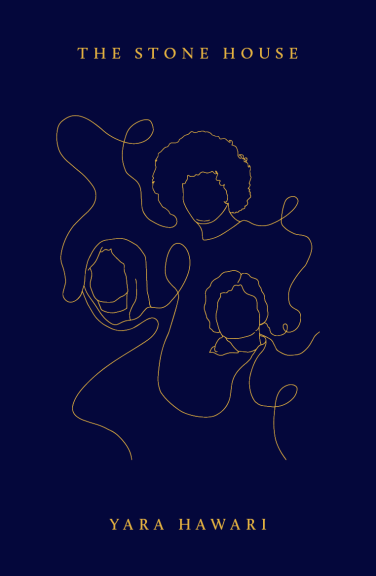
(Hajar Press, London.)(Hajar, Hanna Stephens, and Samara Jundi are to be praised for their simple, graceful cover designs.)
The Stone House was a New Arab Book of the Year in 2021. Please read their excellent Book Club review by Aisha Yusuff. Hajar, the entire team, did remarkable work in bringing the book to the public, describing it as, “A vivid, haunting tale of intergenerational trauma and survival under Israeli occupation.” It is that, and more; it will make the conscious, honest reader sad, remorseful, and very, very angry. At the same time, it will make the reader laugh, rejoice, and give thoughtful praise. Be forewarned that Hawari’s book provides an extended and tantalizing ride into the heart of human thought, emotion, and behavior. For readers of almost all intellectual or situational knowledge levels, deep learning and enhancement are offered. None of this amounts to a small feat for a novella of only 96 pages, a shorter work with a tremendous punch and follow-through. All of it is a great credit to the author. That she has accomplished so much in a debut book is astounding and speaks to her unusual skill, talent, and preternatural gifts.
I discovered Dr. Hawari via her powerful writing for Aljazeera. Doctor Hawari has earned her title, undoubtedly through years of toil and perseverance, with a PhD in Middle Eastern Politics from the University of Exeter, United Kingdom. In addition to writing for Aljazeera and other outlets, she is a co-director at the Palestinian think tank, Al-Shabaka.
Her expert knowledge and professional methodologies must have greatly assisted her in developing The Stone House. An academic quality, though certainly not one of the mundane ordinary, shines through each page and section. But there is something far greater at work. This is the story of her people and, more exactly, her own family. Three generations, from her father to his grandmother, are chronicled in gripping, surprising, and unsurpassable fashion. I note at the end the author herself makes a brief, twiddling appearance—a delightful kick! Her book, certainly a very personal endeavor, is important for many reasons. This was previously noted in a review for Mondoweiss by Haidar Eid, another worthy survey to consider.
One thing that will quickly jump out at the even moderately aware reader is that the conjoined, multi-decade-spanning tales presented in The Stone House are eerily similar to the current-day news and commentary articles published by writers like Dr. Hawari. That is because what is happening in Gaza and Greater Palestine today, the same as has happened all of my life, is but the sad continuation of a colonial saga that has been, as noted recently by Hamas, in progress for over 105 years. The reader will painfully note the similarity between portrayed family massacres and uprootings during the Nakba and those during Israel’s current war of genocide. But across the century-plus of death and destruction, a sense of optimism, defiance, and civility never leaves the survivors, God bless them. I recently watched a micro-documentary from the Guardian that relayed the life and times of a seven-year-old girl and her family in Gaza. Their plight is bleak. Yet living out of a tent and the bed of a pickup truck, the family exhibits better familial cohesion and more expressed happiness than their average counterparts in the suburbs of the United States. Perhaps facing death brings a sense of urgency to living. Or perhaps something higher factors into the equation.
Hawari’s story begins on a school bus in 1968. The author’s then fifteen-year-old father, future archaeologist, professor, and museum curator, Mahmoud, is about to embark on a journey of revelation, across a stolen, occupied country, to Jerusalem. This is Mahmoud’s story, as he undertakes his trip, in the company of other children, with his uncle, Nawaf (by chance, also only fifteen). They discuss and view their corner of the world during events they do not quite fully understand but of which they are sorely cognizant.
Mahmoud glances out the bus’s window and visually greets his mother, Dheeba, who has come down to see her son and baby brother off on their excursion. Once they depart, her story begins. Dheeba, unlike her fallah (farmer) husband, is a Bedouin, known locally, colloquially as Dheeba al-Badawiya, or, “the Bedouin.” For the author, and for me, this terminology held significance. This story delves deeper into the nature of the family’s travails during and after the Catastrophe, the Nakba.
When the bus leaves, Dheeba walks to her mother’s house to discuss the events of the day. With womanly talk and domiciliary horticulture, so starts Hamda’s story, the third and final part of the book, which partly relates to the tumultuous existence of Palestine before the departure of the British and the coming of official, earnest Zionist terror.
The whole story covers approximately six decades, from the end of Ottoman rule, through the treacherous British period, until just after the 1967 Six-Day War or, to Palestinians, “the Setback.” The chronology is generally reversed, with various jumps between periods. I encourage any reader to belay an attempt at mentally (pre)ordering events and to merely proceed with a laissez-faire perusal; simply release conscious logical compartmentalization and let the story tell itself—which it does beautifully. In exchange, in addition to the wonderful memoir, diversified facts are presented in eloquent clarity and with an emotional, heartfelt touch. Per my habit of discussing literary “flow,” I say The Stone House moves like the River Jordan, with many twists, yet always effortlessly carrying the reader along. And just as with the Jordan, ere the end there is “salt” for the reader’s eyes and mind.
Again for a shorter work, it is simply overflowing with ideas, moments, horrors, inspirations, and facets that leap into the brain and stick there. I was repeatedly struck by certain super-heterogeneous commonalities Hawari presents. John Wayne’s popularity, for instance, caught my attention and my fancy. So too did many other revelations, more than a few of which the average Westerner might not have previously considered.
The story is largely set in the ancient town of Tarshiha, which the occupiers call Ma’alot or Ma’alot-Tarshiha. This titular shifting reflects the trend, painstakingly walked through by Hawari, of the Zionists renaming or reconditioning everything they do not destroy. Still, despite their worst efforts, native history and culture live on. Tashiha is and was a “mixed” town, being, the Jewish migrant residents aside, almost entirely Muslim and Christian. Many, perhaps most Westerners, certainly most Americans, do not know (or, it seems, care) that there are Christian Palestinians and Arabs. Mahmoud, his family, and his friends knew it and embraced it, a tradition stretching back many centuries. As Hawari tells around page 14 in the electronic edition, in Tashiha Muslims and Christians live side by side, getting along rather well. Young Mahmoud and his chums pay reciprocal visits to each other on Christmas and Eid. (I suspect there might be a fine dramatized or even purely fictional story or three in those visits!)
There is willful ignorance, stupidity, or even wickedness at work among some of my people that have engendered, let’s call it what it is, an irrational hatred towards all Muslims and “Middle Easterners” (maybe all “others”) regardless of their religion. Mahmoud’s Christmas visits do something to gently dispel the falsehood. We have of late been treated to other such lessons of a sterner variety: Please recall the gatherings of Christians and Muslims together in Mosques and Churches over the past few months, desperately seeking Divine protection, their own comfort and company, and some degree of safety as the IDF saturated Gaza with American-made bombs.
Words are weapons too. To my mind, one of the more interesting elements of the tale regards Dheeba’s nickname and ethnic status as a Bedouin. During the late Gazacaust, I have regrettably heard at least one American voice dismissively call all Palestinians, “Bedouins,” as a slur. Dheeba’s story reveals something curious though all too common about the human condition. Hawari brings up this quirk around page 35. Though leading a respectable and respected life, Dheeba is ever mindful of rife prejudices in the local native population against Bedouins and other similar, yet dissimilar peoples. She found an irony and a disturbance that oppressed people were guilty of the same kind of scandal and misdeed against their fellows. Does that not sound familiar?
A Bedouin looking at a Russian and a Ukrainian might note little outward difference between the two Slavs. A Ukrainian observing a Hutu and a Tutsi would likewise struggle to differentiate between the Africans. The Tutsi in Japan might see a monolith of people. But we, each in our little groups and sub-groups, sometimes see differently, more keenly, do we not? I found this short passage and its sentiments disquisitive. As a traditionalist, I find some time-honored means of classification helpful in maintaining tradition. But little reminders like Dheeba’s do raise the suggestion of the helpfulness of an introduced decorum, especially towards those of our closer ethnos.
In addition to her daughter’s brand of introspection, Hamda’s grim resolve is presented in a daring, hilarious form. The stone house, the structure, not the title, was stolen from the family the way nearly all of their country was converted away by the Zionists. However—never doubt a woman’s ingenuity—Hamda finds a way to force their way back in and forge a temporary reclamation. I leave the exact wind-blown plot to the reader’s discovery along with any independent investigation into the Draconian legal processes the story highlights concerning Zionist land dispossession. Having examined what passes for Israeli real estate law as it concerns Palestinians, I can attest to its convoluted, thieving, and self-serving character.
Throughout all three stories, a pertinent concept is portrayed with great allocution: Inversion. Without reading The Stone House, one may be independently aware of what it means concerning Palestinians and Israelis. The occupiers are always presented as the true heirs of the land, only returning to claim what was always theirs. Palestinians are ever presented, almost universally, as terrorists. Any objection to either of these tenets, in addition to being criminal in some jurisdictions, is said to be “anti-Semitic,” a ridiculous assertion and a twisting of words and truth beyond belief and meaning. Hawari uncovers yet more malicious reversals. One unfounded myth is that the occupiers brought civilization, water, and life itself to an otherwise desolate, barbarian land. The truth is the opposite. Another popular fable has it that the “good” occupiers have always attempted to normalize relations with their backward, terrorist victims. The truth is that for their generally kind welcoming of the Zionists, Palestinians have been robbed, raped (with sexual violence used as a dehumanizing tool and crime of war), murdered, and displaced, with some coercively faux assimilated into a kind of third-class (dys)civic existence. Through the eyes of her family, Hawari presents these contradictions of reality in a manner simultaneously dialectic and stirringly narrative. Along with them, she presents several great betrayals and disconcertions of her people and of the good moral order by, of course, the occupiers, but also by the deceptive British, the great powers, and even by other Arabs.
She also imparts wonderment. In answer to great abomination, the Hawaris and their kin return a constant fortitude gilded with cordiality, fiery righteous spirit, and a zeal for life. Even ordinary personal interactions—such as two women bonding over factory work—convey a pleasantly contumacious independence, elation, and trust. There is a curiosity on every page. Via these little miracles, once again we are reminded of the importance of literature and its ability to conceptually connect across time, cultures, and circumstances. Hawari has joined a select list of story and truth tellers. The inversion of reality, the rank misplacing of atrocities, is in ways akin to the wicked habits of King Zahhak in Ferdowsi’s Shahnameh, the ruler who consorted with Deevs and dark spirits only to accuse his adversaries and subordinates of the same so he might rob them. The tale of modern Palestine has a similar presentment to that of the Elves and Men of Beleriand, holding the faltering line against Morgoth while awaiting war and deliverance as told in Tolkien’s Silmarillion. So far bereft of the aid of great heroes and powers, counting only the contributions of Hezbollah, the Houthis, the Republic of South Africa, and a few others, the Palestinians continue to hold out, endure, and believe. Masterfully told, theirs is a startling and novel tale, if of a nature we’ve elsewhere read glimpses of before.
Yara Hawari’s work is a rare find. To me, it is very much like the historical books of Erik Larson which read like novels. Hawari’s storytelling, dramatization instead of pure fiction, replete with records and insights, is every bit as good, as sound as The Devil In The White City or In The Garden Of Beasts. I was also impressed that she included, without explanation, a suggested musical playlist of songs the reader likely has and has not heard before. Had I but one word with which to summarize the entire story, it would be “breathtaking.” For the foregoing reasons, I heartily endorse and recommend The Stone House.


 PERRIN LOVETT
You must be logged in to post a comment.