NO LOST CAUSES
~A “What If” Alternative Present History~
Danivolsky District, Moscow, one afternoon…
Upon exiting the Metro station and climbing the stairs to the street level, as soon as her eyes peered above the top step, Julia watched an orange street car pull away to the east. In another moment she was standing on the plaza sidewalk. With a quick glance to her left, she saw the next tram coming, a sparkling new white model, still a short distance away. She paused under a canopy, noting the distinct if temporary change in the weather. While she wasn’t sure if meteorological spring would come early, as some now predicted, she was slightly gladdened by the day’s increase in sunlight and temperature. After loosening her scarf and collar, she took out her phone.
With another check, seeing the tram inching closer, she scrolled to Perry’s latest email and its literary attachment. She felt a slight pang of guilt in that she had not yet read it—a nothing of a hopeful little story, as he’d put it. En route to him now, she’d wondered if she had time and the necessary attention to give it justice, be it a nothing or otherwise. Just then, an idea popped into her head, immediately followed by buds popping into her ears just below her mink hat. She carefully selected the “read aloud” feature and tuned the delivery speed to 1.5x. That, she thought, even as the tram slowed to a stop before her, would be fast enough to get through the whole story on her short hop while still allowing her a full digestion. As she boarded and waved her troika card over the reader, a mildly robotic male voice began to tell her the tale:
Rafah, Gaza, Palestine, present-day…
To little Rindi’s reckoning, as best her six-year-old mind could see it, the shift in tempo and the welcomed reprieve had come just a few days earlier, perhaps a few days after the world learned the hideous truth about the mass murder and maiming of nearly one thousand starving people in the streets, lured by the occupiers with the false promise of food and clean water. News, internet, and cellular service, absolutely unreliable since October, had lately almost completely disappeared. Yet rumors swirled and grew. Adults and older children spoke furtively about some new outside actor joining the conflict, someone who could turn a massacre into a fighting chance for life. The daily bombings and raids had slowed and then, just the day before, had stopped altogether. New cruise missiles and jet aircraft were seen, here and there, screaming through the sky high above the refugee camp.
No one believed her when she tried to explain, but she was certain she had caught a glimpse of two of the new missiles. They had looked like small darts and she could have sworn they had little wings. She gasped as they sailed silently through the clear blue heavens, followed by a faint yet reverberating, cascading crackle of artificial thunder. They came and went in an instant. Nobody listened to her, though everybody excitedly if cautiously spoke. She didn’t understand the importance of the directions, but all the adults noted that these new weapons fly in from the Sea and towards the occupiers. Out of terrible desperation, hope arose that some unknown force was driving back the murderous besieging hordes. Beyond hope or even belief, it appeared that was exactly what was happening. The warming winds at the end of winter were bringing great change, greatly needed. Many prayers were raised that it would immediately nourish and heal the ailments of war and famine.
And sure enough, just the night before, trucks, ambulances, and taxis had sped through the rough streets at her far end of the camp, speeding, in fact, all over the beleaguered city. Police, freedom fighters, aid workers, and other good men hastily grabbed up those most grievously wounded or famished, taking them back towards the old port where it was alleged a new field hospital had been very recently erected. In their place were left bottles of “Publix Spring Water” and something called “Clif Bars” — labels printed in a script Rindi couldn’t read though she knew what their wrappings contained. Promises were also left that more and better were on the way very soon. And again their hopes rose.
The deep night had been hectic, enlightening, but still terrifying. Rindi couldn’t remember sleeping. Out in the cold, voices shouted that something miraculous was happening at the old jetty, some work of hasty martial engineering. Soon thereafter, at some distance but still far too close at hand, a mighty series of explosions sounded, blasts that lightly shook the ground and her sleeping mat. Still, any fear tempted to return was denied by some unreasoned optimism. More jet engines roared overhead. Someone cried out that the occupiers’ wall and fence, to Rindi’s people “the cage,” had been felled nearby. A few loud vehicles passed the tent. ‘They are coming!’ someone had shouted in the dark, though with a hint of praise in place of trepidation. Higher rose the hopes of all.
It was very early. The light of a cool dawn was breaking. Rindi had just finished her Clif Bar, splitting it with her little sister. Otherwise, she might have thought it tasted funny, not quite sweet or sour, though with a definite hint of chocolate. Then and there, however, it tasted like deliverance, the first hard sustenance she’d had in over a week. She had just allowed the baby to lick the sticky remains of gooey dough from inside the foil wrapper when, suddenly, great excitement grew to a pitch outside their tent. The constant cheers and the mechanical rumbling, groaning sounds forced her outside for an inspection.
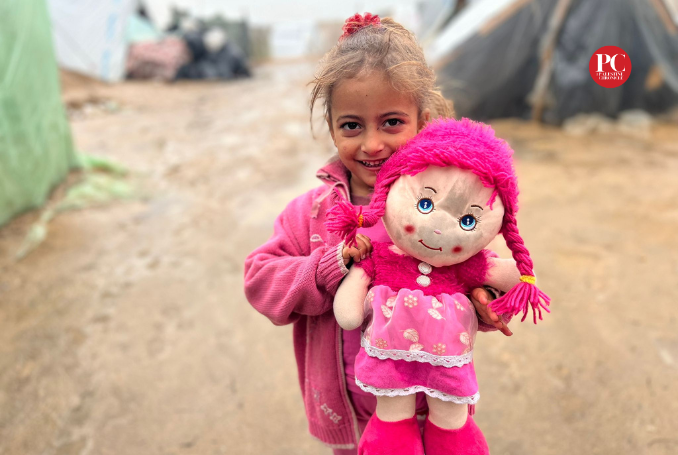
With one hand, she pulled the collar of her pink sweater tight. The very small girl’s shiver returned as she watched the procession, already in progress when she finally forced her way through an opening between the legs of some adults, one of whom was her mother. However this time, her flutters owed to a confident anticipation she didn’t fully understand, a healthy rejoicing change from the usual quakes born of cold, hunger, and dread. Even as she’d approached behind the older folks, the bawl was noisy, near-deafening. Again the ground was shaking, accompanied by a rumbling in the air that flowed with the sound of large engines revving, and the repeated great blasts of many air horns. She was astounded to see a large column of military vehicles passing them by, making for the wall and, Rindi and the others guessed, business with the occupiers beyond. In a long array, there came a convoy of assorted large grey GAMAZ and URAL trucks. Some of them looked like rolling boxes. Some were topped by strange antennas. Others towed trailers and more than a few artillery. A great many of them carried soldiers clad in grey. Betwixt and between the trucks, there were many columns of grey battle tanks—T-90s, T-14s, and the new-to-the-world C-1 Forrests. These latter mechanical beasts, along with some of the trucks, flew flags. She had never seen them before though she found them at once striking and beautiful. The vehicles all boasted a series of markings, words, and numbers Rindi could not make out or interpret. Commanders sat half within their hatches atop the tank turrets, stern men wearing grey camouflage uniforms and helmets. As the last tank passed, Rindi caught its commander looking to her side of the street. He had a short blonde beard and, despite the low light, he wore black sunglasses beneath his helmet. He took off his glasses, slowly raised his other arm, and saluted the crowd. At the risk of dropping her big pink doll, almost half as tall as she, Rindi returned the gesture. She knew he winked directly at her. Then he and the others were gone. She leaned out and watched as they vanished in the distance where the cage walls were or had been. From the remote clouds of dust that leaped into the air, it was obvious they were dispersing once they passed out of Gaza.
Voices called out all around her, though they were temporarily drowned from above. Rindi and all the others looked up to see a flock of ten or twelve attack helicopters fly forward, following the tanks with their noses down. They cleared the wall and, most likely overtaking the armor, they also dispersed in this direction or that. At the edge of sight, it looked like one released a torrent of rockets or flares as it pivoted. Soon they too had vanished. But while they had been overhead, Rindi thought they were very loud, whooping along under counter-rotating props. She noted they were all grey, bearing strange markings she had never seen before. Maybe it was the rising sun or her imagination, but to her, they almost looked like flying crocodiles. As scary as they might be, she loved crocodiles and remembered them from her older brother’s school books. He had explained that some people called them alligators, a distinction she didn’t understand. Sadly, he had never explained further and never would; he had been martyred by the occupiers in the opening weeks of the horrible assault on their town in the north of the Strip.
While she was excited like everyone else, she was also naturally curious. She asked again, “Who are they?” And, again, she was ignored. Her temptation to ask once more was quashed when she heard a new sound coming, a musical sound. Looking down the street, back towards the beach and the port, she plainly saw a marching band approaching at the head of what she took to be a parade. Now the vanguard, the band itself, was passing by. While a few children stopped their ears over the loud, brash music, she found solace and a thrill in the blarred notes. Who were these men, she wondered, this time only to herself. Had she known English (and Latin), the answer marched right by her on a banner: “Appalachian Scots Corps ~ Semper Prius In Periculo.”
Regardless of her understanding, they marched forward. The big drums explained themselves. But she had never seen, or heard of, or certainly heard the other instruments. Bags of cloth, they appeared to her eyes, each topped with numerous pipes or funny reeds. The marching men, soldiers she took them, blew into a reed while squeezing the bags. This produced a constant loud but melodious music. And how these men marched! Each wore a grey uniform, topped by a combat helmet, but underneath their body armor, Rindi was astounded to see they also wore skirts. Not the kind Mama wore—these, also grey, were shorter, stopping around the men’s knees. Their black combat boots stomped along rhythmically.
The whole end of the camp crowded thickly at the edges of the street to catch a glimpse of these newcomers. Rindi found herself clapping and marching in place, her doll dangling precariously under her arm. She saw more of the beautiful flags. Right behind the band came more infantry, more men in grey uniforms and helmets, though these wore pants, not skirts. Each carried a Kalashnikov battle rifle and wore a heavy pack. Even more of the beautiful flags were on moving display. She had never seen them before. A few, the ones maybe a little larger than the others, featured three red and white stripes with a blue field in one corner bedecked with a circle of white stars. But it was the other flags, the more numerous flags, that caught her attention. They were fields of brilliant red crossed with ribbons of blue like an artful elongated “X” with each ribbon holding more white stars.
The marching column reached the end of the street by the clearing and quickly moved on towards the remains of the wall, which must have by then been fully broken down by the tanks. Thousands of these men exited Rafah and entered the fray. And at the very end, a single C-1 slowly rumbled past. Rindi again saw the words and numbers she didn’t understand. This time, however, a man in the crowd read them aloud: ‘THIRD ARMOR / 03-212 / Confederate States Army.’
‘It was them, Allah be praised!’ another man yelled nearby. ‘Their missiles—from the sea—halted the attacks! They drove the great satan’s ships away! They sent the scouts, the doctors, and the food. Allahu Akbar!!’
Rindi looked all around. The people were still generally shouting and cheering in jubilation. ‘Who are they, mother?’ she asked. ‘Who were those men in the tanks?’
‘The Americans,’ her mother said. ‘The Americans have come!’
‘I thought the Americans were our enemies, friends of the zionists,’ Rindi said in protest.
‘My darling little girl,’ her mother explained, ‘you speak of the other, hateful Americans, the step-children of the devil. They who arm and empower the occupiers, they who spread misery around the world whenever they still can. These are the remnants of the true Americans, mostly Christians from the great south of their distant land. At last, they defeated the devil’s forces in America; now they have come to face his children here.’
Even as a trio of SU-25s flew hurriedly over, making for the growing battle, Rindi smiled. Then she threw her hands up (and her doll) and openly laughed in joy.
****
Just a little over a week earlier, Rafah’s triumphant merriment had been preceded by solemnity and slow, strong words in New Richmond, Virginia, capital of the Confederate States of America. From his office, the leader of the free Americans addressed his television audience concerning matters of extreme urgency. Following a short pause, President P.C. Graham took off his spectacles and placed them on his desk. Once more, he looked into the camera and continued speaking to his nation and much of the free world:
‘My fellow Americans, all peoples of goodwill joining us tonight, I have just recounted but a fraction of the litany of abuses, abominations, war crimes, and crimes of aggression committed by Israel against those who may well constitute the poorest, most helpless, and most defenseless population on our good earth. These are plain, painful, and horrible truths that the world can no longer afford to ignore. Less than one decade ago, we in Dixie liberated ourselves from a similar if far less acute tyranny after fifteen long decades of suffering. We barely had the ability to throw off Abraham Lincoln’s propositional chains, and we only did so with the help of our international friends and partners. Are we now prepared to watch as other friends and innocents are slaughtered on the altar of hate, ethno-religious supremacy, and genocidal expediency?
‘What I am about to reveal to you, dear people, dear friends, is my answer to that terrible question. It follows hours and days of discussion among your government officials as we pondered history, morality, and that hideous litany of deadly provocations. I spoke of the murder of little Hind Rajab, her family, and the paramedics sent to rescue her. I spoke of yesterday’s massacre by machine gun of starving people, lured into a shooting gallery with the false promise of food. That horror has already been repeated—they now call the crimes flour massacres. We have discussed these matters and more. I have also discussed the foregoing with Presidents Putin and Jinping. I attempted, in vain, a discussion with that recalcitrant and craven leader to our north.
‘I have spoken with the valiant President Ramaphosa of South Africa far away, praise be to him and his team, as well as the honorable Lady Abrams of New Africa, our southwesterly neighbor, and ally. Lady Abrams and I have the concurrence in judgment of President Jones of Texas and or President Obrador of Mexico. I have spoken with Middle Eastern leaders, including the Palestinian Authority and Hamas, and I have extensively spoken with my other BRICS colleagues, particularly in Iran and Saudi Arabia. I have spoken with other free leaders in our Hemisphere. Several of these leaders and nations have joined me in forming the Coalition of the Noble. My decisions this evening follow in the deliberations of the Security Council and the rulings of the International Court of Justice. Most importantly, they stem from the request and permission of the lawful government of Palestine.
‘Therefore, for all these reasons, by all these agreements, and for the sake of honor, charity, and human dignity, the time to act is upon us all. Because the poor, starving, and displaced people of Gaza and of greater Palestine face certain genocide and as time will not admit delay, I have authorized a Special Military Intervention to demilitarize and deZionize Palestine. This will be a forceful operation designed to liberate and protect the indigenous people and to provide a peacekeeping force while they, and only they decide what is best for their future. For one hundred and twenty-five years, they have been denied the basic right of self-determination. Justice is long overdue and I ask for your prayers that they might make the correct choices going forward, that we may all place these titanic issues in the sovereign hands of God Almighty.
‘A word of warning—to anyone tempted to interfere with this necessary operation, know that if you do so interfere, with force, then you will face consequences of a kind rarely witnessed in history. You can thwart neither positive justice nor the will and wrath of Heaven. Saint Michael heads our Coalition and he will brook no obstruction.
‘Thank you, my fellow citizens. May God bless the Confederacy. And may He keep, hold, guard, and bless all gentle, righteous mankind. Good evening.’
****
A week later, as Rindi, her family, and people celebrated, columns of Confederate armor, infantry, and support rolled through Kerem Shalom, southeast of the 1950 Armistice Line. As the tanks roared ahead into battle and the howitzers and Heavy Flamethrowers began hurling their flying death, a large field command truck flanked by a tracked Pantsir defense platform and several mobile radar-comm assemblies slowed near the tumbled concrete ruins of an illegal settler Kibbutz barn. The men inside listened through the insulated walls as an occasional boom of cannon fire sounded outside, generally some ways ahead or to their right.
Captain Williams lifted one side of his headset and turned to address his men: ‘Time to be cold, real frosty. We are now operational, free and clear, and with, unfortunately, somewhat dimmed netcentric ISR reporting. We’re gonna be outside of Fleet’s immediate AD concern. The Davis is devoting everything to shielding Gaza until the ground 400-450s are up. Everything else is concentrated towards our north and east and the show. We have our radar, a rolling rocket and rotary show, and Biggers out there with the Star Trek gun to save our butts from anything the Zios still have left UAV or artillery-wise. Shovels on the walls in case we need to dig in and camo this heap in a hurry the next hillside we come to. And, ladies, keep y’all’s laces tight in case we have to run for it. Got it?’
After a smattering of ‘Yessirs’ and ‘Rogers,’ Specialist Hobson asked, ‘Which way are we to run, sir?’
‘Well, towards the front!’ Williams returned with a smile. ‘Remember, we’re not alone. New Africans, Texans, and the others are triple-inserting up the coast. Hitting some pretty heavy resistance. That’s where most fleet and air heavy support fire is directed until they punch through. And by the way, we’re all radio English now, with the translators. Aerospace and Signal say they’ve essentially removed intercept and interference capabilities. AND! If y’all hear a rumble to the right, that’s one hundred thousand-plus Egyptians joining the party! There is some extended fleet cruise coverage over our heads. That and some IRG Fattahs are holding the Zios from running out to the desert. We are gonna roll up north—just like we did in the War!—crush this rabble, and meet Hezbollah at Bibi’s house!’
A smattering of rebel yells ended with an announcement from Sergeant Dawson: ‘The desert, sir. Rangers and Recon just took Negev-Dimona and the last associated sites! It appears Mr. Samson is, in fact, impotent, just like GRU said he would be.’
Before anyone could react to the news, Clarke chimed in: ‘Back off the East Coast,’ he said, ‘commander of the Hunley advised the Pentagram that any further interference and he would happily quote-unquote Shermanize Noo Yak and Baastin! Not that the Yankees still have it in ‘em.’
More yells and cheers were quieted by the able voice of Williams again: ‘By interference, they thought they still had it. I presume our good sailor boy meant what just happened in the Med five minutes ago. President Ice Cream reneged on his USN withdrawal and the Yankee floating airport wheeled around, alert launches ready on the deck. Then the Big Beau started slinging Zircons. A moment of silence, please. The very last Yankee carrier is going down by her bow!’
In response, he got anything but silence.
***Big question: Is this too “White Savior” or whatever they call it? Especially from a people with no military, no country, and not even fighting for their own existence at the moment. Not the first tank, ship, pipe, or drum. Lemme know what you think, Babe – Perry
PS: Do let me know if my head is right!
Julia took her earbuds out and pocketed them along with her phone as she walked into the conference room of the Citadel Forum at the Patriarchal Center. Deciding not to be embarrassed by her tardiness, she found the semi-monthly Anglo-Francophile Friends of Moscow meeting coming near to its end. Taking a seat next to Irena by the wall, she did observe a dozen or so young women, visitors evidently from a sorority at the University of Alabama. Her eyes narrowed for a second as she scanned them, making sure they appeared more interested in the subject matter than the presenter. Satisfied, she turned her attention to him.
Pericles was mainly speaking English, with an occasional French or Russian reference. He’d just said something comical about Tucker Carlson. A quick side remark about something called “the Machine” made the young ladies giggle. He then evidently picked up something or somewhere he’d left off and issued his concluding remarks.
‘The guy from We Are the Mighty—what a name—was a Mr. Logan, something or another, a special forces veteran and obviously not a serious organizational planner. Again, his article was about the mighty GAE attacking the entire world at the same time. His summation still sticks in my mind: In short, ‘Murica would stomp them! Of course, they would. That was only four years ago. Today, if he’s noticed, four years later, the mighty can’t even stomp the Houthis to say nothing of a mere ten percent of this country’s professional military.’
Perry looked around and then, seeing her for the first time, winked at Julia. ‘They can no longer stomp anyone anywhere. But they can still cause problems everywhere. On their own or via proxies. They deal it out, and we, the powerful and affluent, hard as we do have it some days, we think we’re really under the gun. Truth be told, we’re not. Which leads us back, again and again, to Gaza where they are. I’ll finish with the last lines of a poem by Canadian journalist Paul Salvatori, We are Not as Strong as Palestinian Children:
‘We don’t know the suffering,
And we don’t know how to suffer
Without making it about us.
‘We are not as strong
as Palestinian children.’
He then half-smiled, leaned away from the podium, and said, ‘We’re not. But we are and should be honored by each other’s good company and discussion. Of the good, the bad, and the very ugly. Many thanks to our hosts and the Center. Don’t forget to pick up those pamphlets on the way out. Thank you all for coming and for putting up with me. Merci et bon après-midi. Vsem dobryy vecher. And, last thing, please think about the strong little girl up on the screen, a real girl in a real camp in Rafah. Thanks.’
After a few brief words here and there and kind of positioning herself between Perry and the chatty girls from al-a-BAM-a, really against them, Julia allowed him to lead her towards the door and his new Niva Classic outside.
‘Sorry I was late, baby,’ she said. ‘But from the ending, you seemed to have held it all together very well.’
‘Thanks,’ he said. ‘Did you by any chance have time to look at the Rafah story?’
‘Not to look at it, no. But I did listen to it on the way over,’ she answered.
‘And?’
‘I was rather impressed in a way. But first, tell me what you, the author, think.’
‘Okay,’ he said. ‘As much as I want to, I don’t like it. Feels hollow, like some sort of impotent rage launched out of nothing. I almost chickened out and had a story within a story told by a random protagonist. Ridiculous, really. The heroes are far-fetched, to put it mildly, soldiers who don’t exist. And even if they did, would or could it even work out as written? Tenuous. But the worst part is the feeling that it almost makes a mockery of real suffering. Sure, the idea of riding to the rescue is great. But that won’t happen—not by me—and still, the victimization is very real and terrible. I put that little girl up on the screen as a reminder, like a real Rindi looking down, happy and sweet, but haunting. The words of the poem. She’s real and strong, and all I have are cheap words. How’s that?’
‘Perceptive. Kind and self-deprecating, but maybe missing something. To do or—’
‘What we can do, I suppose. As-is, all they have are South Africa, the Houthis, and Hezbollah. A world of sympathy, but little action. Things keep heating up and moving forward, but there’s just no telling. Which leads me back to wanting to do something. Anything. And wondering if I’m just making the suffering about me.’
‘You’re not.’
‘Thanks. To do anything. Those final social media words of Aaron Bushnell, America’s least likely and maybe last military hero.’
‘My dear,’ she said soothingly, ‘it’s because of his sentiment that I like the story. Or the thoughts behind it. Whether it’s in a court, in the UN, with missiles, with fire, or just with a few words, a few little nothings of words. Nothings of hope. It’s the act of doing anything to raise awareness beyond, for them, not for you or us, that makes the difference. Rindi is Hind Rajab, isn’t she?’
‘Yes.’
‘And if you were General Pericles, CSA, cleared for action, you’d do it, wouldn’t you?’
‘Yesterday.’
‘Not for glory or for Anglo-Western tradition or any of it, but as a genteel marker of the right thing done necessarily to ease the suffering of others, correct? That no true cause be lost?’
‘Your thoughts are clearer than mine. Yes and yes.’
‘Then, my baby—’ She leaned up and kissed his nose. ‘Your head and your heart are in the right place.’
And so, in a ruggedly capable if outlandishly misplaced little four-by-four, they made their way towards the nearest bridge and dinner beyond. Absent-mindedly, he turned the radio on. She tuned to a new station without thought guiding her action. And on some news program, at a recorded protest away in the West, a lone voice called out the cry, ‘From the River to the Sea, Palestine will be free!’
DO SOMETHING.


 PERRIN LOVETT
You must be logged in to post a comment.