• About
  • Blog (Ext.)
  • Books
  • Contact
  • Education Resources
  • News Links

PERRIN LOVETT

~ Deo Vindice

PERRIN LOVETT

Tag Archives: Daria Dugina

“Dasha” Three Years Later

20 Wednesday Aug 2025

Posted by perrinlovett in News and Notes

≈ Comments Off on “Dasha” Three Years Later

Tags

Daria Dugina

Statement by Foreign Ministry Spokeswoman Maria Zakharova:

Three years ago, a terrorist act orchestrated by Ukrainian intelligence agencies cut short the life of Russian journalist, political commentator, and public figure Darya Dugina (Platonova).

Neither Western pseudo-democracies nor the international organisations obedient to them deigned to react to this treacherous murder, just as they turned a blind eye to other bloody crimes committed by Ukrainian neo-Nazis against journalists and war correspondents. Under the patronage of their handlers, the Kiev regime continues to methodically eradicate any dissent, waging nothing short of a hunt against representatives of the Russian media sphere. We honour the sacrifice of all media workers who have perished in the line of duty, and we will do everything in our power to hold those responsible for these atrocities to account.

The tragic fate of Darya Dugina has become, for millions, a symbol of selfless devotion to the Motherland, unwavering dedication, and loyalty to one’s ideals. In Russia and far beyond its borders, Darya’s memory and her creative legacy endure: her books are published in large print runs, and numerous initiatives and projects are implemented, including the Russian Frontier International Youth Award and the public medal For Fidelity to the Russian World and Traditional Values. Streets in Russian cities have been named after Darya Dugina, and her likeness has been immortalised in commemorative murals and memorial plaques. This year, a monument to the courageous journalist, sculpted by Dmitry Alexandrov, was unveiled in Zakharovo Park in the Odintsovo District of the Moscow Region.

The crime against Darya Dugina knows no statute of limitations. Those guilty of committing it will be found and will face inevitable punishment.

Another Look at the RADICAL LIFE

21 Monday Jul 2025

Posted by perrinlovett in Other Columns

≈ Comments Off on Another Look at the RADICAL LIFE

Tags

book review, Daria Dugina

Professor Dugin reposted my review of his Dasha’s striking little diary compilation. God bless the Dugins! Please read the whole review on Alexander Dugin’s Substack!

Image

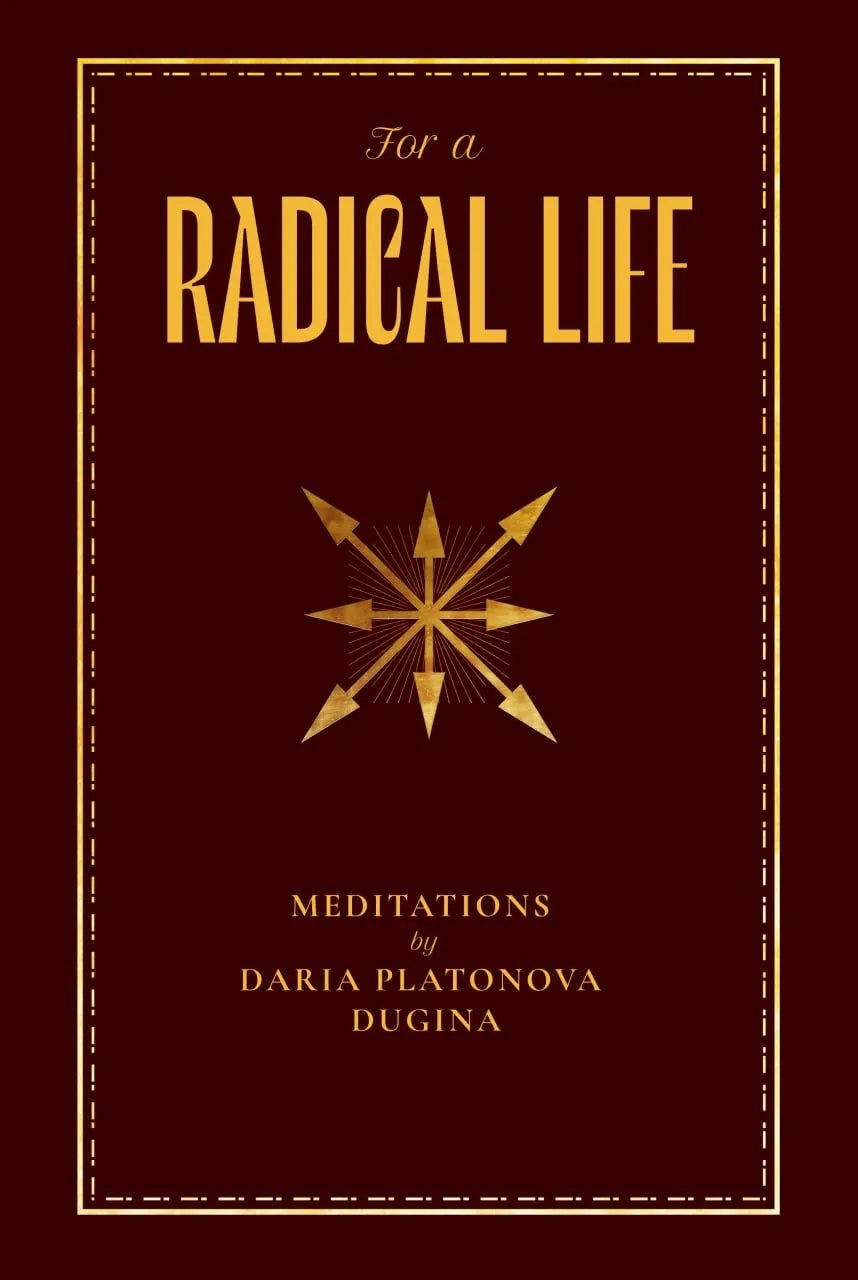
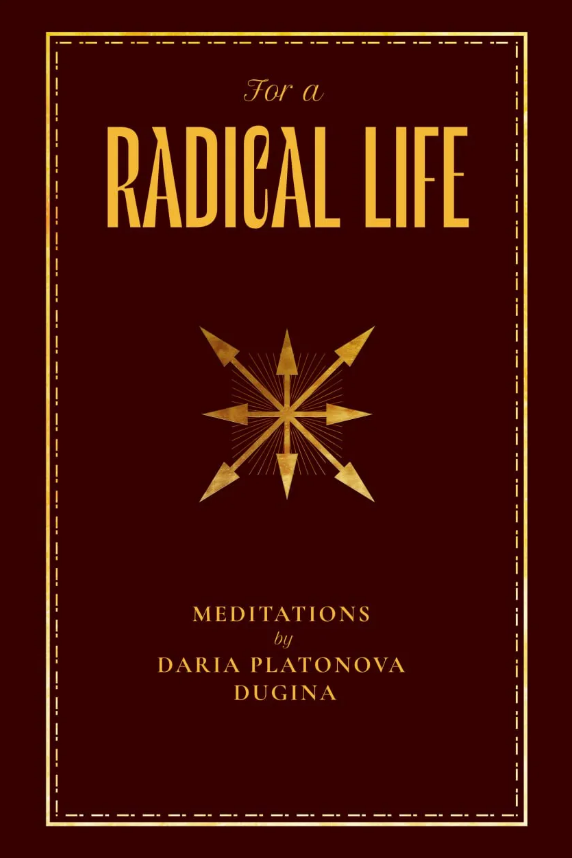
Dugina, Daria, For A Radical Life: Meditations By Daria Platonova Dugina, Tucson: PRAV, 2024. https://pravpublishing.com/product/for-a-radical-life/

Last fall, I had the privilege of reviewing Eschatological Optimism by the late Daria Dugina (1992-2022), a book I learned of thanks to a very good friend. Earlier this year, I was reminded by another great and lovely friend that a second posthumous Dugina book was forthcoming in English from PRAV. One simply cannot have enough literarily in-tune friends in this life. Nor can one get enough of Russia’s brilliant and ever-rising star of intellect and steely determination.

It’s a shorter work, only 70 pages. Yet each and every sentence in it, every word lifts the spirit, touches the heart, and engages the mind. It is a compact gem, expertly translated, compiled, and edited by Jafe Arnold and John Stachelski. I strongly recommend it to anyone interested in life, death, philosophy, and the eternal battle between Divine good and lowly evil. I also suggest the book would make a fine gift for, say, a college student or a young adult. Or for anyone.

…

Encore of My Review of A THEORY OF EUROPE

06 Friday Jun 2025

Posted by perrinlovett in Other Columns

≈ Comments Off on Encore of My Review of A THEORY OF EUROPE

Tags

A THEORY OF EUROPE, Daria Dugina

Commonality. Your reviewer has discovered that just like England and America, Russia has its fair share of Francophiles. Setting aside warfare, economic and political differences, and religious doctrinal minutiae, there is a great shared history among the many European peoples, divergent, of course, though still linked together by a great overarching predominance that transcends language, local culture, and assorted ethnic heritages. Western Europe, France included, has fallen into disarray. Eastern Europe, while in turmoil, still stands, particularly where it stands under the Russian aegis, as a coherent civilizational state. In a book that examines the questions of Europae Restitutio, one particular Russian looks hopefully, through a unique Russian lens, albeit one curated by classical Greek-derived philosophy and copious cross-cultural experience, primarily to France and the emerging, evolving legacy of the Nouvelle Droite. It is an academic’s approach. It is, as the title suggests, a theory, or an amalgam of theories. However, it is also an optimistic lure of promise and potential and a fascinating, thought-provoking disquisition.

From Geopolitika (in: EN, IT, TR, SP, VI, PL)

Also at:

Dugin’s Substack

The American Perennialist

Reckonin’

BOOK REVIEW: A Theory of Europe by Daria Dugina

30 Friday May 2025

Posted by perrinlovett in Other Columns

≈ Comments Off on BOOK REVIEW: A Theory of Europe by Daria Dugina

Tags

A THEORY OF EUROPE, book review, Daria Dugina, philosophy

A Theory of Europe by Daria Dugina


Commonality. Your reviewer has discovered that just like England and America, Russia has its fair share of Francophiles. Setting aside warfare, economic and political differences, and religious doctrinal minutiae, there is a great shared history among the many European peoples, divergent, of course, though still linked together by a great overarching predominance that transcends language, local culture, and assorted ethnic heritages. Western Europe, France included, has fallen into disarray. Eastern Europe, while in turmoil, still stands, particularly where it stands under the Russian aegis, as a coherent civilizational state. In a book that examines the questions of Europae Restitutio, one particular Russian looks hopefully, through a unique Russian lens, albeit one curated by classical Greek-derived philosophy and copious cross-cultural experience, primarily to France and the emerging, evolving legacy of the Nouvelle Droite. It is an academic’s approach. It is, as the title suggests, a theory, or an amalgam of theories. However, it is also an optimistic lure of promise and potential and a fascinating, thought-provoking disquisition.

*Dugina, Daria Platonova, A Theory of Europe: A View of the New Right, London: Arktos, 2024 (Kindle edition)

Daria Platonova Dugina was the rising star of Russian intellectual thought, a powerful philosopher and gifted writer, artistically talented, who loved life and honored God. She was the daughter of Alexander Dugin and Natalya Melentyeva. On August 20, 2022, she was murdered by Western-backed Ukrainian Nazi terrorists. This is my third Dugina book review, following Eschatological Optimism (review) and For A Radical Life (review). A Theory of Europe is a masterfully-compilled set of lectures, essays, discussions, and interviews that move forward as one well-threaded narrative. For readers familiar with Daria Dugina, postmodern European political thought, and views that surpass mere “left” or “right”, it will serve as a wonderful summary of approximately half a century of studied rebellion against the prevailing rot. As with any work bearing the standard of Dasha Platonova, it contains new surprises and revelations to interest any mind. And as with Miss Dugina’s previous works, as posthumously translated into English, I heartily, even sternly recommend A Theory of Europe. Please obtain a copy from Arktos or Amazon. Herein, I examine just a few higher points for the reader’s edification.

The tone of the book is set in the Forward by Professor Dugin, who wrote of his daughter, on page 10, “Dasha believed in the New Right and was inspired by their views on the need for a great restoration of primordially European values—classical, ancient, and medieval.” Most or much of my usual audience is either European, European descended, European adjacent, or otherwise at least tangentially interested in Europe. Those in Europe and of European descent now face an epochal change, a choice between enduring or, by postmodern default, diminishing or even disappearing. One hopes Dugina’s take on the restoration of European values inspires them as well. 

She gets right to the heart of the matter on page 16: “…the French Nouvelle Droite represents a Traditionalist, cultural, conservative revolution. The New Right might be called the new encyclopaedists or the new European “Enlightenment”—Enlightenment 2.0—but in the reverse.” The original Enlightenment, one of the most persuasive con jobs in history, broke the traditions of Europe and Western European Civilization by insidious design. It represented the end of the traditional monarchies, the end of meaningful Western European Christianity, a recalculation of the Greco-Roman legal and philosophical legacy, and the alteration of the organization of European nation-states and polities. Going in reverse means ending the charade and lies of the past five hundred years and reestablishing the old order of Christendom.  

Reestablishing the lost order might require a coalition of what could be labeled strange bedfellows. In order to affect both politics and culture, those on the right need to consider at least tactical alliances with some groups on the left, including labor, the ecology-minded, and more—groups not frequently thought of as conservative allies. “For [Carl] Schmitt, politics is always a confrontation between different political units (groups and collectives of various scales) and presupposes a permanent multiplicity, which Schmitt calls the “pluriversum””. A Theory of Europe, page 24. Such a multiplicity counters the artificial universal hegemony imposed by liberal globalism. “[T]he modern West masks the pursuit of its agenda under the aegis of “establishing democracy” and “defending human rights”, Id., 25, while destroying both. By pursuing or pushing individuality as its primary subject, “Liberalism denies collective identity and proclaims abstract human rights, which leads to focusing only on the isolated individual.” Id., 43-44. So liberated from his traditions and culture, the individual finds himself in a vacuous state of self-destruction.

Another link the New Right, particularly Alain de Benoist, encourages and seeks to establish is that between Europe and the Third World. While such a proposition might initially sound strange, it makes sense as both populations, albeit in different ways, are victims of global modernity. Opins de Benoist,  “We are united in our common revolt against the hegemony of the West.” Id., 48. Europeans in both Europe and places like America and Canada should carefully consider this option, both out of deference to the aspect of tandem rebellion against the status quo and out of geographic convenience—whereas Europeans may find common ground with those in the Third World, they will also find those from the Third World already living among them. For those in America, perhaps particularly in Dixie, Dugina’s treatment of things like the 2017 Charlottesville, Virginia torch rally, page 117, might be of interest.

Dugina also examines the cooperative nexus of various religious elements. Europe (and America) rose under the auspices of Christianity. Many still consider Europe and America Christian, Christian majority, or Christian sympathetic. To some extent this is correct. However, vast swaths of the various European populations have delved heartily into atheism, cultism, heresy, and nihilism. The lingering Christian remnants, of whatever size, may have to make do with other allies previously unlooked for. To that end, Dugina notes the predominance of paganism in the echelons of the New Right. “There are rather many neo-pagans among the New Right, practically 90% of the movement.” Id., 66. She also hints at the previous East-West divergence in dealing with pre-existing folk (pagan) tradition: incorporation versus elimination. “Orthodox Christianity absorbed a rather large mass of ancient East Slavic beliefs. We have tighter ties with Indo-European tradition than Catholics do. Moreover, Orthodoxy is closer to Hellenic culture as it was preserved in Byzantium up to its latest eras.” Id., 67. Somewhat related to the idea of holistic incorporation of multiple cultural facets, she observes the close links between the New Right, de Benoist, and others, and her father’s Fourth Political Theory. 

She also explores the philosophies of America and how they have come to dominate much of European thought and economic-political discourse. While she labels the American way, “pragmatism,” Id., 84, others, like Dr. Michael Hudson, have bluntly dismissed America (and other post-Westphalian Western nation-states) as being nothing more than an agent for the international financial class (whose concerns, while generally cold and plausibly irrational in strategy, certainly are pragmatic as to the ultimate goals of enslaving mankind and stealing everything). 

Concerning the international rentier leeches, in Dugina’s included interview with de Benoist, after discussing how the system reduces man to a mere consumer, he remarks of (financial) capitalism:

Capitalism is a system of world government, a system that is driven by limitlessness, infinitude, and always needs more—more profit, more markets, more goods. The slogan of this tendency is: more is always needed. This means that in order to turn the planet into a gigantic market, it is necessary to eliminate all political, social, and cultural barriers, which means eliminating all differences. Id., 182

Summarizing the final effects of the Enlightenment, of the philosophy obsessed with “the end of history”, Dugian notes: “To sum up, today the West is dead. European culture has died. French culture has died along with it.” Id., 254. She ends the book by discussing how Russia’s Special Military Operation in Ukraine has thrown a wrench into the machinations of the luciferian globalists. Sadly, her life was stolen not long after the SMO began. Still, her early observations have proven prescient. Russia’s martial retaliation, along with the greater economic and geopolitical war waged by the sovereign world majority against the globalists, has demonstrated various glimpses, for those who can or will see them, of solutions to many of the quandaries scrutinized in A Theory of Europe. Huge parts of the world have already learned great lessons from the late rebellion. It remains to be seen, in full, if Europe and its New Right, along with associated movements elsewhere in the fading Combined West, will follow suit. Russia, China, et al have, at least, given anti-liberal dissidents a little breathing room and bought time if nothing else. Perhaps the gentle reader of Dugina’s fine treatise might make a positive difference in that regard. If nothing else, it will set the gears and wheels of the brain in motion. And as with any great book, it pays dividends just to read it. Kindly do that soon.

*I would be remiss as a reviewer and friend if I did not thank Professor Alexander Dugin for his excellent heartfelt commentary within A Theory of Europe (and for gifting us the author), Constantin von Hoffmeister for his editorial prowess, Jafe Arnold for his translation skills and his Preface, and Daniel Friberg of Arktos for permission to utilize the foregoing quotations. Thank you, gentlemen.

Deo vindice.

Discussing the Radical Life

22 Sunday Dec 2024

Posted by perrinlovett in News and Notes

≈ Comments Off on Discussing the Radical Life

Tags

Daria Dugina, Jafe Arnold, PRAV

Constantine Von Hoffmeister and Jafe Arnold (PRAV Publishing) discuss the life and legacy of Daria Dugina. Watch or listen HERE.

Also, happy winter!

Daria Dugina and “Generation D”

20 Tuesday Aug 2024

Posted by perrinlovett in News and Notes

≈ Comments Off on Daria Dugina and “Generation D”

Tags

Daria Dugina

Today marks two years since SBU terrorists backed by the satanic states and its worthless minions murdered Daria. Jafe Arnold provided fitting, moving words for the anniversary.

As the clock strikes midnight, today marks two years since Daria Platonova Dugina became the name of a generation, a turning point, an explosive revelation whose waves are still unfolding.

Ever since the night of 20 August 2022, Daria Platonova Dugina is a standard, a rallying cry, a mantra borne by the hearts and minds of a unique caliber of human beings: the differentiated man and the differentiated woman, the ones who have heeded the call to be radically human in the sway of Heaven and Earth, Gods and Mortals, War and Peace, Life and Death.

In any place, in any time, in any situation, on the frontlines, behind lines, between the lines, these men and women can be found by anyone with eyes that see and ears that hear. They are playing their part, fulfilling their due, truly living and truly dying, being who they truly are, who they were meant to be — as a pledge, a chance, a recognition that they otherwise might never have deserved or realized. Practicing the great powers of philosophy, theology, and art, intercepting the Divine messages for poetic transmission, playing their hands in the spheres of politics, culture, media, etc. — everything in the world under the Moon falls within the scope of their endeavors under the Sun. It takes two to tango: the Daria Platonova Dugina generation is dancing with the World Soul, learning to walk as if for the first time.

The Daria Platonova Dugina generation is not a certain number or category of entities — it is a way of being, an embracing of the meanings and mysteries of Being, a resoluteness to live every moment not as merely another or any other “here and now,” but as the Here and Now, the Augenblick, the kairos. You have been given the chance to live, to know, to think, to love, to do, to be in the world with others, to live on by being meaningful for others. No car bomb can take this away from you. In fact, the only possible deprivation is your own hiding, your own cowardice, your own lack of love for yourself, for others, for the world into which you were thrown with the chance of being something instead of nothing.

Two years and a day ago, on Earth there walked, thought, wrote, and danced a young person. This person was writing her dissertation in philosophy, working in media, creating art, and participating as much as she could bring herself to bear in the dramatic life of her country, her Continent, her family, her comrades, and her growing fields of followers and onlookers. Two years ago, the pawns of a hopeless campaign against life, beauty, thought, and meaning killed her with the aim of extinguishing what their eyes and ears cannot bear. In so doing, however, they committed a basic, foolish error, something that could be called, as we might say in trying to intuit their very limited and mistaken point of view, the “mistake of the century.” In reality, there was no mistake. What happened was meant to happen. What is now supposed to happen is: you. By killing Dasha, they “mistakenly” unleashed the unstoppable torrent, the merciless firestorm, and the serene bliss of the eternal question: “To Be or Not To Be?” Fiddling with technology and setting a car alight as part of a desperate “operation,” they “mistakenly” blew open the gates to the Special Operation of Light that every once in a while pours in out of eternity to illuminate the astonishing revelation of the reality for which we are responsible. Piercing the stormy night sky, Lightning awakens, astounds, humbles, enraptures, inspires, and illuminates the world before and ahead of you.

Daria Platonova Dugina is our generation’s name for that which is already waiting within you, in your best you, in the only you that can ever truly be called you yourself as you exist (ex-ist, stand out). It has many manifestations, many ways, many questions, and many challenges, but they all boil down to one unnamable yet everywhere knowable truth. In ancient Greece, at the temple of Apollo at Delphi, it was expressed thusly: gnothi seauton, “know thyself.” In the sacred books of ancient India, it was expressed thusly: tat tvam asi, “thou art that.” In medieval Rus’, something of the sort resounded in a letter from a monk to the Tsar: “two Romes have fallen, the third stands, and there will be no fourth.” In our days, let it be said: it is high time, better late than never. Your loved ones, your descendants, and unknown masses will thank you for being something instead of so many nobodies and nothings.

Mr. Poe Goes To Greece

11 Tuesday Jun 2024

Posted by perrinlovett in Other Columns

≈ Comments Off on Mr. Poe Goes To Greece

Tags

4PT, Daria Dugina, Edgar Allan Poe, Geopolitika, writing

Courtesy of Geopolitika and an unknown (but greatly appreciated) translator. Διαβάστε στα ελληνικά. I think that’s 4 or 5 languages now, and the essay has quickly become one of my most popular writings to date – if not the most widely read.

Also, I just learned my review of Daria Dugina’s Radical Life is at her dad’s Fourth Political Theory site.

Thank you, my many and great international friends.

On The Eschatological Optimism of Edgar Allan Poe

17 Friday May 2024

Posted by perrinlovett in Other Columns

≈ Comments Off on On The Eschatological Optimism of Edgar Allan Poe

Tags

Daria Dugina, Edgar Allan Poe, Eschatological Optimism, Signum

A Dream Within a Dream: Was Edgar Allan Poe an Eschatological Optimist?

Perrin Lovett


Recently, it was my pleasure to read Eschatological Optimism by Daria Platonova Dugina. From that astounding book, among many points that stuck in my head was a question regarding one of my favorite literary figures, American author and poet, Edgar Allan Poe (1809-1849). For whatever reason, I thought the matter was worth looking deeper into.

As recounted in Ms. Dugina’s book, after the presentation of her lecture, “Eschatological Optimism as a Philosophical Interpretation and Life Strategy,” followed a transcribed question and answer session. This included exchange sufficiently garnered my attention:

Question: Is Edgar Allen Poe an eschatological optimist? His last book, Eureka, is about our tragic universe and how its finitude is tantamount to a revelation harbored in misfortune. 

Daria Dugina: Thank you. I haven’t thought about this. I will definitely reread it in this context.

    • Dugina, Daria “Platonova”, Eschatological Optimism. Tucson, Arizona: PRAV Publishing, 2023, at 66.

The slight matter of an affirmative declaration versus a pure question aside, I found that brief discussion virtually identical to a query transcribed in Dugina, Daria, “Eschatological Optimism: Origins, Evolution, Main Directions,” Geopolitika, 20 December 2022, as translated by Sophia Polyankina, et al: “Valentin wrote: Edgar Allan Poe is an eschatological optimist, too. His last book Eureka is about our tragic universe, the finality of which is identical to the disclosure of a prisoner in misfortune. Thank you for a recommendation, Valentin. I will definitely read it.” Valentin’s transcribed suggestion, of course, stemmed from Ms. Dugina’s video presentation, hosted on or about 28 November 2020 on the Signum YouTube channel. The quoted remarks occur around time-mark 51:59. 

I am of the opinion Valentin’s suggestion is correct. Before explaining why, I offer Ms. Dugina’s short definition of what constitutes eschatological optimism. From her book, page 54:

…eschatological optimism is the consciousness and recognition that the material world, the given world which we presently take to be pure reality, is illusory: it is an illusion that is about to dissipate and end. We are extremely, sharply conscious of its finitude. But, at the same time, we maintain a certain optimism; we do not put up with it, we talk about the need to overcome it.

Without delving into the Christian and philosophical depths Dugina explored, her general sentiment has been and is readily accepted or embraced, if via other terminology and if not so well synthesized, by an array of people regarding various human experiences. It is somewhat synonymous with the “Stockdale Paradox,” as explained by Vice Admiral James Stockdale of the US Navy, an observation from his time as a prisoner of war: “You must never confuse faith that you will prevail in the end —which you can never afford to lose— with the discipline to confront the most brutal facts of your current reality, whatever they might be.” See Collins, Jim, “The Stockdale Paradox,” Jim Collins Concepts (from a recounted, undated conversation)(discussed in regards to Stockdale, Jim, and Cybil, In Love and War, Toronto; New York: Bantam Books, 1985). Americans, largely being who they are, have largely taken the admiral’s advice to heart considering business “motivational” matters. In my previous review of Eschatological Optimism, I abbreviated the base concept as: “[T]he eschatological optimist, while accepting that terminal change in the world is imminent, nonetheless soldiers on by consciously and purposely living.” Lovett, P., “Apophatic Apologetics,” Geopolitika, 4 September 2023 (yes, wherein I *ahem* “cleverly” used one of Poe’s lesser-known spellings of his own middle name…). In other words, this is the Christian’s way of carrying on the fight until Christ’s Return.

As such, where do we find evidence of Edgar Allan Poe’s urge to fight and overcome the dissipating illusion? I am not certain that Dugina ever directly answered the question, and I sincerely hope my report does her legacy justice. Eureka: A Prose Poem, as noted by Valentin —who I do hope finds this essay, finds it worthy, and accepts my thanks for initially raising the issue— is a plausibly definitive starting point. 

Poe was Baptized in the Episcopal Church (American Anglican/Protestant) though he was raised and married in his (birth and adoptive) family’s Presbyterian (Protestant) faith. For all my purposes herein, I assume Poe was a faithful Trinitarian Christian seeking grace and salvation via his humble acceptance of Jesus Christ. (I happily leave any sectarian doctrinal or theological quibbles to the professionals.) Poe’s, to me, peremptory deference to the Almighty comes through his approximate forty references to “God” in Eureka. Herein, I cite Poe, Edgar Allan, Eureka: A Prose Poem, New York: Geo. P. Putnam, 1848 (Gutenberg Kindle edition).

Speaking nearly two hundred years early to Dugina’s references to the ultimate battle between the crude world below and God’s perfect spiritual order above, Poe’s Eureka is subtitled: “An Essay on the Material and Spiritual Universe.” Amidst language that has humored and confounded scholars since 1848, Poe begins by explaining, on page 1, “My general proposition, then, is this: —In the Original Unity of the First Thing lies the Secondary Cause of All Things, with the Germ of their Inevitable Annihilation.” In order words, the illusion will end. 

Poe almost immediately addresses the metaphysical limitations of the human mind when attempting to understand or even properly speak of God. From page 9:

“Infinity.” This, like “God,” “spirit,” and some other expressions of which the equivalents exist in all languages, is by no means the expression of an idea—but of an effort at one. It stands for the possible attempt at an impossible conception.

This speaks to the apophatic basis of trusting and reaching for God, by negation, through faith, and without complete reason or knowledge. The approach via negation is a cornerstone of eschatological optimism. We do not “know” precisely or mathematically and we cannot even precisely quantify our attempt at knowing in the first place. Accordingly, we trust. Poe takes this matter as a given. He simply states, on page 11, “We believe in a God.”

He further elaborates, on page 22: ”[P]roperly speaking—since there can be but one principle, the Volition of God. We have no right to assume, then, from what we observe in rules that we choose foolishly to name ‘principles,’ anything at all in respect to the characteristics of a principle proper.” 

On page 24 he describes an approach to appreciating the ultimately unknowable by three methods that look to me a little like the apophatic, the kataphatic, and the third “Aristotelian” (or “Aquinian”) way:

Whether we reach the idea of absolute Unity as the source of All Things, from a consideration of Simplicity as the most probable characteristic of the original action of God;—whether we arrive at it from an inspection of the universality of relation in the gravitating phænomena;—or whether we attain it as a result of the mutual corroboration afforded by both processes;—still, the idea itself, if entertained at all, is entertained in inseparable connection with another idea—that of the condition of the Universe of stars as we now perceive it—that is to say, a condition of immeasurable diffusion through space.

He goes on, many times, to reference the unerring nature and will of God. As others have noted before, some of Poe’s words and thought processes appear mildly convoluted, or, perhaps in kinder terminology, “imaginative.” Still, for purposes of Dugina’s theory, he sums up his proposition in a definitive declaration on page 73: “Let us endeavor to comprehend that the final globe of globes will instantaneously disappear, and that God will remain all in all.” The great and fully final eschaton; and, at no time does Poe appear fraught or dismayed by the prospects. Rather, in his mainly philosophical treatment of the predicament, he remains ardently optimistic as a predetermined and unquestioned fact of being. This, of course, like all of Eureka, is a matter of speculative conjecture. Before moving to proofs perhaps more in keeping with Poe’s literary reputation, I thought to attempt adding something novel to the discussion.

Thanks to the efforts of a wonderful friend, I was placed in contact with a distant relative of Edgar Allan Poe, a Mr. Jim Poe of Tennessee, United States. Our Mr. Poe is, as I suppose the relationship, a distant cousin of the great author. Leaving genealogical exactitude to other professionals, I briefly assert Mr. Poe of Tennessee’s father’s, father’s, father’s, father’s, father’s father was David Poe of Dring County Cavan, North Ireland, the same who immigrated to Baltimore, Maryland, then Colonial America. Among the sons of David Poe of Baltimore were Mr. Poe of Tennessee’s ancestor, John Hancock Poe, and one David Poe, Jr. This David, Jr. was Edgar Allan Poe’s father. I asked my Mr. Poe about THE Mr. Poe’s faith, at least as understood by the family. I received word that many early Poes (of roughly Edgar Allan’s time) were “devout Presbyterians in Scotland and North Ireland.” Further, as a matter of fervent faith, I was informed that Edgar Allan Poe’s great-grandfather, also another David Poe, “was known back in North Ireland as David Poe the Covenanter, among those who were severely persecuted for their adherence to the theology of the Reformation.” 

I found additional support for this suggestion via the treatment of the Presbyterian Covenanters of Scotland (and Northern Ireland) by the English Monarch in Mary Phillip’s book, Edgar Allan Poe The Man, Volume One. Chicago: John Winston Co., 1926. As recounted on page 8, the Poe family mark of reprisal was particularly harsh: “[T]he King’s pardon was granted to all who had taken part in ‘the late wicked Rebellion,’ but with special exception of David Poe…” David was, in fact, sentenced to hang — a sentence happily unexecuted. 

Regrettably, Christianity has been beset with sometimes violent dissension from at least the betrayal of Judas. Or perhaps, from a post-Ascension standpoint, from the blasphemous heresies of the hated First-Century Nicolaitans. Jesus Christ promised Saint Peter that “the gates of hell shall not prevail against” the Church. Matthew 16:18. Our Lord never said hell would not continuously crash against the Church; in fact, elsewhere He essentially promised the opposite. See John 15:18-20. This is the war of the prince of the fallen war against God and His People. Daria Dugina understood the war and the critical importance of actively fighting in it; her quote I simply adore: “In the conditions of the modern world, any stubborn and desperate resistance to this world, any uncompromising struggle against liberalism, globalism, and Satanism, is heroism.” Eschatological Optimism, at 102. In this war, our battle there is no room for weakness or compromise. As Daria’s father noted concerning the real struggle of good against evil in the Twenty-first Century: “Satan, seeing that someone has challenged him, will not allow us to go back to half-way solutions.” Dugin, Alexander, “Satanism is Putting Matter Before Spirit,” Geopolitika, 18 September 2023 (as translated from: Дугин, А., “Сатанизм — как постановка материи над духом,” Газета Культура, 5 Сентябрь 2023).

Edgar Allan Poe understood the Christian implications of our war now, which was his then, and he surely remembered some of his family’s then late worldly struggle regarding religion, some of which may have affected him personally. This was expounded upon by Professor James Kibler in his 2022 essay, “Poe’s Battle with Puritan Boston,” Abbeville Institute, 6 April 2022. Poe certainly knew about his struggles against the early American literary powers, a particularly keen forum of his earthly travail, as told by Professor Harry Lee Poe (another descendant also from Tennessee) in “Poe’s War of the Literati,” Abbeville Institute, 20 July 2017. While his personal demise was unpleasant and is still shrouded in mystery, his universal fame today suggests Poe won his part in that war. 

Poe’s fame today, and since his untimely death, is almost entirely due to that by which we best know and appreciate his creative thinking, his literature. My essay was inspired by Russian friends I have never met. It is my limited understanding that Poe enjoys a respectful reputation in Russia, of a similar variety he engendered in my America and elsewhere — a grand, stirring, determined, if somewhat muddled estate. One book, a rarer tome that I have not read, though it has worked its way into my extended booklist, may shed light on Poe’s presence in Russia: Grossman, Joan Delaney, Edgar Allan Poe in Russia: A Study in Legend and Literary Influence. Wurzburg: Jal-Werlag, 1973. By way of a review of Grossman’s take on Poe, we learn: “In 1895, two significant Russian translations of Poe’s poetry and prose appeared. Konstantin Bal’mont, one of the translators, embraced the ‘image of Poe as half-mad, half-genius…’” J. Lasley Dameron and Tamara Miller, “Poe’s Reception in Russia,” Poe Studies, June 1975, Vol. VIII, No. 1. 

Bal’mont’s observation matches, so far as it goes, many reviews of, say, Eureka, and it concurs with Poe’s own perhaps transient or self-deprecating self-assessment. 

“In describing this time of his life, Poe wrote to George Eveleth: ‘I became insane, with long intervals of horrible sanity. During those fits of absolute unconsciousness, I drank—God only knows how often or how much. As a matter of course, my enemies referred the insanity to the drink rather than the drink to the insanity.’” “Poe’s War…,” supra (emphasis added). 

I note that even within that missive, amidst his situational explanation, Poe still refers deferentially to God. Taken within its own limited context, it appears that like Job, Poe was willing to endure his personal problems without ever blaming or renouncing God. Perhaps selfishly, I call that further proof of a kind of optimism. Also, for my purposes herein, I find it may be a mistake, or at least, a needlessly restrictive approach, to limit any inquiry into the plausible theological philosophy of a great author by primarily exploring his personal circumstances. We know Poe best because of what he wrote, particularly in his fiction. It may be that in addition to what can be gathered from the life and times and semi-ephemeral didactic thoughts of the man, we should also give a measured weight to any clues within that fiction. I am cognizant of the potential fallibility of such a methodology. References are not necessarily definitive affirmations. For instance, Poe was not a direct proponent of the Mishna, Kabbalah, or Talmud because he somewhat artfully deployed Rabbinical tradition within the dialogue of A Tale of Jerusalem. That story, a warning against misplaced, prideful, and self-aggrandizing faith, trust, or circumspection, is more in line with Poe’s Masque…, discussed immediately hereafter, as another kind of example. It is also, in keeping with Poe’s humorous nature, probably an intentional parody of Zillah: A Tale of the Holy City, a preexisting work of historical fiction. See Tendler, R. Yitzchok, “Pharisee Sects and Edgar Allan Poe,” Torah Musings, 2 April 2013. We are looking for a complimentary match for what is already known or supposed about Poe’s outlook on the eternal. Therefore, in addition to Eureka, I now present two short stories that I think illustrate Poe’s eschatological optimism.

The Masque of the Red Death is a cautionary tale about what happens when people try to hide and insulate themselves from the battles of our world instead of actively resisting the ever-present evil. See Poe, Edgar Allan, The Works of Edgar Allan Poe, Vol. Two, “Raven” Edition: Gutenberg for Kindle, 106-111. “THE ‘Red Death’ had long devastated the country. No pestilence had ever been so fatal, or so hideous. Blood was its Avatar and its seal—the redness and the horror of blood.” Id. at 106. This initial description is a highly suggestive metaphor. The mark of the Red Death, “The scarlet stains upon the body and especially upon the face of the victim, were the pest ban which shut him out from the aid and from the sympathy of his fellow-men,” Ibid, fostered the kind of societal atomization Gogol and other writers have aptly described and which Ms. Dugina properly dismissed as dyscivilizational and spiteful towards the Almighty and His Order.

“But the Prince Prospero was happy and dauntless and sagacious.” Id. Today, Prospero and his friends would enjoy the vapid trappings of postmodernity, veiling their eyes against genuine illusory reality by erecting a false fantasy of comfort and safety. The Masque is one of my favorites of all things Poe. I am satisfied that it may, here, provide at least a counter-example of the questioned optimism. For it is a stern warning about what not to do. Leaving aside the mirth, horror, and nearly overwhelming symbolism Poe bequeathed us, let us move along toward the moral of the story. 

When the eyes of Prince Prospero fell upon this spectral image (which with a slow and solemn movement, as if more fully to sustain its role, stalked to and fro among the waltzers) he was seen to be convulsed, in the first moment with a strong shudder either of terror or distaste; but, in the next, his brow reddened with rage. Id. at 109.

Unwanted or not, unprepared or not, the gates of hell will crash upon one. The end will come. Prospero’s reaction as described, is that of the foolish, neopagan postmodern man who finally confronts any facet of unpleasant reality: confusion and disbelief give way to fear, fear gives way to impotent rage. Those who are faithlessly unprepared and who fail to stand firm against the true enemy of God are destined to fall before the hateful wrath of the world. 

“And one by one dropped the revellers in the blood-bedewed halls of their revel, and died each in the despairing posture of his fall. And the life of the ebony clock went out with that of the last of the gay. And the flames of the tripods expired. And Darkness and Decay and the Red Death held illimitable dominion over all.” Id. 110-111. 

Sad, morbid, entertaining—if confined within the pages of a book, but dreadful. Those souls, rarified but doomed, were like the other Hanoi prisoners Stockdale described, the ones who lost sight of the necessity of confronting the brutal facts of reality. Fortunately, that is not our fate. Nor, I think, Poe’s, nor of some other of his valiant characters.

Over many years, I have read most of Poe’s stories, and many of them stand out to me for one reason or another as works of great worth. So I was very happy that, upon a little reading for refreshment and a lot of thinking, another favorite stagger-hopped right up and yelled, “Here I am!” In my mind’s eye, the poor, disfigured, tormented, and unfortunate little king’s jester, Hop-Frog, is a veritable dictionary definition of eschatological optimism brought to literary life. Hereafter, I reference Poe, Edgar Allan, The Works of Edgar Allan Poe, Vol. Five, “Raven” Edition: Gutenberg for Kindle, 14-24. 

Titular Hop-Frog is our nominal optimist. His employer is a foolhardy (like Prospero) but cruel king. Poe describes the king and his seven court ministers in less than flattering terms: “They all took after the king, too, in being large, corpulent, oily men, as well as inimitable jokers.” Id. at 14-15. As with many real and fictional tyrants, he was not above taking as slave-prisoners select members of societies he conquered. So it was that he came to have possession of or dominion over poor little Hop and his friend, whom my mind, at least in the sense of Hugo’s Quasimodo and Esmerelda, wants to call his “girlfriend”, the diminutive dancer, Trippetta. Though being, like Hop, a dwarf, Trippetta was of normal proportion, gait, and of a comely appearance. Thus, she was generally more popular and better treated than Hop by the king and his court. She also kindly used what influence her grace and charmed circumstances afforded her in various attempts to make Hop’s life more gentle and bearable. However, as sometimes happens, her good luck ran out one evening during a festival celebration. 

Ever one seeking to entertain his audiences, the king turned to Hop-Frog for novel merriment and distraction. Whether by design or else by true reluctance (and probably by both), Hop was slower than normal in providing a recreational scheme. To assist his creative processes, the king employed the tested tactic of forcing unwanted intoxication upon Hop. Seeing her friend further distressed and observing the alternating wicked humor and violent proclivity of their master, Trippetta placed herself between the men in an act of supplication. For her kind intervention: 

The tyrant regarded her, for some moments, in evident wonder at her audacity. He seemed quite at a loss what to do or say—how most becomingly to express his indignation. At last, without uttering a syllable, he pushed her violently from him, and threw the contents of the brimming goblet in her face. 

The poor girl got up the best she could, and, not daring even to sigh, resumed her position at the foot of the table. Id. at 18.

Hop, the proverbial camel’s back, broke. He then remembered or invented a game so fun that it delighted the wicked king. One assumes this game was pre-planned for this or a similar occasion. In short order, Hop had the ridiculous king and his oily ministers attired in highly flammable costumes so as to resemble a laughable troupe of apes. For good measure, he had them fastened securely together, the “Eight Chained Ourang-Outangs…” Id. at 19. When all was ready, he hooked their chains to the end of a chandelier hoist chain (lowered for the play act). With Hop riding the master chain, the assembly was then raised off the floor to the uproarious applause of the gathering. Using a torch as both a light and a weapon, little Hop-Frog then commenced in earnest his resistance to evil:

“Ah, ha!” said at length the infuriated jester. “Ah, ha! I begin to see who these people are now!” Here, pretending to scrutinize the king more closely, he held the flambeau to the flaxen coat which enveloped him, and which instantly burst into a sheet of vivid flame. In less than half a minute the whole eight ourang-outangs were blazing fiercely, amid the shrieks of the multitude who gazed at them from below, horror-stricken, and without the power to render them the slightest assistance. 

At length the flames, suddenly increasing in virulence, forced the jester to climb higher up the chain, to be out of their reach; and, as he made this movement, the crowd again sank, for a brief instant, into silence. The dwarf seized his opportunity, and once more spoke:

“I now see distinctly.” he said, “what manner of people these maskers are. They are a great king and his seven privy-councillors,—a king who does not scruple to strike a defenceless girl and his seven councillors who abet him in the outrage. As for myself, I am simply Hop-Frog, the jester—and this is my last jest.” 

Owing to the high combustibility of both the flax and the tar to which it adhered, the dwarf had scarcely made an end of his brief speech before the work of vengeance was complete. The eight corpses swung in their chains, a fetid, blackened, hideous, and indistinguishable mass. The cripple hurled his torch at them, clambered leisurely to the ceiling, and disappeared through the sky-light. Id., 23-24.

It was generally thought, so wrote Poe, that Trippetta had removed herself to the roof in a bid to assist Hop. After the fiery fact, they escaped to their homelands. In summary, Hop-Frog, abused but determined, fought and defeated his earthly enemy (and what a way to get rid of a tyrant!), and then literally ascended above (as if towards God) to go home. Set against the framework of eschatological optimism, Hop was painfully aware of the circumstances and essence of his restrained earthly existence, his illusory reality. He was extremely conscious of its finitude. Yet, ever trusting, he did not quietly put up with his condition. He overcame it. A stubborn resisting hero.

I might otherwise smugly drop my fist on the table and proclaim, “Case closed!” Yet, I will not deign to understand the impossible. Rather, while I fully believe Valentin’s question of cognizance is correct, I offer the foregoing as an extended conversation starter. For those undertaking the task, I leave one final illusory and optimistically resisting-friendly quote from A Dream Within a Dream, Edgar Allan Poe, The Works of the Late Edgar Allan Poe, New York: J. S. Redfield, 1850: “O God! Can I not save one from the pitiless wave? Is all that we see or seem but a dream within a dream?”


*Author’s postscript: a word about Signum:

Signum (Сигнум) is a Russian think tank, a “humanitarian research center” dedicated to the continuing development of a better intellectual environment for social and humanities education, particularly for high school and college-aged students. In addition to written articles and papers, they specialize in lecture and course presentations – in person and via electronic formats. I encourage the Western reader to go to their website and auto-translate the presented materials. Signum is headed by the capable Semyon Semukhin and was founded by Maxim Krizhanovsky, to whom I owe a great debt of gratitude for his kind humoring of my little project. I look forward to one day seeing this essay presented at Signum, translated into Russian. (Such a feat is still beyond my current abilities.)

A special sub-note: I must pause and point out that Yelena Zhivkovich is the best Russian language instructor anywhere. I am grateful for her knowledge, dedication, and charm. Thank you, Yelena!

At first glance, I assumed Signum was a large, long-standing organization operationally on par with, say, the US’s Heritage Foundation. What I discovered was that Maxim built the forum just a few years ago and, most incredibly, it is run by very young people, many of whom are students themselves. They are backed by a solid coalition of highly resource capable organizations and eagerly assisted by a wide range of professionals in delivering excellence of thought and exploration to the excellent young minds of Russia and beyond. They are to be praised for all that they do. Превосходно!

FOR A RADICAL LIFE Review Encore

20 Saturday Apr 2024

Posted by perrinlovett in News and Notes

≈ Comments Off on FOR A RADICAL LIFE Review Encore

Tags

Daria Dugina, FOR A RADICAL LIFE

My review of For A Radical Life by Daria Dugina is now up at the following sites:

Reckonin’

Confiteri

Katehon

Geopolitika (in ENG, with possible translations to follow)

The Old Blog, obviously.

It’s also linked somewhere at Telegram, GAB, and Social Galactic. Please spread the word. Buy the book HERE.

COLUMN: Prophecy Of A Theban Princess: A Review of FOR A RADICAL LIFE by Daria Dugina

10 Wednesday Apr 2024

Posted by perrinlovett in Other Columns

≈ Comments Off on COLUMN: Prophecy Of A Theban Princess: A Review of FOR A RADICAL LIFE by Daria Dugina

Tags

Antigone, book review, Daria Dugina, FOR A RADICAL LIFE

Prophecy Of A Theban Princess: A Review of FOR A RADICAL LIFE by Daria Dugina


Last fall, I had the privilege of reviewing Eschatological Optimism by the late Daria Dugina (1992-2022), a book I learned of thanks to a very good friend. Earlier this year, I was reminded by another great and lovely friend that a second posthumous Dugina book was forthcoming in English from PRAV. One simply cannot have enough literarily in-tune friends in this life. Nor can one get enough of Russia’s brilliant and ever-rising star of intellect and steely determination.

Dugina, Daria, For A Radical Life: Meditations By Daria Platonova Dugina, Tucson: PRAV, 2024.

©2024 PRAV.

It’s a shorter work, only 70 pages. Yet each and every sentence in it, every word lifts the spirit, touches the heart, and engages the mind. It is a compact gem, expertly translated, compiled, and edited by Jafe Arnold and John Stachelski. I strongly recommend it to anyone interested in life, death, philosophy, and the eternal battle between Divine good and lowly evil. I also suggest the book would make a fine gift for, say, a college student or a young adult. Or for anyone.

In Arnold’s excellent Foreword, I learned of yet another Dugina book, now only available in Russian, Топи и выси моего сердца (Depths and Heights of My Heart), ACT, 2023. I recommend that one even without having read it—a feat I mean to accomplish once I achieve perhaps A2/B1 Russian proficiency. 

As for For A Radical Life, it is a radical and informative mental excursion presented in short, referenced paragraph form. The collected material draws from sources in Eschatological Optimism with which the reader may already be familiar, along with assorted media quotes and personal diary entries. As for the latter, the reader certainly has not previously considered the meanings of those elements. One such entry from 2019, on page 46, appears as the back cover quote: “Wherever there is death, there is truth.” These words, or any similar sentiment, from this particular author, while deeply meaningful, necessarily leave the reader pained and sorrowed. Arnold pointedly gets to the exact truth behind one horrible death in a sea of carnage: “Her life was cut short by a car bombing carried out as part of Ukrainian special operations initiated, armed, trained, and funded by the CIA.” For A Radical Life, at 4. He notes the wicked powers of the postmodern West have, by their murder, “opened a Pandora’s box.” We will briefly look inside it, ere the end of this review.

Dugina self-identifies as a warrior, an intellectual, steel, a proclaimer of “No!”, and the “Minister of Defense.” The reader will learn the context of these labels upon a full perusal. I was very happy to see this new book repeat a declaration I’ve praised before and what may be my favorite quote by anyone this century: “In the conditions of the modern world, any stubborn and desperate resistance to this world, any uncompromising struggle against liberalism, globalism, and Satanism, is heroism.” Id, at 22. 

Dugina was and is a hero, physically (and only physically) struck down by the liberalism, globalism, and satanism of the West. However, something else she wrote may poetically place their heinous deeds in proper perspective. In her diary, on September 2, 2021, she wrote, “I once said that I’m becoming and will become Antigone. Prophecy and recognition are coming to be. I am becoming Antigone.” Id, at 51 (emphasis mine). And in a way, she may have well become like that precise character of Sophocles. 

Antigone’s death in her eponymous tragic play is brought about by her reluctant if unrelenting uncle Creon, King of Thebes, a harsh punishment for her defiance of his order not to mourn or tend her deceased brother, Polynices. Though Creon does eventually relent and abate his judgment, it is already too late. The heroine is dead. Her death prompts the death of Haemon, Creon’s son and Antigone’s fiancé. Haemon’s death begets the death of his mother, Queen Eurydice. By tormenting Antigone to her death, the king inadvertently brings down his own ruling house. 

Creon is a somewhat inconsistent character in general, within and without Antigone, and his placement into my analogy is maybe an equal contrariety. Being a tragic figure himself, he is far more sympathetic than the rulers of the postmodern West. However, if we transpose Dugina’s diary entry upon the play, then, as she becomes Antigone, the West becomes and represents Creon. Extending the imagined interchange, it is conceivable that, in conjunction with so many other crimes, the West may have sealed its fate by murdering Daria Dugina. When NATO and the USA are catastrophically defeated in Ukraine and elsewhere, their losses may be traceable, at least symbolically, back to her car bomb murder. 

The final lines of Antigone belong to the choregos herald*: “Wise conduct hath command of happiness before all else, and piety to Heaven must be preserved. High boastings of the proud bring sorrow to the height to punish pride. A lesson men shall learn when they are old.” Creon was a victim of allegiance to his own “rules-based” order. Nearly driven mad with remorse, nonetheless, he did learn his sad lesson. Yet his understanding came at the exorbitant cost of his posterity, his lineage destroyed with unyielding irony. Unlike Creon, the rulers of the faux West are evil rather than tragic. We may hold little hope that they learn anything from the consequences of their misdeeds and their inevitable defeat. But they will be defeated. 

Any one of you may participate in the pending triumph over this current iteration of the devil’s transient empire of lies and death. One simple way is to join with the wit, charm, wisdom, sorrow, joy, and iron defiance of Daria Dugina. Read her Meditations and live your own radical life.

*The symbolism keeps flowing. On February 26, 2024, in Moscow, Princess Vittoria Alliata di Villafranca noted of Daria Dugina: “It was only when, confronting the Empire of Chaos, Daria raised her name Platonova like a flag to affirm that being a woman today means choosing between two opposite archetypes, that finally the enemy noticed her.” Again, may their attention to her detail destroy them! Of course, the raised name of “Platonova,” of the “new Plato,” is essentially self-explanatory with even a little understanding of the philosophy of Daria Dugina. In the foregoing context concerning Antigone, it is most interesting to also know that the old Plato was upon a time himself counted among the Athenian choregoi. There comes a time when too many coincidences begin to look like prescient ordination. Regardless of the allegorical, raise your flag, sound your chorus, and be a radical!

Deo vindice!

← Older posts

Perrin Lovett

From Green Altar Books, an imprint of Shotwell Publishing

From Green Altar Books, an imprint of Shotwell Publishing

Perrin Lovett at:

Perrin on Geopolitical Affairs:

Archives

  • January 2026
  • December 2025
  • November 2025
  • October 2025
  • September 2025
  • August 2025
  • July 2025
  • June 2025
  • May 2025
  • April 2025
  • March 2025
  • February 2025
  • January 2025
  • December 2024
  • November 2024
  • October 2024
  • September 2024
  • August 2024
  • July 2024
  • June 2024
  • May 2024
  • April 2024
  • March 2024
  • February 2024
  • January 2024
  • December 2023
  • November 2023
  • October 2023
  • September 2023
  • August 2023
  • July 2023
  • June 2023
  • May 2023
  • April 2023
  • March 2023
  • February 2023
  • January 2023
  • December 2022
  • November 2022
  • October 2022
  • September 2022
  • August 2022
  • July 2022
  • June 2022
  • May 2022
  • April 2022
  • March 2022
  • February 2022
  • January 2022
  • December 2021
  • November 2021
  • October 2021
  • September 2021
  • August 2021
  • July 2021
  • June 2021
  • May 2021
  • April 2021
  • March 2021
  • February 2021
  • January 2021
  • December 2020
  • November 2020
  • October 2020
  • September 2020
  • August 2020
  • July 2020
  • June 2020
  • May 2020
  • April 2020
  • March 2020
  • February 2020
  • January 2020
  • December 2019
  • November 2019
  • October 2019
  • September 2019
  • August 2019
  • July 2019
  • June 2019
  • May 2019
  • April 2019
  • March 2019
  • February 2019
  • January 2019
  • December 2018
  • November 2018
  • October 2018
  • September 2018
  • August 2018
  • July 2018
  • June 2018
  • May 2018
  • April 2018
  • March 2018
  • February 2018
  • January 2018
  • December 2017
  • November 2017
  • October 2017
  • September 2017
  • August 2017
  • July 2017
  • June 2017
  • May 2017
  • April 2017
  • March 2017
  • February 2017
  • January 2017
  • December 2016
  • November 2016
  • October 2016
  • September 2016
  • August 2016
  • July 2016
  • June 2016
  • May 2016
  • April 2016
  • March 2016
  • February 2016
  • January 2016
  • December 2015
  • November 2015
  • October 2015
  • September 2015
  • August 2015
  • July 2015
  • June 2015
  • May 2015
  • April 2015
  • March 2015
  • February 2015
  • January 2015
  • July 2014
  • June 2014
  • September 2013
  • August 2013
  • July 2013
  • June 2013
  • May 2013
  • April 2013
  • March 2013
  • February 2013
  • June 2012

Prepper Post News Podcast by Freedom Prepper (sadly concluded, but still archived!)

Blog at WordPress.com.

  • Subscribe Subscribed
    • PERRIN LOVETT
    • Join 41 other subscribers
    • Already have a WordPress.com account? Log in now.
    • PERRIN LOVETT
    • Subscribe Subscribed
    • Sign up
    • Log in
    • Report this content
    • View site in Reader
    • Manage subscriptions
    • Collapse this bar
 

Loading Comments...
 

You must be logged in to post a comment.