• About
  • Blog (Ext.)
  • Books
  • Contact
  • Education Resources
  • News Links

PERRIN LOVETT

~ Deo Vindice

PERRIN LOVETT

Category Archives: Other Columns

Columns concerning any and everything. Enjoy!

BOOK REVIEW: One Hundred Miles from Manhattan by Chris Orcutt

05 Saturday Jul 2025

Posted by perrinlovett in Other Columns

≈ Comments Off on BOOK REVIEW: One Hundred Miles from Manhattan by Chris Orcutt

Tags

book review, Chris Orcutt, One Hundred Miles from Manhattan

One Hundred Miles from Manhattan by Chris Orcutt

Review by Perrin Lovett


Your reviewer owes the late, great Tom Moore for helping discover the subject matter of today’s critique. I’m not sure if Tom ever read anything by Chris Orcutt, but I know that if he had, then he would have enjoyed it. As I have written before, Tom was an extremely good friend and my adopted big brother. He also served admirably as my mentor en écriture de fiction, wingman, and general conspirator. Sometime after his death, I stumbled across Orcutt’s website while randomly looking for new authorial inspiration. The first thing I read was his essay, “Being a Novelist Isn’t a Job, It’s a Lifestyle”. I approved. Tom would have approved. Read it yourself and you’ll catch a glimpse of an artist as dedicated to the craft as may be found anywhere. Now it is my honor to briefly examine one of his many novels, the fun, daring, and masterfully written One Hundred Miles from Manhattan. 

(Stately, eclectic cover design by Elisabeth Pinio.)

*Orcutt, Chris, One Hundred Miles from Manhattan, “Wellington”, NY: Have Pen, Will Travel, 2014 (2017 2nd Kindle edition)

One Hundred Miles from Manhattan has been occasionally deemed a collection of short stories. And it is. But isn’t every novel chapter a short story? Probably. So by linking a series of these things together, especially if they are well-linked, a legitimate novel—however we define “legitimate”—is born. Orcutt describes his book as a “modern novel”, see the cover above. That is true in the sense it is contemporary fiction and that it innocently defies certain conventions or preconceptions in a manner to make Gustave Flaubert or Julian Barnes proud. The ten stories or chapters offer ten different perspectives on a series of independent yet related tales. Orcutt sets up a fine plot of points, which are then connected by the reader’s immersed mind.

The book reminded me of a few other works. Orcutt’s stories, all of them vivid and engrossing, take place in the fictional town of Wellington, New York. That geographic commonality at once suggested, in my mind, Mary Morrissy’s Prosperity Drive. (You leave the Aussies intact, Lassie?) Characters reappear and themes recur here and there. And Wellington itself becomes a perpetual personality in much the same form and fashion as the titular character in H.P. Lovecraft’s “The Street”. And just like Morrissy’s Prosperity Drivers and Lovecraft’s Lane, albeit in distinctive locution, Wellington and its population are adroitly, entertainingly, and guardedly presented as offbeat.

Who doesn’t love to hate the rich? Jesus said, “It is easier for a camel to pass through the eye of a needle, than for a rich man to enter into the kingdom of heaven.” Matthew 24:19. Confucius said, “Wealth and honor are what people want, but if they are the consequence of deviating from the way, then I would have no part of them.” It’s not necessarily that the wealthy are wicked. Or it’s not that, in a sense of totality, money is evil. Part of the stigma of the well-to-do is that their fortune allows them the opportunity to engage in behavior inherent to all of us with unfettered ease and unadulterated excess. That alone might explain much of the universal caution against the trappings of great opulence. 

Forewarned or not, Wellington is overrun with wealthy people, both of the generational landed gentry and the nouveau riche Manhattanite yuppie kinds. Much of the narration involves horses. Horses are fine and noble beasts, yet horse people are about as weird as they come. If one knows, then one knows: from California to Kentucky to Florida, it’s the same pattern. Wellington’s “hilltoppers” are sterling examples of horse and general monied eccentricity. However, safely confined within the pages of a book, their various follies make for excellent fiction. 

Orcutt opens with a quote by Anton Chekhov. He then proceeds with a story about an unusual “shooting party”, one led by a rather determined woman. Her self-imposed exile at the end appears happier and less taxing than, say, tenure at a standard labor camp. Another tale delves deeply into the lethally neurotic absurdity of fighting over a literal pile of trash. Perhaps you, dear reader, have heard of or imagined such things? Yet another story reminds us that little to nothing will come between the hobby engineer and his model train set layout. Assorted cautionary themes run the length of the book. In a sense, perhaps an inverted sense, One Hundred Miles from Manhattan might be considered an American ode to the Russian village fiction of the twentieth century. Lavish as it is, there is a certain pastoral romanticism associated with Wellington. And in keeping with the spirit of Valentin Rasputin, et al, a level of hardship is keenly examined—though it is volitional hardship, not so much on the local peasantry but, rather, on the peculiar affluent residents. Some of the presented rural fascination is coupled with criticism of modernity, subtle yet palpable criticism delivered with ranged emotion. 

Orcutt’s writing is crisp, evocative, and arresting. He balances, very well, a technical precision with great relatability. Somewhere, he mentioned he writes stories he would like to read. He succeeds with aplomb, which is a testament to several factors (that I can think of): a deeply contemplative philosophical outlook, high creativity, and an ability to accomplish that hardest and most critical aspect of writing—being able to jot it all down in such a way that the reader not only understands but mentally makes the story his own. He’s noted in several places his admiration for different great authors of the past. If he ever tried to emulate some of their manners or tack—and all of us try that to some extent—then he has succeeded in channeling the best as required and where necessary; but, he has also developed a most unique and enjoyable style all his own. More of Orcutt’s rare distinctiveness is on humorous, insightful display in his 2017 book, Perpetuating Trouble: A Memoir, which is part biography, part story-telling, and part poignant writing guide. I highly recommend it, to writers and all, along with, of course, One Hundred Miles from Manhattan.

I’m also looking forward to 2026 and the coming first segment of Bodaciously True & Totally Awesome, a nine-episode novel, twice the heft of War and Peace, about Gen X and our glory in the greatest of all decades, the 1980s. Grab the Swatches and pop those collars! Evidently, Orcutt spent the past decade locked in the last functioning Aladdin’s Castle mall arcade researching and refining the chronicle. If dedication equals perfection then… Okay, honestly, I was there. Did that and all. Part of me really wants to relive the majesty. But part of me is a little wary that once pulled back … I won’t want to leave again! Rad.

COLUMN: Iran Has A Right To Defend Itself: Global Majority, Please Pay Attention

16 Monday Jun 2025

Posted by perrinlovett in Legal/Political Columns, Other Columns

≈ Comments Off on COLUMN: Iran Has A Right To Defend Itself: Global Majority, Please Pay Attention

Tags

GAE, geopolitics, Iran, War, Zionist Entity

Iran Has A Right To Defend Itself: Global Majority, Please Pay Attention

*A rare Monday column.

When they’re not worshiping satan and raping children, the Zionists occupying Palestine scheme for ever-expanding power and the acquisition of “Greater Israel”. In the early hours of Friday, June 13, 2025, Tehran time, they may have pushed their aggression too far. Operatives from Mossad, Unit 8200, and Unit 9900 scurried around Iran sabotaging air defense installations. Then, with great assistance from the Global American Empire, the IDF commenced a substantial attack on Iranian military and scientific leadership, military, industrial, and nuclear research targets. Because it was an IDF attack, backed by the Yankees, civilians were also specifically tormented. Once the IRGC restored AD capacity, they began wave after wave of retaliatory strikes against the Occupation Entity, inflicting upon it perhaps the worst damages of its 77-year, stolen, gerrymandered history. 

As with most conflicts, it’s still too early to determine much about the scope and duration of this war. However, critical geopolitical lessons were almost immediately provided for those willing and able to study them. And the global majority must study them!

The first is that the Occupation Entity, sometimes erroneously referred to as “Israel”, is evil. This point should be self-evident based on the past eight decades and, especially, from the past two years and the Gaza Genocide. This “Israel” is not the Israel of the Old Testament. That title and torch passed to Christians in the early first century AD. Please read Acts 3:25! Talmudists are not Hebrew Israelites and only illiterate heathen Judeo-”Christian” evangelicals refuse to see the difference. The Entity is extraordinarily dangerous and cannot be trusted.

The same goes for the remnant Yankee Empire. As the Russians have long observed, it is simply agreement incapable. The Iranian nuclear “deal” talks were a ploy to buy the Zionists time to prepare for their assault. And the Empire provided, as ever, arms, intelligence, and legal cover. It even sent the demented Bruce Jenner to comfort the Zionists in their fallout shelters. The Yankees did the same thing during the late negotiations between Russia and the Banderaite regime of the former Ukraine. The Empire is not part of the alliance of sovereign countries. It is no one’s friend. While its power wanes, it is still dangerous.

Donald Trump is a carnival barker clown. It is my strong suspicion he was no more validly elected than Brandon Autopen before him. While a maverick, he is still beholden to his masters, the real owners of what was America. 

The actions of the Zionists and Yankees demonstrate their desperation. The world they thought they would rule has rebelled against them. They are running out of resources and time. They are wild, malicious beasts, wounded and cornered. Before they fade into history, expect a vicious fight from both.

Tactically and operationally, advanced offensive weapons require advanced defenses. The defense systems themselves must be guarded, electronically and physically. Eight hours of marginal coverage provides enough time for serious damage to be inflicted. Espionage and sabotage agents must be prevented from entering a country, and those present must be hunted down and destroyed. 

BRICS+ and other global majority countries must keep moving away from the Anglo-Amero-Zionist axis of slavery and destruction. In the name of all that is good and Holy, cease your factional squabbles, band together, and cooperate in defeating the rank evil that threatens all mankind. Countries like India, Saudi Arabia, Turkey, and Iran have a decision to make—try to game a rigged system and remain tied to the neocolonial disorder, or else, fully and completely break with it. As no man can serve two masters, no country can have it both ways. You’re all on the right track, but now is the time to run.

Christians, Muslims, and others of goodwill must remember that God is in charge, He cannot be defeated, ever, and He will both deliver those who faithfully serve Him and utterly vanquish those who oppose Him. The current global war really is a contest between the Highest Good versus the lowest evil. Stay on the right side. And fight.

To the lingering American people, I have little specific to say. On my morning walk, I encountered two lizards fighting on the sidewalk. I didn’t bother them in their folly or frolicking, instead continuing to shake the dust off as I moved on. Murikans, your country was founded by a hedge fund owned by Freemasons and chartered into existence by a sodomite pedophile. 400 years later, very little has changed. And you keep letting matters slip. Odds are, you will continue to do so. Many or most of you will keep happily playing the idiotic games set forth by a ruling elite that hates you. Any of you who wish to survive and leave anything to your children need to renounce the existing chaos and rebuild privately. The literate among you should, if nothing else, read a book or two. 

The regional situation in West Asia, like the rest of it, is evolving. Keep a close eye on it. And maintain trust and faith in Providence.

Deo vindice.

Encore of My Review of A THEORY OF EUROPE

06 Friday Jun 2025

Posted by perrinlovett in Other Columns

≈ Comments Off on Encore of My Review of A THEORY OF EUROPE

Tags

A THEORY OF EUROPE, Daria Dugina

Commonality. Your reviewer has discovered that just like England and America, Russia has its fair share of Francophiles. Setting aside warfare, economic and political differences, and religious doctrinal minutiae, there is a great shared history among the many European peoples, divergent, of course, though still linked together by a great overarching predominance that transcends language, local culture, and assorted ethnic heritages. Western Europe, France included, has fallen into disarray. Eastern Europe, while in turmoil, still stands, particularly where it stands under the Russian aegis, as a coherent civilizational state. In a book that examines the questions of Europae Restitutio, one particular Russian looks hopefully, through a unique Russian lens, albeit one curated by classical Greek-derived philosophy and copious cross-cultural experience, primarily to France and the emerging, evolving legacy of the Nouvelle Droite. It is an academic’s approach. It is, as the title suggests, a theory, or an amalgam of theories. However, it is also an optimistic lure of promise and potential and a fascinating, thought-provoking disquisition.

From Geopolitika (in: EN, IT, TR, SP, VI, PL)

Also at:

Dugin’s Substack

The American Perennialist

Reckonin’

BOOK REVIEW: A Theory of Europe by Daria Dugina

30 Friday May 2025

Posted by perrinlovett in Other Columns

≈ Comments Off on BOOK REVIEW: A Theory of Europe by Daria Dugina

Tags

A THEORY OF EUROPE, book review, Daria Dugina, philosophy

A Theory of Europe by Daria Dugina


Commonality. Your reviewer has discovered that just like England and America, Russia has its fair share of Francophiles. Setting aside warfare, economic and political differences, and religious doctrinal minutiae, there is a great shared history among the many European peoples, divergent, of course, though still linked together by a great overarching predominance that transcends language, local culture, and assorted ethnic heritages. Western Europe, France included, has fallen into disarray. Eastern Europe, while in turmoil, still stands, particularly where it stands under the Russian aegis, as a coherent civilizational state. In a book that examines the questions of Europae Restitutio, one particular Russian looks hopefully, through a unique Russian lens, albeit one curated by classical Greek-derived philosophy and copious cross-cultural experience, primarily to France and the emerging, evolving legacy of the Nouvelle Droite. It is an academic’s approach. It is, as the title suggests, a theory, or an amalgam of theories. However, it is also an optimistic lure of promise and potential and a fascinating, thought-provoking disquisition.

*Dugina, Daria Platonova, A Theory of Europe: A View of the New Right, London: Arktos, 2024 (Kindle edition)

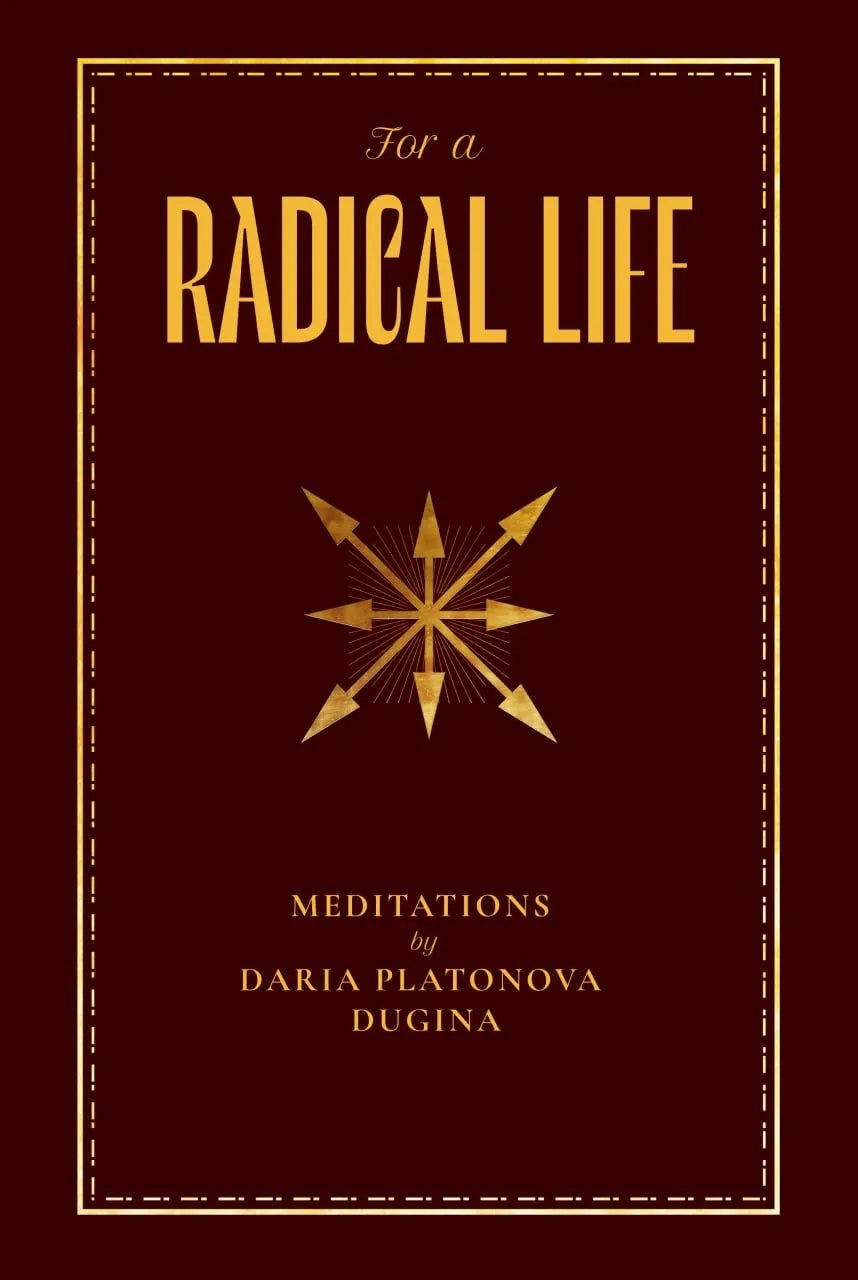
Daria Platonova Dugina was the rising star of Russian intellectual thought, a powerful philosopher and gifted writer, artistically talented, who loved life and honored God. She was the daughter of Alexander Dugin and Natalya Melentyeva. On August 20, 2022, she was murdered by Western-backed Ukrainian Nazi terrorists. This is my third Dugina book review, following Eschatological Optimism (review) and For A Radical Life (review). A Theory of Europe is a masterfully-compilled set of lectures, essays, discussions, and interviews that move forward as one well-threaded narrative. For readers familiar with Daria Dugina, postmodern European political thought, and views that surpass mere “left” or “right”, it will serve as a wonderful summary of approximately half a century of studied rebellion against the prevailing rot. As with any work bearing the standard of Dasha Platonova, it contains new surprises and revelations to interest any mind. And as with Miss Dugina’s previous works, as posthumously translated into English, I heartily, even sternly recommend A Theory of Europe. Please obtain a copy from Arktos or Amazon. Herein, I examine just a few higher points for the reader’s edification.

The tone of the book is set in the Forward by Professor Dugin, who wrote of his daughter, on page 10, “Dasha believed in the New Right and was inspired by their views on the need for a great restoration of primordially European values—classical, ancient, and medieval.” Most or much of my usual audience is either European, European descended, European adjacent, or otherwise at least tangentially interested in Europe. Those in Europe and of European descent now face an epochal change, a choice between enduring or, by postmodern default, diminishing or even disappearing. One hopes Dugina’s take on the restoration of European values inspires them as well. 

She gets right to the heart of the matter on page 16: “…the French Nouvelle Droite represents a Traditionalist, cultural, conservative revolution. The New Right might be called the new encyclopaedists or the new European “Enlightenment”—Enlightenment 2.0—but in the reverse.” The original Enlightenment, one of the most persuasive con jobs in history, broke the traditions of Europe and Western European Civilization by insidious design. It represented the end of the traditional monarchies, the end of meaningful Western European Christianity, a recalculation of the Greco-Roman legal and philosophical legacy, and the alteration of the organization of European nation-states and polities. Going in reverse means ending the charade and lies of the past five hundred years and reestablishing the old order of Christendom.  

Reestablishing the lost order might require a coalition of what could be labeled strange bedfellows. In order to affect both politics and culture, those on the right need to consider at least tactical alliances with some groups on the left, including labor, the ecology-minded, and more—groups not frequently thought of as conservative allies. “For [Carl] Schmitt, politics is always a confrontation between different political units (groups and collectives of various scales) and presupposes a permanent multiplicity, which Schmitt calls the “pluriversum””. A Theory of Europe, page 24. Such a multiplicity counters the artificial universal hegemony imposed by liberal globalism. “[T]he modern West masks the pursuit of its agenda under the aegis of “establishing democracy” and “defending human rights”, Id., 25, while destroying both. By pursuing or pushing individuality as its primary subject, “Liberalism denies collective identity and proclaims abstract human rights, which leads to focusing only on the isolated individual.” Id., 43-44. So liberated from his traditions and culture, the individual finds himself in a vacuous state of self-destruction.

Another link the New Right, particularly Alain de Benoist, encourages and seeks to establish is that between Europe and the Third World. While such a proposition might initially sound strange, it makes sense as both populations, albeit in different ways, are victims of global modernity. Opins de Benoist,  “We are united in our common revolt against the hegemony of the West.” Id., 48. Europeans in both Europe and places like America and Canada should carefully consider this option, both out of deference to the aspect of tandem rebellion against the status quo and out of geographic convenience—whereas Europeans may find common ground with those in the Third World, they will also find those from the Third World already living among them. For those in America, perhaps particularly in Dixie, Dugina’s treatment of things like the 2017 Charlottesville, Virginia torch rally, page 117, might be of interest.

Dugina also examines the cooperative nexus of various religious elements. Europe (and America) rose under the auspices of Christianity. Many still consider Europe and America Christian, Christian majority, or Christian sympathetic. To some extent this is correct. However, vast swaths of the various European populations have delved heartily into atheism, cultism, heresy, and nihilism. The lingering Christian remnants, of whatever size, may have to make do with other allies previously unlooked for. To that end, Dugina notes the predominance of paganism in the echelons of the New Right. “There are rather many neo-pagans among the New Right, practically 90% of the movement.” Id., 66. She also hints at the previous East-West divergence in dealing with pre-existing folk (pagan) tradition: incorporation versus elimination. “Orthodox Christianity absorbed a rather large mass of ancient East Slavic beliefs. We have tighter ties with Indo-European tradition than Catholics do. Moreover, Orthodoxy is closer to Hellenic culture as it was preserved in Byzantium up to its latest eras.” Id., 67. Somewhat related to the idea of holistic incorporation of multiple cultural facets, she observes the close links between the New Right, de Benoist, and others, and her father’s Fourth Political Theory. 

She also explores the philosophies of America and how they have come to dominate much of European thought and economic-political discourse. While she labels the American way, “pragmatism,” Id., 84, others, like Dr. Michael Hudson, have bluntly dismissed America (and other post-Westphalian Western nation-states) as being nothing more than an agent for the international financial class (whose concerns, while generally cold and plausibly irrational in strategy, certainly are pragmatic as to the ultimate goals of enslaving mankind and stealing everything). 

Concerning the international rentier leeches, in Dugina’s included interview with de Benoist, after discussing how the system reduces man to a mere consumer, he remarks of (financial) capitalism:

Capitalism is a system of world government, a system that is driven by limitlessness, infinitude, and always needs more—more profit, more markets, more goods. The slogan of this tendency is: more is always needed. This means that in order to turn the planet into a gigantic market, it is necessary to eliminate all political, social, and cultural barriers, which means eliminating all differences. Id., 182

Summarizing the final effects of the Enlightenment, of the philosophy obsessed with “the end of history”, Dugian notes: “To sum up, today the West is dead. European culture has died. French culture has died along with it.” Id., 254. She ends the book by discussing how Russia’s Special Military Operation in Ukraine has thrown a wrench into the machinations of the luciferian globalists. Sadly, her life was stolen not long after the SMO began. Still, her early observations have proven prescient. Russia’s martial retaliation, along with the greater economic and geopolitical war waged by the sovereign world majority against the globalists, has demonstrated various glimpses, for those who can or will see them, of solutions to many of the quandaries scrutinized in A Theory of Europe. Huge parts of the world have already learned great lessons from the late rebellion. It remains to be seen, in full, if Europe and its New Right, along with associated movements elsewhere in the fading Combined West, will follow suit. Russia, China, et al have, at least, given anti-liberal dissidents a little breathing room and bought time if nothing else. Perhaps the gentle reader of Dugina’s fine treatise might make a positive difference in that regard. If nothing else, it will set the gears and wheels of the brain in motion. And as with any great book, it pays dividends just to read it. Kindly do that soon.

*I would be remiss as a reviewer and friend if I did not thank Professor Alexander Dugin for his excellent heartfelt commentary within A Theory of Europe (and for gifting us the author), Constantin von Hoffmeister for his editorial prowess, Jafe Arnold for his translation skills and his Preface, and Daniel Friberg of Arktos for permission to utilize the foregoing quotations. Thank you, gentlemen.

Deo vindice.

COLUMN: Strategically Incapable and Increasingly Irrelevant

21 Wednesday May 2025

Posted by perrinlovett in Legal/Political Columns, Other Columns

≈ Comments Off on COLUMN: Strategically Incapable and Increasingly Irrelevant

Tags

Russia, strategy, War

Strategically Incapable and Increasingly Irrelevant


In his 1871 essay “On Strategy”, Helmuth von Moltke (Moltke the Elder) opined, “Strategy is a system of ad hoc expedients; it is more than a mere scholarly discipline. It is the translation of knowledge to practical matters, the improvement of the original leading thought in accordance with continually changing situations.” He further noted, or warned, “That is why general principles, rules derived from them, and systems based on these rules cannot possibly have any value for strategy.” Both Russia and America offer sterling examples proving the worth of Moltke’s wisdom.

For approximately 200 years, Russia has operated and refined a logarithmic mathematical model for conducting warfare. In addition to things like tables of organization and equipment, fire requirements, and logistical considerations, the Russian science-cum-art also integrates dynamic adaptability. Russia’s system, to which the West has no answer or equivalent, is on display via the Special Military Operation, wherein Russia makes very effective as-needed use of another of Moltke’s devices, the concept of offensive defense. This is why Russian negotiators can confidently leave a meeting warning, “next time it will be eight [Oblasts Ukraine and NATO will have to part with]”. It’s why and how Russia currently runs a 26 to 1 kill ratio over what’s left of Kiev’s NATOnian army. It’s why they win.

America, on the other hand, a very few, mostly naval exceptions aside, has never been able to conceive of, organize, or execute any real strategic or operational ambitions. Whereas Russia’s eternal principles might be summarized as “promote and defend Russia, win at all costs,” America’s version is a perpetual commitment to serve the international financial class at all costs. America’s servile house values of usury, sodomy, and genocide may work well to destroy America and associated vassal states, but they are worthless in a war against any foe approaching the peer level. They offer no value for strategy and no path towards victory.

In the SMO contest against NATO, the US, and Ukraine, Russia constantly practices that Clausewitzian maxim of politics with other means. With (mit, not von). Moscow maintains a willingness to engage in honest dialogue, all the while maintaining a death grip on the enemy’s throat. In other words, they will have victory one way or another. And Russia appears to find the other means easier to trust than the ordinary political discourse route. America, having no strategic ability, resorts to things like counterproductive sanctions, hodge-podge junk weapons meant for short-term tactical misuse, and endless word spells—none of which are effective. Of course, lately, both sides have appeared open to talks. Russia, we know, is open, and America says it is. America says a lot, usually without meaning, but here’s to a little hope. 

Secretary General of the Collective Security Treaty Organization, Imangali Tasmagambetov, recently expressed “cautious optimism” over the late diplomatic dialogue between Moscow and Washington. In cases like this, that’s probably the only kind of optimism worth holding. After the Putin-Trump telephone chat on May 19, 2025, both sides expressed variants of that optimism. However, there were stark differences between the two cautious assessments. For his part, Vladimir Putin kept open the idea of peace, but conditioned it on objectives Moscow considers essential (like defending Russia, winning, etc.). Trump instead focused on nebulous economic benefits, perhaps forgetting he was talking about warfare rather than a shady New York real estate deal. Regardless, what works will work, so there is still room for circumspect hope, so long as hope is guarded by wary reason.

For all the late hub-bub, America still appears unfitted to maintain a normal existence and relationship with the rest of the world. It remains rather dangerous, though its power to damage is waning. And while America may constitute a pole in the emerging multipolar world order, it is a pole unlike any of the others. As such, the others would do well to keep a close eye on the American monster until something changes. America certainly has not joined forces with Russia and China in the global war of the sovereign states against satanic evil. And for at least a while longer, America cannot join the right side of the conflict, itself being a product of that evil. In fact, America isn’t even sovereign, being instead controlled by various factions of darkness.  The best America can offer at present is more chaos, panicked unpredictability, and endless words of little sense or value. 

America still has a firepower advantage in rhetorical word-slinging. However, that advantage is double-edged because literally everyone sees and understands what Washington’s verbosity really means. (Everyone except America, NATO, Ukraine, and maybe Israel, that is.) For instance, when Trump recently ranted that America won World War II, many Americans felt a sense of pride, both in that the rant was made and in that they felt it was correct. It was dead wrong, of course, and Dmitry Medvedev correctly deemed Trump’s babbling “pompous nonsense.” Similarly, in response to more Trumpian gibbering, Iran’s Supreme Leader, Ayatollah Seyyed Ali Khamenei, called Trump’s bellicose garrulity “a source of disgrace for the American nation.” And, most hilariously, the Ansar Allah of Yemen responded to Trump’s labeling of the Yemeni defeat of the US Navy a “capitulation” by simply continuing to deal with their political problems with other means, aka, by continuing to win.

Again, whatever works, will work. And I have no doubt that the leaders of Russia, China, Iran, North Korea, Yemen, Burkina Faso, et al, know exactly what they contend with in America and how to keep contending with it. To that end, it’s interesting and important to note that “Ansar Allah” literally means “supporters of God”. Really, this is important to all ends, because when one supports God, He usually supports one back. After all, 

Deo vindice!

Originally at Geopolitika, 5/20/25.

BOOK REVIEW: The Lightkeeper by Dr. Sherry Shenoda

09 Friday May 2025

Posted by perrinlovett in fiction, Other Columns

≈ Comments Off on BOOK REVIEW: The Lightkeeper by Dr. Sherry Shenoda

Tags

book review, Christianity, Sherry Shenoda, THE LIGHTKEEPER

The Lightkeeper by Dr. Sherry Shenoda

A Review by Perrin Lovett


Edith Hamilton, classicist and author of The Echo of Greece, once said, “Greece’s great men let all their acts turn on the immortality of the soul. We don’t really act as if we believed in the soul’s immortality and that’s why we are where we are today.” I read The Echo seven to ten years after my misspent undergraduate career and my belated studies of Athens and Rome. However, as they spoke to Hamilton, so the ancient philosophers, historians, and poets spoke to me. I strongly suspect they had a similar influence, formal or autodidactic, on the author of The Lightkeeper. In a book about Deuterocanonical Biblical Wisdom, the wisdom of the ancient thinkers is on display at the beginning of many chapters, also being embedded within them in an instructive, narrative fashion. Among other things, it is a book about the immortality of one particular unusual soul.

*Shenoda, Dr. Sherry, The Lightkeeper, Chesterton, Indiana: Ancient Faith Publishing, 2021. 

Dr. Sherry Shenoda, originally from Egypt, is a California pediatrician, wife, mother, and extraordinarily gifted storyteller. Learn more about her at her website. And please purchase a copy of her sublime novel from the Ancient Faith storefront. 

The philosophy of it all: there is a noble degree of Orthodox (Coptic) Christian apologetics behind the plot and message of The Lightkeeper. It is a beautiful and original explication of the very concept of (Lady) Wisdom, exploring the mysteries of that proverbial truism with stirring elocution. Herman Melville once noted that in addition to the tenants of Old Testament Hebrew faith, Wisdom is also laced with an appreciation of Platonism. More recently, Professor Alexander Dugin likewise explained a strain of the Platonic running through Judaic philosophy, as well as in Islamic reasoning, and, of course, the underpinnings of Eastern Christian Orthodoxy. The same strain grounds The Lightkeeper and provides deep impetus for the story, especially as to the protagonist’s journey. 

It is a book riddled with time travel. And it opens and closes with an entertaining, or even breathtaking loop (a Closed Timelike Curve to make Seth Lloyd smile) that provides closure for the characters, the reader(!), and for much of the apophatic trust through and beyond questioning that both hammers home the philosophy of the book and narrates the first two parts of the tome. From the outset, Shenoda’s Lightkeeper wrestles with questions about her identity and her purpose. She even wrestles with Wisdom in the literal sense. But via her righteous perseverance, she is eventually gifted true wisdom of the kind only God may dispense. And the entire storyline is incredible as it teaches, without lecturing, the value of patiently trusting and enduring; the twists and turns and mysteries presented eventually cobble together a compelling rendition of the lessons lived and learned by Solomon and Adam. Again, there is recurrent time travel throughout the tale, which, on its own, curves here and there, seemingly chaotically at first glance, but with an ardent purpose before the end. And the story even ends with a form of “wave collapse”. 

The ending, or rather, the third part through the satisfying conclusion, provides multiple completions both within the story and within the mind of the reader. Per the Biblical sapiential, the protagonist, already immortal, though still suffering doubt and mental anguish, finds true Life Everlasting in addition to the fulfillment of her real intended purpose. “It’s all for me,” she keeps repeating. And it is, though it is not without the influence of the Lady of Wisdom and the permitting glory of He Who is Above. And another he! He who tends the favorite lighthouse. What, really, are we mortals without a love story? And to that end, Shenoda delivers in a rather surprising, though very gratifying, disposition. I do not dare spoil the romance, instead, I advise the reader will find it riveting and rewarding. Of course, that latter description is one I shall apply to the entire work.

If I am not mistaken, The Lightkeeper is Shenoda’s second book and first full novel. One truly hopes for a second, third, fourth, and so on, as the author exhibits a keen ability to provoke thought and emotion with her exceptional literary fiction. The Lightkeeper is a gem for any Christian, any philosophically-minded individual, anyone seeking pleasant complexity, if within a gently read format, or anyone interested in a touch of eccentric fantasy or traditional romance. I applaud Shenoda and highly recommend her book.

SPECIAL SUNDAY PREVIEW of JUDGING ATHENA

04 Sunday May 2025

Posted by perrinlovett in Books For Sale, fiction, Other Columns

≈ Comments Off on SPECIAL SUNDAY PREVIEW of JUDGING ATHENA

Tags

JUDGING ATHENA

A Preview of JUDGING ATHENA


I knew the answer, of course, but a man sometimes likes a second opinion. And, in a world first, I think I got a completely succinct, unbiased, and accurate answer from an AI bot. I asked Brave’s browser if it is considered crass to write a review of one’s own book. The machine quickly told me, “Yes.” I knew it was right because the yes didn’t have any extra fingers. And because it is crass, as everyone already knows. So instead of being an oaf, I’ll just tell you a few quick things about my new romance novel and provide a short preview section. Judging Athena is available from Green Altar Books and Amazon (there are substantial previews linked at both sites, by the way). Why not buy ten or twenty copies?!

In addition to being a wonderful, innocent love story of the kind the literary world has seemingly forgotten, the book provides a healthy dose of Christian apologetics aimed at fostering romantic connections between men and women and the joint salvation found in the small church of the family home. There’s also copious treatment of general salvation along with a variant of extreme rarity. Here’s my “what makes this book stand out” statement from an (unsuccessful) literary agent query: 

The tide is turning. Outside the West, the majority of humanity is already hard at work dispensing with the overt lies, destruction, and satanism of the Enlightenment. Even within the West, the pendulum is beginning to swing back towards tradition and sanity. The day of all things, including literature, that are anti-God, anti-human, and anti-family is ending now. Judging Athena, with its innocent, Godly narrative, provides a pleasant, positive alternative to the rank filth heaped upon mankind for much of the past century. While a novel and fantastical example, it is also a stern example of several combined Biblical and Patriarchal themes designed by God to bless men, women, children, societies, and nations, all with a constant and reverent eye toward achieving the glory of salvation in Heaven. The book is also fun and refreshing. Good and decent people want good, decent fiction.

Furthermore, the explicated or championed return to tradition and family life is exactly what is desperately needed to keep places like America, Russia, and France French, Russian, and American. After all, ideology and culture are downstream from identity, and identity comes from people. People come from families. You know, moms, dads, and children? We’ve got work to do, friends, but like the book, it will be fun and rewarding. For what it’s worth, also know ye that the little book features such treasures as a philology riddle, a few very light instances of action, a modicum of space travel (way faster than Warp Drive), roses by the bushel, a funeral for a spider, and more. There’s also a creative (and licensed) inclusion of part of this lovely tune by the lovely Sima Itayim!

By the way, if you happen to be a member of AALA, I’m honestly looking for marketing, foreign translation, and potential film rights assistance. Pause for the cause???

Next time, I think I shall return to the geopolitical with an eye on America’s new place in the global pecking order. My working title for that is “Breaking Ranks”. You’ll know it when… Blabbity, blabbity, blah. Here’s the first short, sweet chapter of Judging Athena. Enjoy, and as always, Deo vindice. 


One – Made of Finest Nickel


The temperature slowly descended as the oppressive gray of twilight gave way to another early New England night. The young man sheltered beneath the lofty portico, between sturdy stone columns afore the entrance of the impressive structure. He looked some distance down the long, dark sidewalk and across the street, back towards the parking lot and his car. The distant lamp was well-placed and provided nearly ample lighting, though, of course, the time and the weather failed to fully cooperate. At just a tad after six o’clock, the afternoon, or the evening, held a darkness better suited to a damp midnight. It was, after all, if he had reasoned, the middle of November. And the chill threatened to give way to hard cold, a stern preview of the approaching winter. Not the first snowflake had he yet glimpsed that fall, but that afternoon, or since he’d left work some thirty or so minutes earlier, a healthy if depressing sleet had presented itself in force. Even where he stood, the rise, fall, and whip of the wind brought more tinkles of slush to his face and coat. The resulting sensation, along with a semi-long squint of a look at his older Honda Civic, brought recent words back to his mind.

‘Yeah, you’re gonna need it sooner or later. Maybe sooner than later,’ the mechanic had told him. ‘For you, I can get a new radiator in there for, lemme just say, give or take, about seven-fifty. Could do it in one day. If they got the parts, of course.’

‘Seven-fifty,’ he’d quoted back somewhat hazily to the kindly man.

‘Give or take.’

‘With the— If I needed any related tuning or if something else needed replacing, would I be safer budgeting a flat thousand?’

‘You know your car, young feller,’ the mechanic said. ‘Heater core, worn tires, et cetera. Eventually, it’ll be more like a couple grand. But, yeah, a thousand would make it easy for now. And just so you know, I think she’s got a few more miles and maybe months left in her. I do know money is tight. Just keep an eye on the gauge and the reservoir level until you’re ready. I’ll be here, so lemme know.’

‘Thank you very much.’

‘And back to the flakes,’ the mechanic said, ‘nobody claims they like ‘em, but in a case like this, I say just sprinkle as needed and trust the good Lord to get you through.’

They both laughed at the time. Back under the awning, the young man suddenly wondered if he had any flakes left in that little jar. He simply couldn’t remember. He needed to budget—even more than he usually did—but the poor man’s antifreeze fix was pretty cheap. He looked and squinted again now that the wind had died just a bit. From his vantage point, he didn’t see any steam coming from under the hood. That was well. He didn’t have a thousand dollars or even the suggested seven-fifty. The situation made the Lord’s trust mandatory and, accordingly, something else to be grateful for. Turning to go through the large, heavy doors, he thought a little more about his finances.

Once inside both sets of doors, he stopped just inside the little entry alcove before the main landing and rotunda. After shaking slush from his hair and water-resistant medium-weight jacket, he momentarily took out his phone. In a jiffy, he’d punched up his meager checking account. Based on what he needed to set aside for rent and the basics until the next payday, he simply didn’t have the money for major repairs. Not just yet. He said a quick trustful prayer about it all and then turned off his analytical mind; he had a different kind of necessity to purchase, one that wasn’t about him, and, thus, to his mind, far more important. With a sigh of determination, he pocketed the phone and walked deeper into the main hall.

Fully surrounded by its environment, he was reminded how much he enjoyed the Gallery. In addition to so much visual detail and subdued excitement, it had the pleasant smell of a good museum or library, and the temperature and humidity were always perfect. But on that evening, and at that hour, he felt like he was all alone there. He saw no one else and he couldn’t make out the first voice or footfall. Regardless, he walked on toward fulfilling his little mission. Just before taking his next step, he thought, perhaps prophetically, certainly fortuitously, to pop a breath mint into his mouth. A turn to his right and he saw the main reception desk. No one was there. Walking just past it and turning again to his right, he found the gift shop. Still observing no one about, he slowly walked inside.

It was as he remembered it: well-lit, modern, comfortable, and full of interesting merchandise, though he understood more than a few of the wares were a little pricey. He was just beginning to earnestly look around, wondering exactly what he wanted and how much it would set him back, when he thought he heard sweet, soft music playing. As if in a dream, he tried to listen to the melody. Suddenly, he realized the song had lyrics. Or were they plain spoken words? Something suggested they were. In fact, he almost thought some enchanting voice was speaking to him, saying, ‘Just a moment, and I’ll be there.’

And just like that, someone was there. He saw her coming from the corner of his eye. ‘Hello,’ she said, approaching him with a smile. ‘My sincerest apologies if I’ve kept you waiting.’

He just looked in the direction of the voice and froze, staring in disbelief. The sound of her speech was enough to bend time; it was clear, concise English, but it bore the supple hint of an accent he simply could not place. Given enough time, he might have reluctantly, unimaginatively decided it could have been a French accent. But the temporal temporarily evaded him. If her voice slowed perception, then the sight and beholding of her brought time and space to a complete standstill. Before him was, as best he could describe her, the most beautiful woman he’d ever seen. Or even dreamed of seeing. In fact, he instantly decided he was looking at the most beautiful woman in all the world, maybe of all time. 

He discerned a nearly supernatural being, one of impossible, definitional, and divine beauty made or forced to be painfully visible, almost palpable, visceral. She was tall for a woman, about his height. He wasn’t sure if she was wearing heels. If so, then she might have overtopped him by half an inch. Her proportions were simply perfect as displayed by way of proffer through the elegant gray dress or skirt suit she wore. She had the longest, silkiest, blackest hair imaginable. Piercing eyes shined forth from an angelic face without flaw. Her irises flickered like lightning, though he was unsure of their exact color, at one imperceptible millisecond appearing blue, then gray, then hazel, and then some alluring, undefinable combination. If she wore any makeup, it was minimalistic. Her face and body defied any sign of age; if he had to guess, if his life depended on it, he would have said she was a little older than him, perhaps in her late twenties. She was a young woman in her utter prime, the ideal specimen. And somehow he felt as much as saw a glow about her. She was smiling, friendly, honestly, and kindly with rich red lips as she slowly advanced towards him. Before her wafted a smell sweeter than any flower, a scent that, even as it demanded attention or even adoration, almost physically pushed him away like the strong breeze at the edge of a hurricane. Helpless and deprived of his clear senses, he took a step backward. He felt his pulse begin to race. The rapid beat felt so good, if the feeling did cause him additional slight confusion, possibly alarm, something between fear and glee. Yet, truth be told, it was probably much closer to pure glee.

‘How may I help you, sir?’ she asked.

‘I, I—’ he stammered even as he felt his back touch something. Quickly turning, virtually in a panic, and with no time to spare, he was just able to grab the little green porcelain vase before it fell off the short white marble stand. As he handled it, he caught a glimpse of the price tag – $999.95. ‘Oh, wow,’ he stuttered as he gingerly replaced the vessel. ‘I, I, I—’

‘I’m so sorry, I didn’t mean to startle you,’ she apologized, still through a bewitching smile that now intimated kind laughter.

‘No, I’m sorry,’ he said as he turned once more to face her. Maybe it was the lighting or a trick of his mind, but it appeared that she had melted into a more ordinary form of extreme beauty, still seemingly too perfect, but, at least, earthly. ‘I, I— I’m just looking for a little g-g-gift.’

‘I’m Athena,’ she said, extending her right hand to him.

He nervously took it and then openly if thinly gasped. Upon their touching, upon the grace of a short, formal handshake the kind proper ladies receive and dispense, he was taken by a sudden calm that swept his whole body, mind, and soul. And just like that, he was back to being himself, back to being able to see, think, and speak again, and back on his minor gift quest. He was keenly aware, however, that he felt greatly gladdened, or joyous even.

‘Athena,’ he said with a warm smile and a subtle blush. ‘Athena? Like the winged Nike Athena? Wow. I’m Josh.’

‘It’s very nice to meet you, Josh. And, yes. Shhhh—I’ve never heard anyone guess my secret identity before,’ she said with an open laugh, soft, sincere, and perhaps flirty. ‘Now, you’re looking for a gift? You’re in the right place!’

‘Well, yes,’ he said more affirmatively, finally feeling like he’d come back to having his feet on the ground. ‘I’m looking for something small and simple for a lady friend.’

Athena strolled a few feet into the assorted shelves and stands, one finger to her lips as she thought. ‘Your friend, is she a special lady? I take it she is.’

‘Yes, very much so, very dear to me. My sweet Isabella,’ Josh said. ‘I suppose I want something she can wear, something to remind her of the exhibit and our seeing it. It’s also for her birthday in a few weeks.’

‘Are you coming to see it together, the Gallery, or have you recently browsed?’ she asked.

‘Oh, I’ve been here before. But this will be her first visit. We’re coming tomorrow, about this time, as part of a little group. We’re taking a guided tour of the Patterson prints.’

‘I see,’ she said with another delicious smile. ‘Please give me a second while I think. With the flu season hitting early, we’re a little short-staffed tonight. The shop, while I know most of what’s here, isn’t my usual station. Patterson— I fear we don’t have anything directly related to his works, certainly nothing like apparel.’ She paused as she looked around thoughtfully.

‘Oh, I didn’t mean to keep you from anything,’ Josh said. ‘Do you work at the desk, or back in the gallery?’

‘Yes, the latter. I’m the curator,’ she said, still looking and thinking.

‘Of the whole museum? Wow, that’s impressive!’

‘Yes, and thank you,’ she said, turning again with that smile. ‘Something she can wear. But I take it not a hat or t-shirt, correct?’

‘Well, no, maybe something a little more special or formal than that, more meaningful.’

‘I’ve just the thing!’ she said, snappily striding towards the back wall. ‘Or, just the set of items. How about jewelry?’

Josh joined her in front of the wall and a case full of adornments and treasures. His money woes uneasily hinted at the back of his mind. ‘Maybe something, uh, something affordable? Small?’ He looked at her hopefully.

‘Just the thing!’ she almost sang. She reached down to the end of a shelf and picked up a short necklace with a small oval locket, the assembly of which appeared to be made of slender loops of some shiny if slightly tender metal. ‘This is our Doris Harper limited collection. Mrs. Harper makes every piece by hand in her Maine cottage. No two pieces are ever the same—each is a unique triumph. And she only makes them of the very finest nickel. A gift to thrill Miss Isabella for a lifetime.’

Josh understood exactly zero about jewelry, or metals, for that matter. But he instantly loved what he saw and happily envisioned it hanging around someone special’s neck. ‘Nickel?’ he asked somewhat timidly.

‘Not so brash or commonplace as gold or silver. Or platinum. And there is great art in these designs. The craftsmanship, the presentation is what sets them apart. We regularly ship them coast to coast and to Europe,’ she explained. ‘I don’t know what it is, some secret, but they’re treated with a patented clear protective layer or electroplating that preserves their so-slightly muted luster and prevents any unwanted allergic activity if that would be a problem. I just happen to be wearing one of her bracelets.’ She raised her other hand in demonstration. Josh looked at the bracelet, not knowing exactly what he was supposed to look for. He also took the chance to observe her left hand, seeing smooth lineless skin, polished hard nails, and, he noted with a quiet thrill, no rings. He gave a quick glance back to her neck and head. He couldn’t see a necklace though he saw she wore simple earrings that complimented the bracelet, her outfit, and her flawless face.

‘I do like that locket,’ Josh said, his thoughts still resting on her appearance and bearing. ‘Dare I ask how much it costs?’

‘Far less than one would think,’ she said knowingly and kindly. ‘This is only one-fifty!’

Josh quickly calculated he could afford it, that it would only delay his repairs but a short month if that, and that the purchase would be well worth it. ‘Isabella will love it forever,’ he happily thought to himself, her sweet, cute face temporarily replacing Athena’s in his whirling mind. He smiled at the notion of presenting it to her the very next evening around the corner in the traveling exhibition room. ‘I’ll take it!’

As he reinserted his debit card into his wallet, he watched Athena wrap the little white box holding the locket. They were both smiling throughout the transaction. But through the whole process, Josh thought to himself: ‘I wonder what Isabella would think of Athena? I wonder what I think? What do I think?! Is this love at first sight?! Oh, my Lord! What, if anything, do I say? What do I do?’ He felt his heart rate accelerate again.

Still with that smile to thaw any heart, Athena handed him the little wrapped package. ‘I’m sure she’ll love it. I will be in, this time tomorrow. If you get the chance, I’d like to see you again, Josh. I’d like to meet you and your special little lady!’

‘And that will be something!’ he thought. ‘It’s a deal,’ he said. ‘We’ll, hopefully, see you tomorrow.’ He turned to go but then paused. Turning back to her, he reached out for her hand. Shaking it lightly, again feeling that delightful calm and warmth, he said, ‘Thank you so very much, Athena. Well met, and I look forward to seeing you again.’

She smiled once more, though this time the look went much deeper and higher than before, a touch of giddiness added to her existing pleasant transcendence. He left and she watched him until he exited through the main doors. As a matter of common courtesy, she immediately decided against further observing his movements outside.

‘Wow,’ she said openly. She then reflected on their brief meeting. He was an inch or so above average height for a man in those times. His hair was dark brown and well matched his keen sparkling eyes. She could tell that beneath his blue coat he was slim though not thin. Below his coat, she’d seen clean, neat casual slacks over well-loved walkers. He was, to her eyes, very cute, adorable even. She had, even when she first approached him, sensed he was sweet, kind, gentle, and pure. That boy. That man of what? He’s probably only in his early twenties. Yet he seemed so timeless. And sincere. Wonderful. And … she then thought very deeply: ‘Could he have actually seen me? Even for a second, could he have seen me as I really am? As best his eyes might contrive? If so, he is a great rarity. Regardless, his lady friend is most fortunate. He didn’t say what kind of special friend she was. He wore no ring, nor did he mention her romantically. I dared not read his thoughts, settling for a woman’s guess instead. And what do I now guess? Isabella. I know not about her, but is this? For me, is this? Could this be love at first sight?!’ A feeling she had not known or even thought of in an age took her for the barest moment. She closed her eyes and breathed deeply. Then, as she gave thought to the night’s closing, she decided to check the computer registry for the following evening and any scheduled guest groups.

Outside, seated in his small, older economy car, pelted by more sleet that, by the sound, hardened as the temperature continued to drop, Josh thought for a quiet moment. Then he spoke to the night, ‘I know Isabella will love this gift. And our visit. All of them will.’ He smiled, crossed himself, and then spoke to his Father, ‘Thank you, O Lord, for this gift, for Isabella, and for my meeting Athena. I don’t even know what I want to ask. Or even what to think. You know my heart and all things. Thank you, thank you, thank you! For all this and Your continuing mercy. Amen.’ He smiled just before adding, ‘And please, God, please keep the wagon wheels turning!’ With that, he turned the key and watched with relief as all the gauges rolled into place. He backed out and drove on and all was well in the deepening night.

A few hours later, at his bedside in his little apartment, he said another prayer. It was one of thanksgiving for his life, his blessings, and for tomorrow evening. He almost sang it out, so glad was his heart.


COLUMN: Home-growns Are Next

18 Friday Apr 2025

Posted by perrinlovett in Legal/Political Columns, Other Columns

≈ Comments Off on COLUMN: Home-growns Are Next

Tags

"law", deportations, GAE, Trump

Home-growns Are Next


Twenty years ago, the late, great Thomas Moore published a fantastic action novel, The Hunt for Confederate Gold. One of Tom’s themes was the domestic terrorism of the then-new Yankee Department of Homeland Security (DHS), another imperial gift to the “land of the free” stemming from the September 11th false flag attacks.  DHS was nominally created in 2003 to secure the homeland from nebulous terrorism or some such hysteria. Fears immediately grew that DHS would instead morph into yet another agency dedicated to making the lives of the innocent miserable. The fears were well-founded. These are, after all, the people who practice amateur proctology at American airports. In Tom’s book, DHS agents run roughshod over the civil liberties of Dixians. Charles Sheehan-Miles captured a fictional phenomenon similar to Tom’s in Republic (2007), wherein Yankee stormtroopers are so abusive that West Virginia has no choice but to risk war via secession. 

Today, DHS is back in the news in real-life, for a variety of reasons, none of which have anything to do with making Americans freer or more secure. When the department isn’t rounding up anti-genocide protesters from US college campuses and deporting them under rather specious circumstances, they’re evidently “gangstalking” US citizens. Just like the good old Stasi! Rounding up those who oppose the wanton slaughter of entire populations is also what the French do, and they don’t even have freedom fries. So far, the American street-nabbings, secretive hearings, imprisonments, and deportations have been limited to guests, residents, and Visa holders. So far. 

There are more than a few people residing within the US desperately in need of deportation. About half of them appear to work either in Congress or for the Trump administration. Trump ran for his second term partly on immigration reform. He even issued a stern and proper-sounding Order back in January regarding Protecting The American People From Invasion. As Americans place a nearly divine faith in and around the power of mere words, this grand proclamation, only six decades too late, should suffice. Something tells me that beyond mere words, nothing else of substance will happen. Incompatible invaders only become a problem once they’re a problem for the elites. The elites celebrate the core values of “democracy”, one of which is genocide. Protest that, in any way, and off to El Salvador with you.

Now, the Trump hints that he wants to deport Americans to foreign prisons or torture centers. It wasn’t exactly clear what he meant when he spoke to Nayib Bukele the other day at the White House—and nothing the Trump says is ever that clear—but all-in-all it would appear someone is in the crosshairs. 

I’d like to go a step further. I mean, I said it to [AG] Pam [Bondi] I don’t know what the laws are —we always have to obey the laws— but we also have homegrown criminals that push people into subways that hit elderly ladies on the back of the head with a baseball bat when they’re not looking, that are absolute monsters,” Trump added. “I’d like to include them in the group of people to get them out of the country, but you’ll have to be looking at the laws on that.

One might suspect the monsters the Trump mentioned, none of whom commit crimes within the federal purview, probably aren’t his targets. The real “monsters” he’d really like to ship away are the kind who dare defy or object to those lovely values of the Talmud or any associated evils. And the law has nothing to do with it, with anything. The law in the US has always been a fiction, words on paper, quickly disregarded whenever deemed necessary to maintain elite control. Think the law is a barrier to the deportation of US citizens? Then, just type “Clement Vallandigham” into the search engine of your choice. Decades before Sinclair Lewis wrote It Can’t Happen Here, it already had happened. It has happened since. And it will happen again. 

No, I’m sure it won’t happen to you, so don’t worry. Things like this always happen to someone else. Maybe the unlucky dissenters of tomorrow will be shipped off to Trump Camp in Somaliland, the proposed future home of the surviving Palestinians and future imperial regional military meddling center. Breakaway Somaliland is yet another place most ‘Murikans couldn’t find on a map, but it may receive official recognition from the Trump in exchange for allowing the use of its land for Trumpian madness. No, fellow Southerners, they will never recognize Dixie.

Nothing in America is ever what it seems. Trump’s tariff scheme isn’t about trade barriers, which would if enacted properly, be a good thing. It’s probably not even coherent economic warfare. It fits with the Trump way: much talk, muddled action, and rank confusion. Peace-maker Trump, all about “America first”, keeps groveling before his foreign overlords while making war or chaos in El Salvador, Greenland, Somaliland, Yemen, Palestine, Lebanon, Iraq, Iran, China, Ukraine, Russia, and likely one-hundred other places—none of them in America or of any strategic interest to Americans. When all the foreign adventures fail, and they will, then the focus will be entirely on the home-growns.

All of this late lunacy was accurately predicted by Dr. Fadi Lama in Why The West Can’t Win (2023), page 357: 

The chickens have come home to roost. The oppression inflicted by the Money Powers against humanity will now be directed internally. Until people in the Western Realm revolt against this miniscule parasitic financial “elite” that oppresses them, and recover their civilizations and sovereignty, the best depiction of their future would be George Orwell’s statement in 1984: 

If you want a picture of the future, imagine a boot stamping on a human face – forever.

The US is not a sovereign country, and therefore cannot be a valid part of the new order of sovereign nations. It could theoretically fit in as a pole in the multipolar arrangement of world power. But unlike the others, the US pole will remain untrustworthy and dangerous—abroad and, especially, at home. This situation will, I think, continue until the US collapses or burns out. For my part, when or if the time comes, I’d like to be deported directly to Moscow. Thanks in advance, Yanks!

Deo vindice.

COLUMN: “Economic Gain Extracted”

02 Wednesday Apr 2025

Posted by perrinlovett in Other Columns

≈ Comments Off on COLUMN: “Economic Gain Extracted”

Tags

economics, War

“Economic Gain Extracted”


Preparing to promote a novel, even while writing another one and lazily revising two more, I may also be formulating a theory regarding the place of the US in the multipolar world. It may be that the Empire of Lies and Cowards may have no choice but to play nice, or to pretend to when dealing with the other great powers, Russia and China. If you’re in a senior leadership position in Beijing or Moscow, kindly keep a wary eye on your new frenemy in Washington.

Concerning the rest of humanity, the US has not changed. It’s all bluster, bragging, browbeating, bribes, and, then, bombs. And regarding those souls trapped in the US homeland, it begins to look like more of the same though with only a slightly different character or hue. 

At one point during the late Signal chat retardery, the lowbrow discussion turned towards all of the vital American interests in bombing houses, convenience stores, and cancer hospitals in Yemen and Europe’s collective inability or unwillingness to participate in the scheme. Someone initialed “SM”, likely Stephen Miller, wrote, “If the US successfully restores freedom of navigation at great cost there needs to be some further economic gain extracted in return.” By the way, bombing poor but invincible people will not “MAGA”, unless as Max Blumenthal says, MAGA really means “Miriam Adelson’s Goals Achieved.” But “economic gain extracted” essentially summarizes the entire purpose, history, and spirit of the American experiment. Being little more than a hitman for the international financial class, the US is always extracting gain for the money masters, everywhere, in everything, and from everyone. 

Scott Bessent, retired hedge fund looter, Soros acolyte, open homosexual, and current Secretary of the Imperial Treasury, was remarkably candid during a recent meeting of the Trumpian cabinet about plans to further the gains of the rich men: “Yes, sir, [Massa Trump, sir]. So, uh, we are, under your direction, we’re reprivatizing the economy. We’re bringing down government spending. We’re bringing down excess employment in the government sector. On the other side, we’re going to re-leverage the banking system…” 

America was founded for the corporations, by the corporations, and of the corporations. Literally, everything it officially does today is designed to enrich the wicked elite by plundering everyone else. Accordingly, re-leveraging the banking system can only mean making the plundering easier. The process is in play in America, along with Yemen, Western Europe, Greenland, Ukraine, et cetera.

Washington reluctantly accepts that it cannot defeat Russia. However, it is hellbound and determined to loot and wreck Ukraine or whatever parts of the former Ukraine survive. Bessent and Trump are trying to force a “deal” on the illegitimate junta in Kiev, possibly more onerous than the Weimar plan that eventually gave the world its second global war. Rumor has it Lil’ Ze has rejected the plan, for now, but it fits the eternal American pattern: poor people and their alleged governments take all the risks and casualties and bear all the expenses, while the banks, hedge funds, and other corporations steal all the resources and keep all the profits. Corporatism is war with other means.

Despite centuries of practice, the US has never been good at regular maneuver warfare. Its power rested, post-WW2, on two things: the perceived strength of the US military, and the perceived safety and universality of the US Dollar. Both things have taken serious hits this century, and now the game appears to be one of frantically trying to leverage bombing with or against predatory financialization. Please keep those seatbelts on, fliers.

The Yemeni adventure is possibly a runup for an even more catastrophic attack on Iran. One truth from the Signal idiocy is that Americans know nothing about Yemen. Iran is another country Americans know nothing about. They’re not likely to learn about either, as now even US college students are increasingly illiterate. Iranians, however, are notoriously avid readers. As are Indians and Chinese, with around 600 million regular readers among each population. The moral of this short column is that my novels need translation into, among other languages, Persian, Hindi, and Mandarin. That’s how I’ll extract my economic gain.

Deo vindice.

COLUMN: Why Men Should Read Fiction

14 Friday Mar 2025

Posted by perrinlovett in Other Columns

≈ Comments Off on COLUMN: Why Men Should Read Fiction

Tags

books, current events, JUDGING ATHENA

Why Men Should Read Fiction


Vox Day did a very good job, over at Sigma Game, lately explaining why (American/Western) men don’t read much these days. Few real men want anything to do with loony witches, fembots, and caustic blue-haired harpies. Yet those types, along with some other usual suspects, constitute the majority of Western book authors, publishers, distributors, buyers, editors, gatekeepers, and agents. If one reads Vox’s article, then one will gain a decent understanding of the astroturfing of what passes, at least in the eyes of too many postmodern women, for best-selling literature. Add to this tragedy the decline of general intelligence, burgeoning post-literacy or illiteracy, and the shunning of men from traditional male ideas, systems, endeavors, and spaces, and one has a recipe for a rolling disaster. 

Patrick Lawrence wrote the other day about part of that unfolding disaster as it pertains to the peculiar case of Yankee Attorney General Pam Blondie’s circus sideshow release of files regarding the criminal activities of dead pedophile Jeffrey Epstein. If one has just arrived from another galaxy, then know that Epstein was the poster boy for an international child sex trafficking ring and likely intel asset. Evidently, the only good thing the man ever did was die. Blondie hyped her file release, then crawfished when the event underwhelmed. She now claims she has better information and will release it once certain redactions are made. Lawrence honed right in on one given reason for some of the redactions: “national security”. 

Let us consider: What issues of “national security” would require redaction in regard to a deceased sex-trafficker or his underage victims, unless our government or close allies had been involved in said sex-trafficking ring?

The Yankee empire, its agents, friends, and allies, have a long and wicked history of involvement in related matters. Way back in 2019, I wrote a few bits about the quiet release of another batch of previously classified data, the FBI’s “Finders Files”. Those files concerned a series of 1980s cases of child sexual abuse at daycare centers that became popularly known as the “Satanic Panic”. After the children’s allegations were “investigated”, we were informed the kids made it all up, nothing happened, and don’t you dare suspect anything similar going forward. Thirty years later, we learned that everything the kids said was true, the government knew about it at the time, and there was a cover-up. A few august members of the retarderati responded to my articles by telling me I was a fool for rehashing long-debunked cOnSpIrAcY ThEoRiEs. And, yes, I had linked to the same set of files back then in the articles, but again, the not reading angle. 

What does any of this have to do with fiction? Well, I included the Finders and a fictional version of Epstein, the notorious Geoffrey Steinberg, in my 2019 novel, The Substitute (2023 revision from Green Altar Books). Oddly enough, when he found out I was writing my first major work of fiction, the late, great Thomas Moore said, “That’s great, and you should! Just remember, though, that half the people are illiterate and the other half don’t read.” He was, of course, being jovial, though as we know he was onto something. Those who have read my book enjoyed a narrative telling of the foregoing criminal atrocities and more as seen through the eyes of a former CIA killer. In chapter sixteen, page 191, Tom Ironsides even warns a young FBI agent specifically about the Finders. Agent Pennington was at Tom’s house after the hero inadvertently busted up an Epstein-esque operation within the public school system(s). On the next page, Tom’s former employer thanks him for his help while promising the DOJ will relieve him of the burden of testifying out of deference to … national security. And Tom knows what Lawrence suspects: there is always Yankee government involvement in such filth.

By the way, I noted a long history of such evil. This involvement is as old as, in fact, older than America itself. If one has access to that newfangled internet thing, then please search for the strange case of all the little skeletons found under Benjamin Franklin’s old house on the apply-named Craven Street in London. Yeah.

One beauty of writing fiction is that the author can provide satisfaction for certain unpleasant matters in ways simply impossible for the average man to affect in real life. For instance, in chapter twenty-one of The Substitute, in the subsection “Justice Delivered,” Tom learns that Mr. Steinberg, his tropical island liar, and several dastardly associates are eliminated one evening by a massive thermobaric explosion. (Secret reveal: the blast is caused by a drone cargo 747 loaded with the mythical “C-12” ultra-high explosive [a non-RDX, post-nitroamine agent]. Why? Because.) As a bonus, the reader also witnesses Tom’s fond memories from the time it was his honor to assassinate a chief associate of Steinberg in Sicily. That extrajudicial hit, by the way, will be explicated in my forthcoming novella AURELIUS. 

Remember, all men and women, that fiction has the stirring ability to connect the reader to assorted subjects by creating a personal link between those subjects and the reader’s thoughts and emotions—a powerful and sometimes fun force. 

In conclusion, I recommend a few random novels for the esteemed consideration of my readers here. First, there’s the self-serving mention, again, of The Substitute. Then there’s Counterparts by the late Gonzalo Lira. Next, we have The Ways of the Dead by Neely Tucker. After that, I am currently enjoying the heck out of The Lightkeeper by Sherry Shenoda, a fantastic Christian fictional tale possessed of a keen and unusual literary quality. Finally, and again of self-serving interest, there’s the soon-to-be-published Judging Athena, Christian fiction unlike any other and utterly unlike my ordinary fare.

(Green Altar Books, forthcoming.)

Athena is an exposition and championing of the beauty of marriage and the salvation-fostering benefits thereof. Believe it or not, even though it’s my work, there’s zero cursing, lust, or jaded polemics in it. There is a modicum of turbulent action, partly of a nature related to those instances noted above. However, when those very few scenes come along, they will be welcomed by the reader, and they unfold, divinely inspired, in a different direction than my usual compulsion. The love story itself, as compelling as it is innocent, is a superb singularity. Soon, my friends.

Deo vindice.

← Older posts
Newer posts →

Perrin Lovett

From Green Altar Books, an imprint of Shotwell Publishing

From Green Altar Books, an imprint of Shotwell Publishing

Perrin Lovett at:

Perrin on Geopolitical Affairs:

Archives

  • January 2026
  • December 2025
  • November 2025
  • October 2025
  • September 2025
  • August 2025
  • July 2025
  • June 2025
  • May 2025
  • April 2025
  • March 2025
  • February 2025
  • January 2025
  • December 2024
  • November 2024
  • October 2024
  • September 2024
  • August 2024
  • July 2024
  • June 2024
  • May 2024
  • April 2024
  • March 2024
  • February 2024
  • January 2024
  • December 2023
  • November 2023
  • October 2023
  • September 2023
  • August 2023
  • July 2023
  • June 2023
  • May 2023
  • April 2023
  • March 2023
  • February 2023
  • January 2023
  • December 2022
  • November 2022
  • October 2022
  • September 2022
  • August 2022
  • July 2022
  • June 2022
  • May 2022
  • April 2022
  • March 2022
  • February 2022
  • January 2022
  • December 2021
  • November 2021
  • October 2021
  • September 2021
  • August 2021
  • July 2021
  • June 2021
  • May 2021
  • April 2021
  • March 2021
  • February 2021
  • January 2021
  • December 2020
  • November 2020
  • October 2020
  • September 2020
  • August 2020
  • July 2020
  • June 2020
  • May 2020
  • April 2020
  • March 2020
  • February 2020
  • January 2020
  • December 2019
  • November 2019
  • October 2019
  • September 2019
  • August 2019
  • July 2019
  • June 2019
  • May 2019
  • April 2019
  • March 2019
  • February 2019
  • January 2019
  • December 2018
  • November 2018
  • October 2018
  • September 2018
  • August 2018
  • July 2018
  • June 2018
  • May 2018
  • April 2018
  • March 2018
  • February 2018
  • January 2018
  • December 2017
  • November 2017
  • October 2017
  • September 2017
  • August 2017
  • July 2017
  • June 2017
  • May 2017
  • April 2017
  • March 2017
  • February 2017
  • January 2017
  • December 2016
  • November 2016
  • October 2016
  • September 2016
  • August 2016
  • July 2016
  • June 2016
  • May 2016
  • April 2016
  • March 2016
  • February 2016
  • January 2016
  • December 2015
  • November 2015
  • October 2015
  • September 2015
  • August 2015
  • July 2015
  • June 2015
  • May 2015
  • April 2015
  • March 2015
  • February 2015
  • January 2015
  • July 2014
  • June 2014
  • September 2013
  • August 2013
  • July 2013
  • June 2013
  • May 2013
  • April 2013
  • March 2013
  • February 2013
  • June 2012

Prepper Post News Podcast by Freedom Prepper (sadly concluded, but still archived!)

Blog at WordPress.com.

  • Subscribe Subscribed
    • PERRIN LOVETT
    • Join 41 other subscribers
    • Already have a WordPress.com account? Log in now.
    • PERRIN LOVETT
    • Subscribe Subscribed
    • Sign up
    • Log in
    • Report this content
    • View site in Reader
    • Manage subscriptions
    • Collapse this bar
 

Loading Comments...
 

You must be logged in to post a comment.