
Bodaciously True & Totally Awesome, Episode II: True Blue by Chris Orcutt
Review by Perrin Lovett
Here we go again! Generation X, elders, young folks, it’s once again time to head back to the glory of the 1980s. Here’s another brief look at Chris Orcutt’s unfolding masterpiece, Bodaciously True & Totally Awesome. Specifically, it’s Episode II: True Blue. To butcher some Whitesnake lyrics, “here [we] go again on [our] own.” But, of course, we’re not alone. Far from it. Thanks to Orcutt, we’ve got some hellaciously good company for this particular tour de force down memory lane!
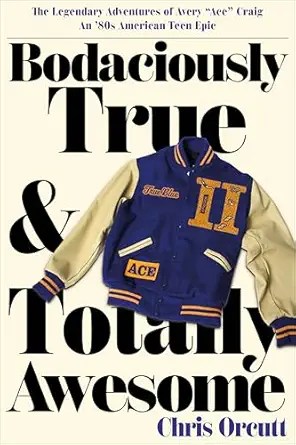
(Cover design by Victoria Heath Silk with image by Hurst Photo & Top Quality Vectors.)
*Orcutt, Chris, Bodaciously True & Totally Awesome, Episode II: True Blue, New York: Have Pen, Will Travel, 2026.
If necessary, please read my review of Episode I: Bad Boy. Please also read my interview with the author. Orcutt also gives a mean video interview! And if you’re just tuning in, then please buy a copy of both books (Bad Boy is now available, outright, and True Blue is available for pre-order) and fully acquaint yourself with Chris Orcutt, the author some regard (rightly) as the American Tolstoy and whom I’ve previously called “the best American novelist alive today.” I’ve also proclaimed, based on reading Episode I: Bad Boy, that Orcutt has joined the ranks of the greats—Homer, Ovid, Chaucer, Shakespeare, Pushkin, Gogol, Murakami, et al. With True Blue, he does not disappoint.
Your reviewer herein incorporates all points of the Bad Boy review as if each were restated in full. I will now specifically summarize a few of them, updated for True Blue. Bodaciously… still moves like a roller coaster, although this time, there is a lot of snow, so kindly remember a parka and boots. Avery, the sixteen-year-old protagonist and James Bond fan, now acts out his admiration for Ian Fleming’s star character in gripping fashion. Once again, Orcutt’s writing is flawless. Again, my six-by-nine paperback is a marvel of literary engineering. Yet again, a spiritual or philosophical theory presents itself throughout the pages; Avery, as Orcutt put it in our interview, “is groping for meaning spiritually, kind of trying on different spiritual or philosophical hats.” As Orcutt said, this process was not deliberately inserted into the text. As I said, it is something the reader will discover and process on his own. Orcutt says, correctly, that a story is a story, not an argument. Of course, this particular story, like the better ones, comes with good examples and keen reminders—notes to engage the reader’s spirit and intellect. Avery continues to be a stellar ladies’ man, and his relationships, proceeding at a dizzying pace, add multiple aspects of excitement to the reading experience. That experience is further heightened by Orcutt’s deft usage of various historical elements, added via living incorporation, that take True Blue into territory where most novels simply cannot go. The reference footnotes keep rolling, and Orcutt even has one FOR TOLKIEN! (A big deal for your reviewer.) The exploration of human psychology continues, led valiantly by Avery, the alpha. Through all the new twists and turns, the reader, regardless of age or generation, will continue to feel and recall the attendant emotions and notions of youth. Oh, and the quintessence of our glorious 1980s music also continues!
Now, without giving too much of the story away, here is a modicum of detail. True Blue presents a series of little reminders about things that have practically vanished from American life. Remember popping the clutch to bypass a dead battery? You will! Well, those over forty or fifty will. Remember high school employment? Avery takes a few interesting jobs, which, in addition to earning him money, further the excellent action and romantic themes of the book. There is a subtle shift, or intensification, in the story, wherein Orcutt expands on the groundwork previously laid out in Bad Boy. The refined, non-dialectical social commentary continues. For instance, Avery’s life and times, his adventures, are set betwixt and between his high school tenure. There is a long, well-woven subplot concerning the highs and lows of American education, particularly how it interferes with life and learning without necessarily adding much substance. In chapter seventeen, around page 313, a capstone is raised, more poignant than anything from, say, Ferris Bueller’s Day Off, that highlights the dichotomy. At precisely the right time, Avery kindly states the obvious: “It was amazing how much of school was superfluous.” John Taylor Gatto would have approved. (Note: I’m keeping the citations slightly rough [e.g., “around page…”] just in case any minor formatting adjustment moves anything a page or so.)
True Blue dives deeper into family dynamics, in general, and, especially, those concerning the late modern American period as typified by the 1980s. Several families are portrayed, each with its own flavor and characteristic. Without preaching or even trying to scene set, Orcutt exposes the good, the great, the not-so-good, and, frankly, the awful about how we live(d). Some of the material, all of it strikingly realistic and serious, feels a little dark and disturbing—and some of it is. Therein lies part of its literary beauty, as it accurately showcases the way we were, the way many of us have always been, and the way we still are today. There is no need to consult any edition of the APA’s DSM, but one will ponder why we, any of us, sometimes do the things we do, and how we tolerate our own ways and the ways of others. There is nothing in this thread to salvage, esoterically, per se, but Avery does use some of what he discovers as the impetus to right a few wrongs. (If one hasn’t read Bad Boy yet, just know that one will simply love Avery, a legitimate hero and endearing figure.)
One of those rightings allows, in my opinion, the best action sequence in the epic so far. I won’t give any of it away. Rather, I ask the reader how far he’d be willing to go to restore the honor of a horribly wronged friend. Avery, one will discover, is willing and able to go into icy hell and back. Previously, Orcutt opined that one of his favorite scenes in Bad Boy was the D.C. hotel pool fight. I concur with him: that scene, a relatively short sequence, was detailed in the extreme and came to life better than most screen performances. The snowy scene I’m thinking about in True Blue is like that, but better, longer, and with far higher stakes.
In real life, one of the interests we all share involves the advice we give and receive. Avery and company walk through a sea of advice, some good and some terrible. Generation X and subsequent generations have generally lacked good advice and role models. They’re there if one is lucky. Avery lucks out during a scene in chapter nineteen, around page 348, while he’s working one of his unusual jobs. The scene could have come right out of a Robert Ludlum thriller, by the way. After a brief discussion about the Craig household, one of Avery’s older “coworkers” remarks, “It’s terrible what they’ve done to your generation. … You have to figure out all this stuff by yourselves.” In answer, Avery observes, “We might have to fend for ourselves more, but we’ve also got a lot more freedom, so I figure it evens out.” Roundabout, there follows some of the best relationship advice I’ve seen in the whole compendium, fatherly words young men need to hear more often.
One last scene I adored—find it during your reading(!)—saw Avery and a friend enjoying cigars one evening. Specifically, they smoked a few Macanudos. While it was not stated, the preponderance of the leaf suggests the exact models were probably Cafes, then and now ultra-popular smokes. When I read it, I, the man who usually doesn’t annotate fiction, jotted down a quick set of financial speculations: my guess is that back in 1986, the boys would have probably given, at most, two or three dollars for each cigar. Today, the going price is closer to ten to twelve dollars. (Many thanks to our beloved banksters and politi-critters and their mass financialization for the endless inflation!) This particular scene was personal for me because every once in a while, I get to enjoy a cigar or three with a very good friend from high school. Some years ago, he remarked that we should have smoked the occasional cigar while we were in school. It was by then, of course, far too late; however, I heartily agreed with him. So it was that I was very happy to relive the missed experience in fictional form. (To the “cigars are bad,” hand-wringing harpies: put it in your pipes and smoke it.)
If it’s possible, I might like this episode 2% better than the initial installment. And as with Bad Boy, I don’t just recommend True Blue, I’m mandating it. Or, allow me to put it like this: on January 20, 1981, in his inaugural address to the nation, President Reagan said, “We have every right to dream heroic dreams. Those who say that we’re in a time when there are not heroes, they just don’t know where to look.” If you’re still in doubt as to where to find the living remnant of the American Dream, then all you have to do is look in Bodaciously True & Totally Awesome.
 PERRIN LOVETT
You must be logged in to post a comment.