
Veriphysics: The Treatise: The Failure of the Enlightened Mind and the Path Toward Truth by Vox Day
Review by Perrin Lovett
If traditional Western Civilization were an airplane, then the philosophy of the Enlightenment was the set of new-fangled engines installed under the wings. The engines failed and, predictably, the plane crashed. Luckily, there are survivors. It is up to them, as soon as they recover, to rebuild and relaunch the craft and its mission. They’ve just received blueprints and schematics courtesy of Vox Day and Veriphysics: The Treatise: The Failure of the Enlightened Mind and the Path Toward Truth. Here follows a quick glance at Day’s proposed path forward.
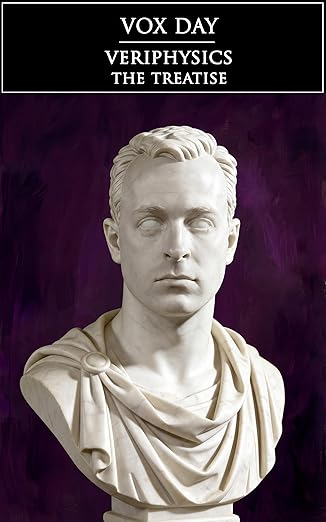
(Castalia House 2026. That guy looks familiar.)
Day, Vox, Veriphysics: The Treatise: The Failure of the Enlightened Mind and the Path Toward Truth, Switzerland: Castalia House, 2026.
Vox Day is the genius behind the Darwin-crushing concept of MITTENS, the full taxonomy of the socio-sexual hierarchy, SJWs Always Lie, Corporate Cancer, Probability Zero, and a host of other useful projects and publications. Your reviewer has read Day with great appreciation since 2001, and his earliest days as a columnist at World Net Daily. A Top 40 recording artist, he slings some mean beats and lyrics. Veriphysics is available from Amazon.
A funny thing happened on the way to the philosophy. A few years ago, I was involved with a minor project with a then-functioning Moscow-based educational think tank. My proposal was understandably placed on the back burner pending the debut of a major project, an introduction to philosophy geared towards high school and college students. While I waited, I inspected some of the incoming major project material, finding it slightly out of place. Rather than beginning with classical philosophy, say, with Plato or Aristotle, the wisdom of the Russian Church, or any other ancient source, the focus jumped straight to the Enlightenment. And the material was sourced from a U.S. Ivy League university. I found this odd for several reasons, not least among them the copious availability of knowledge at MSU, RSUH, and other local institutions. Something felt off. I will not say it felt like an attempted inversive encroachment, but…
Anyway, for whatever reason, the fledgling think tank ceased primary operations. My contribution was published elsewhere. And the philosophical direction and defense of Mother Russia continues, in no small part due to the efforts of men like Alexander Dugin.
Dugin’s Fourth Political Theory is a framework for reclaiming tradition. See Dugin, Alexander, The Fourth Political Theory, London: Arktos, 2012/2018. In 2024, I wrote: “Dugin’s Fourth Theory may be summarized as a rebellion against Liberalism, its “enlightened” modernity, and the underlying anti-human satanism at its heart.”
One of the criticisms of Dugin’s theory is that it lacks exactitude. However, rather than being a precise “how to” set of directives, it is a potentially universal approach wherein the exact applications are left open for each society, nation, or civilizational state. See my essay at the last link, above, for a glimpse of how Dugin the philosopher is also Dugin the doer, rebuilding a critical component of Russian society, the traditional Russian way. Russia’s ancestral trajectory was broken by decades of communism, followed by a single decade of hard, heavy liberalism. This century, Russians are forging ahead while also rekindling tradition, with Dasein in one hand and Oreshnik in the other. Much or most of the wider world is, to one degree or another, following their path.
But what of the West and its potential? The heirs of the Greco-Roman legacy have endured many centuries of relentless liberalism. As Day previously noted, this is observably worse than communism. As Dugin has said, Westerners are the original victims of liberal modernity. How, then, will Westerners begin to shake off the Enlightenment and relaunch their civilizational aircraft? The process, which cannot begin a day too soon, will take time and great effort. Luckily, Day’s Veriphysics provides an accessible, actionable framework for understanding what went wrong and how to remediate it.
As a treatise, Veriphysics is a short book, 86 pages long, but it is packed from beginning to end with gems. In fact, in its totality, it is essentially a large diamond. Herein, as if with a jeweler’s loop, I merely examine a few facets. I’m also going to try an experiment towards the end.
The Enlightenment has failed. Day notes, on page 4:
One by one, the foundational concepts that shaped the modern world have been tested against reality over time and found wanting. The social contract, the invisible hand, the marketplace of ideas, the arc of progress, democracy, the separation of powers, freedom of speech, and the rights of Man: each of these ideas have been weighed in the balance of recent centuries and discovered to be, at best, a partial truth elevated far beyond its proper domain, and at worst, a deceptive illusion that fueled three centuries of unnecessary human suffering.
Veriphysics breaks the illusion and its five main premises, from page 8: “…autonomous reason, sovereign individuality, mechanical nature, the fact-value distinction, and inevitable progress…” Here I note that, like Dugin, Day correctly identifies individuality as a duplicitous issue, rather than a concrete value. While the individual, created in God’s Image, has his definite worth, he is not severed from the whole as the Enlightenment proposed. The realization of this atomization of man was a shock for your formerly libertarian reviewer, a shock I trust is shared by many.
Part One is a recitation of the failures of various Enlightenment planks: representative democracy, the inversion of natural rights to make J.B. Bury blush, assorted economic disasters, the corruption of science, and more. Day explains the general pattern of observable failure: “[L]ogic first, then mathematics, then empirical evidence—and still the orthodoxy persists, sustained by institutional inertia and the career interests of its beneficiaries.” Page 32. Day’s new philosophy aims to reverse and undo these failings by allowing the bold to preserve tradition while conforming that tradition in a way that meets modern needs.
Day defines the doctrine on page 58:
[U]nlike classical philosophy, … Scholasticism, … and Enlightenment philosophy, … veriphysics is focused solely on truth, or veritas. Every aspect of veriphysics is meant to explore and expand the concept of truth to the greatest extent possible, through every path that is capable to leading to some aspect of the singular, core, and underlying Truth. The objective of veriphysical philosophy is veriscendance … veritas and ascendance.
Two areas where Day goes into detail are the capture of our traditional institutions and the baleful curse of usury. I have lumped these two together for a reason. And in getting to the institutions, Day examines how classical philosophy failed to adequately counter the Enlightenment’s rise, a matter partly of the dialectical versus the rhetorical. He notes that understanding the previous weaknesses is necessary for reversing the damage those weaknesses allowed. Day lists five mandatory factors for defeating the Enlightenment’s grip on mind and society, culminating with the rebuilding of what was lost. Part of this process involves the ancient Christian concept of participation—the melding together of knowledge, human and divine. See page 62.
The university is an example of a stolen institution. “The very idea of a university, a community of scholars devoted to preserving, transmitting, and extending knowledge, was a medieval Christian innovation. The Enlightenment did not create these institutions; it invaded them, subverted them, and eventually seized them.” Page 48. Furthermore, the Enlightenment, while removing academic value from the formerly functioning universities, increasingly ransoms the lives of students via usurious debt, a double evil. Student loans in places like the United States are a severe problem for the young, yet they are only one piece of the collapsing debt puzzle.
The Enlightenment dispelled and reversed millennia of prohibition against interest on loans. This was a direct contradiction of the commands and wisdom of Almighty God, Jesus Christ, the Christian tradition, the Hebrew tradition, the Islamic tradition, the traditions of other religions, and the traditions of all civilizations, great and small, that survived the lethal temptation of usury. “The Enlightenment promised liberation; the usury that funded it delivered a new form of bondage.” Page 25.
And in a nation like the United States, it’s really a matter of super-usury; not only does the required extra money for the interest not exist in reality, but the underlying money loaned out is also a fraudulent, non-existent fiction. “Money itself is debt—a liability of the central bank, created through lending, destroyed through repayment. An economy that repaid its debts would be an economy without money. The system requires perpetual expansion of debt to function; deleveraging is not an option but a crisis.” Id.
The postmodern monetary system is about as simple as it is evil. The money masters geometrically increase the money supply and, accordingly, its burden on the people, while sucking all true wealth and real value into their own pockets. It’s not a system of robbing Peter to pay Paul; it is a scheme of murdering Peter to pay Judas. How can this be fixed? The notion of the sabbatical and the jubilee comes to mind. But how to get there from the ruins of the Enlightenment? As noted above, understanding precedes correction. To that end, Day offers a starting point, a mechanism for evaluating the ideas, fantasies, and deceptions of the liberal disorder: the Triad of Truth.
“Veriscendancy offers a genuine criterion: the Triad of Truth, the Triveritas. A claim merits assent—may be accepted as probably true—when and only when it satisfies three conditions: logical validity, mathematical coherence, and empirical anchoring.” Page 70. He also lists a few examples of the Triveritas in action. For my experiment, I thought to apply it, in a quick sketch, to usury.
The premise of usury, as currently practiced in the U.S., is that paying monopoly rent to the Epstein Class for limitless debt-based fake money is beneficial for societal prosperity and harmony. The logic behind it is a stretch, but let’s give them that one out of kindness. The mathematical analysis, however, fails. Michael Hudson, Steve Keen, David Graeber, and others have described in extraordinary detail how the multiplication of money through debts quickly outpaces a society’s ability to repay the debts. The compounding effect is too great to be sustainable. Hammurabi knew this, as did anyone else who ever ran the numbers. The empirical anchor is likewise broken free from the economic ship. Forget the financial damage done; the hyper-financialization is having dysgenic and dyscivilizational effects. Because they can’t afford families, people are no longer having children. The nation subjected to unfettered usury literally flirts with extinction. Thus, the usury premise fails the Triad of Truth.
Day’s conclusion is optimistic. “The ascent is possible. The tools are available. The opportunity is open. All that is required is the will to climb.” Page 85. And he’s correct. Veriphysics provides an inspirational, well-reasoned, and superbly functional framework for starting the ascent. Buy it, read it, and commence your part in forging truth from knowledge. Western Civilization depends on you.
*Many thanks to Vox Day for writing Veriphysics and for graciously allowing me to use the foregoing quotes and cover image.
 PERRIN LOVETT
You must be logged in to post a comment.